
Two amino acids. That’s the whole molecule.
Most peptides are long. Folded. Complicated little machines. Vilon is lysine stuck to glutamic acid and nothing else. It’s the shortest peptide anyone has ever caught doing something real in a cell.
And what it does is mess with how your aging cells read their own DNA.
Vilon peptide (also written Lys-Glu, or just KE) is a synthetic dipeptide built by a Russian gerontologist named Vladimir Khavinson. He reverse-engineered it from a thymus extract. The thymus is the little gland behind your breastbone that trains your immune system when you’re young and then quietly shrivels as you get older. Vilon peptide is his attempt to bottle the signal that gland sends.
What Vilon Peptide Actually Is
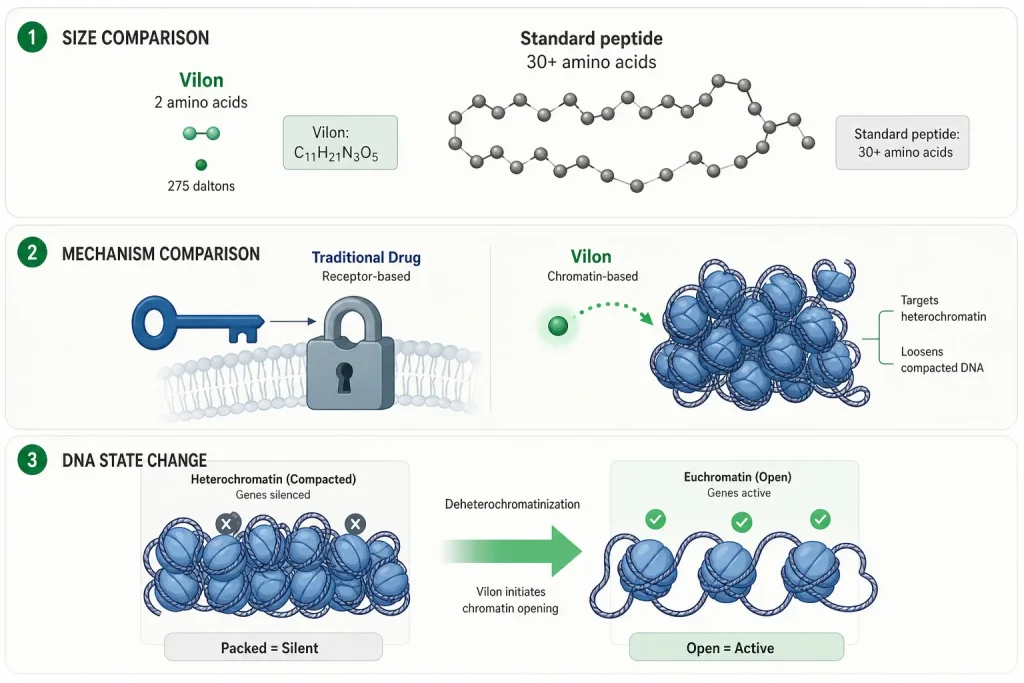
Most drugs work like a key in a lock; they need size and shape. Vilon is too small for that.
Instead, it targets DNA directly. Your genes are packed into tight bundles called heterochromatin, which silences them as you age. Vilon loosens this packing, reopening genes that have been switched off. The technical term is deheterochromatinization, literally “un-boxing the genes.”
The key difference: normal drugs change what one gene does. Vilon changes which genes are even accessible.
What Vilon Peptides Does
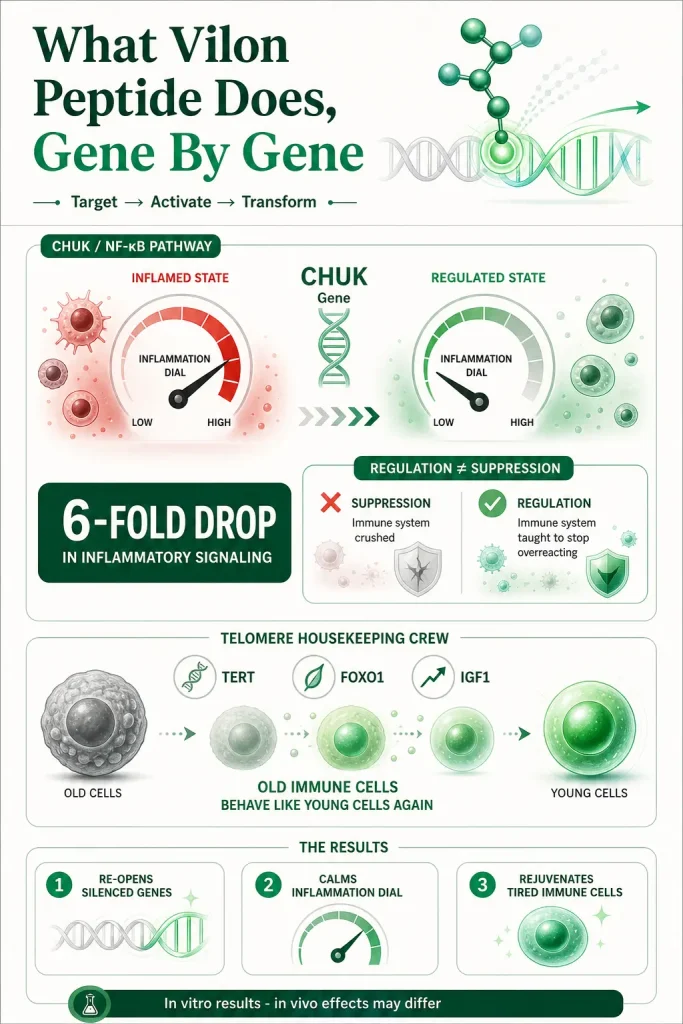
Once you accept it works on the DNA filing cabinet, the rest makes sense.
Vilon targets CHUK, which regulates NF-kB, your body’s inflammation control pathway. It doesn’t suppress inflammation entirely but fine-tunes the response. In stimulated immune cells, researchers measured a six-fold reduction in inflammatory signaling.
The distinction matters. Suppression disables your immune system. Regulation teaches it to respond appropriately. As you age, your immune system becomes overactive and inflamed. Vilon restores calibration.
Vilon also activates genes that maintain telomere length: TERT, FOXO1, and IGF1. These determine cellular lifespan. In immune cells from elderly donors, Vilon restored normal division rates and youthful function patterns.
In short: Vilon re-opens silenced genes, normalizes inflammation, and restores aging immune cell function.
One critical point: results in a petri dish don’t always translate to the living body. That distinction matters for what you’ll actually experience.
Vilon Peptide Benefits, And The Honest Evidence Tier Nobody Gives You
Here’s where every other page lies to you by leaving things out.
They list benefits like a menu. Lifespan. Immunity. Tissue repair. Anti-aging. All true on paper. But they never tell you which of those came from mice, which came from a dish, and which came from a guy on a forum.
So here it is, sorted by how much you should actually trust it.
Lifespan extension — animal only. Khavinson and Anisimov gave it to mice. Published it in Mechanisms of Ageing and Development. Across this whole class of peptides they reported mean lifespan bumps of 20 to 40 percent. Real result. In rodents. Your mileage as a non-rodent is unknown.
Tumor suppression — animal only. A 2000 study showed Vilon slowed spontaneous tumor growth in mice. Striking. Still mice.
Immune normalization — human, but barely. This is the one good human data point and almost nobody cites it. A 2014 Russian study (Kuznik and colleagues, Medical Immunology) gave appendicitis patients Vilon at 10 micrograms per injection alongside normal treatment. Their immune markers improved versus the control group.
Ten micrograms. Remember that number. It’s going to clash with what the supplement crowd does in a minute.
Tissue repair — dish only. In fibroblast cultures it bumped up a proliferation marker called Ki-67 and tweaked an enzyme called MMP-9. Wound-healing relevant. In a dish.
“Clear energy, better skin, faster recovery” — anecdote only. This is forum talk. Could be real. Could be placebo. There’s no trial. Label it in your head as a rumor, not a result.
See the gap? Almost everything sold to you as a Vilon peptide benefit is a mouse or a cell, not a human.
That’s not me trashing it. That’s me respecting you enough to draw the line where the data actually stops.
How Often Do You Take Vilon And Why Nobody Agrees
You searched how often to take peptides because you want a number. The problem is there are three numbers, and they fight each other.
The classic Russian clinical course. Small daily amount, injected under the skin, for 5 to 10 days straight. Then stop. Repeat the course every 3 to 6 months. This is the protocol built on actual clinical logic, short pulse, long rest.
The pulsed monthly pattern. Five injection days inside a four-week block, run across 8 to 16 weeks. The longevity crowd’s “maintenance” rhythm.
The micro-dose continuous camp. 100 micrograms to 1 milligram a day, sometimes with no cycling at all. The “less is more” believers.
Now look back at that real human study. Ten micrograms. The only properly documented human dose is dramatically smaller than the milligram-range protocols floating around supplement forums.
Sit with that. The internet’s “standard” Vilon dose can be hundreds of times higher than the dose that actually got studied in people.
That’s not a recommendation either way. It’s a reason to be skeptical of confident dosing charts written by people selling vials.
Vilon Vs Epitalon Vs Thymalin
If you found Vilon, you found it standing next to these two. Here’s how they split the work.
Vilon is the immune guy. Thymus, T-cells, the chromatin-unboxing trick. Two amino acids.
Epitalon is the clock guy. It works on the pineal gland and gets talked about for telomerase and sleep-wake rhythm. It’s the most-searched peptide in this whole family.
Thymalin is the messy parent. It’s the full thymus extract Vilon was carved out of. More stuff in it, less precise.
The clean way to think about it: Thymalin is the whole orchestra. Vilon is the one instrument Khavinson decided was carrying the melody, isolated so you can hear it alone.
That’s why researchers like Vilon. One mechanism, dosed precisely, instead of a soup.
Is Vilon Legal? Is It FDA Approved? The Part The Vendors Mumble
No. It’s not FDA approved. Not for anything. Not for any disease, any condition, any human use.
It’s sold “for research use only.” Lyophilized powder in a vial, with language on the label saying it’s not for human consumption.
And here’s the line every shop buries in 6-point font: actually injecting a research-use-only compound into yourself is, legally, not allowed. People do it. The law doesn’t bless it.
The other landmine is purity. “Research grade” is not a guarantee of anything. Potency and contamination vary wildly between sellers. If a vial doesn’t come with a batch-specific certificate of analysis from a third-party lab, you genuinely do not know what’s in it. To avoid counterfeit or untested vials, compare the best peptide vendors first.
One small piece of good news, since Vilon is synthetic. Lysine plus glutamic acid made in a lab carries none of the prion risk that haunts peptides pulled from actual animal thymus tissue. No cow, no mad-cow worry. That’s a real point in synthetic’s favor.
Side effects reported are mild and boring, the way you’d hope. Sore injection site. A few tired days. Occasional headache. Nothing dramatic in the published record, though the published record is mostly Russian and mostly thin.
If you take one thing from this section, take this. “Research use only” does not mean “safe to inject.” It means “nobody tested whether it’s safe to inject.”
Where Vilon Fits In The Whole Peptide Circus
Quick map, because you probably wandered in from a bigger rabbit hole.
A peptide is just a short chain of amino acids, the same building blocks as protein, only smaller. “Natural” peptides are the ones your body already makes. Vilon is a synthetic copy of a natural fragment.
And the question “what’s the strongest peptide” is the wrong question. There’s no strongest. There’s only the right tool for a specific job. Vilon’s job is the aging immune system. That’s it. That’s the lane.
It’s not a miracle. It’s a scalpel with a very narrow target and a very thin human file.
FAQ
What Is Vilon Peptide Used For?
In research, it’s used to study immune aging, gene expression, and chromatin changes in old cells. It’s investigated for immune support and longevity. It’s not approved to treat anything in humans.
What Does Vilon Peptide Do?
It loosens packed-down, switched-off DNA in aging cells, reactivating silenced genes. It also tunes the body’s inflammation switchboard (NF-kB via the CHUK gene) and pushes tired immune cells to behave younger.
How Often Do You Take Vilon?
Protocols disagree. The classic Russian course is a short daily run of 5 to 10 days, repeated every 3 to 6 months. Others pulse it monthly or micro-dose daily. The only well-documented human dose was tiny, 10 micrograms.
Is Vilon The Same As Epitalon?
No. Same family, different jobs. Vilon targets the thymus and immune system. Epitalon targets the pineal gland and gets studied for telomeres and circadian rhythm.
Conclusion
Vilon is the smallest bet in the longevity casino.
Two amino acids that may re-open genes your own aging shut off. The mouse data is genuinely impressive. The cell data is real. The human data is one Russian appendicitis study and a pile of forum anecdotes.
Anyone approaching ultra-short peptides for the first time should read how to use peptides safely before touching a vial.
This article is for educational and informational purposes only. Vilon is a research compound, is not approved by the FDA, and nothing here is medical advice or a recommendation to use it. Talk to a qualified healthcare professional before acting on anything you read about peptides.