
Unyx publishes certificates you can open on the testing laboratory’s own server rather than on their website. That is rare, and it counts for something.
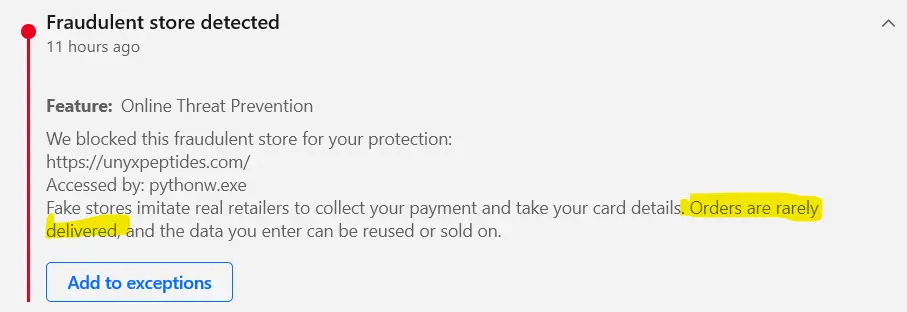
It also is not enough. The laboratory issuing those certificates is itself disputed. None of the 53 tracked reports carry a usable endotoxin result, while the product pages display sterility badges. And the site currently trips a Bitdefender fraud warning nobody has explained.
Real, lab-hosted certificates exist. So do a disputed testing lab, a browser fraud warning, and safety badges the paperwork does not support. This is not a scam finding. It is a gaps finding.
Are the certificates real?
Yes, and this is the strongest thing in Unyx’s favour.
Most peptide vendors upload an image of a certificate to their own site. An image proves nothing. Anyone with a PDF editor can produce one.
Unyx certificates can be opened on Freedom Diagnostics’ own certificate-hosting domain. Two examples pulled directly:
- SS-31, lot 55432, reported 1 June 2026. Purity 99.77%. Label 10 mg, measured 11.83 mg.
- TB-500, reported 23 April 2026. Purity 99.67%. Label 5 mg, measured 5.28 mg.
A separate audit matched all 27 retail product families to laboratory records, with 26 documents hosted by the lab directly. That is a real paper trail.
One disclosure about that audit: the site that produced it earns a 25% affiliate commission from Unyx. Its document checks still hold up, because the original certificates are independently inspectable. Its overall score is not a disinterested opinion, and neither of us should treat it as one.
So who is Freedom Diagnostics?
This is the question that decides everything above, and almost nobody asks it.
Every Unyx certificate comes from one laboratory. If that laboratory is sound, Unyx has excellent paperwork. If it is not, Unyx has excellent-looking paperwork, which is a different product entirely.
Freedom Diagnostics operates out of Franklin, Tennessee, hosts a public register of over 42,000 certificates, and claims ISO and GLP standards. Plenty of grey-market vendors use it.
On r/massspectrometry, where actual analytical chemists post, the picture is contested and has been for two years.
The accusations. One recurring critic alleges the lab produces simulated mass spectra rather than spectra recorded at the retention times shown on the chromatograms, holds no reference standards, and therefore cannot legitimately run the net-peptide-content assay it reports. Others describe the certificates as unsigned. Separately, a vendor commented that Freedom published reports carrying their logo despite having no relationship with them.
The defences. Other users with long account histories say they have used the lab repeatedly without problems, and accuse the loudest critic of being a shill account for a competing lab. One person had HGH tested at 99.8% purity and called that figure implausible for the grey market — which cuts both ways, depending on whether you read it as good product or generous testing. An employee posted to confirm the company is real, and conceded it has almost no online presence.
What is actually established. Freedom Diagnostics holds no ISO/IEC 17025 accreditation, the standard you would expect for high-stakes chemical analysis. Its business model depends on repeat work from the vendors paying for the tests, which is a structural conflict whether or not anyone acts on it. One commenter found its listed address shared with an insurance agency and an employment agency; another noted the visible lab photographs show equipment in a room that is plainly not a clean room.
None of that is proof of fraud. Reddit is not evidence. But “third-party tested” means very little when the third party has no accreditation, a structural incentive to please its clients, and an unresolved argument about its methods running through the one forum where chemists would notice.
The badge that the paperwork does not support
Here is the single clearest discrepancy on the whole site.
Unyx product pages display sterility and endotoxin pass badges. The certificates linked from those pages do not contain sterility or endotoxin results.
A tracking platform following 53 Unyx certificates across 28 compounds, from 23 April to 21 August 2026, found zero with a usable endotoxin outcome. It treats a missing result as unknown rather than as a pass, which is the correct way to read it.
Separate tests might exist. Neither I nor anyone else has found them published. Until they are, those badges are decoration.
This matters more than purity for anything injected. Purity tells you the right molecule is in the vial. Endotoxin testing tells you whether bacterial breakdown products came along with it, and those cause fever and systemic reactions at quantities far too small to see.
What 53 tests actually showed about quantity
Average reported purity across the set was 99.8%. Consistent with the marketing, and genuinely good if the underlying analysis is sound.
The quantity picture is more interesting. Of 46 certificates with a measurable label comparison, 23 landed within 10% of label and 22 came in more than 10% over. Extra weight is normal for salt-form peptides, and it is the opposite of the underdosing that defines complaints in this market.
One went the other way. A retatrutide sample tested on 21 August reported 12.53 mg against a 15 mg label. That is 16.5% short.
One underfilled result out of 46 is not a pattern. It does establish that the public record is not uniformly perfect, which is worth knowing when a vendor advertises as though it is.
Why the review numbers do not add up
Three separate problems, and the third is the one that bothers me.
The storefront count repeats. Product pages examined by auditors displayed the same aggregate rating and the same 2,047 verified reviews across different products, with repeated testimonial blocks. A store-wide rating can legitimately appear on every product. What the presentation does not establish is how any of it was collected or verified.
The dedicated review site contradicts itself. PeptideCommunity.co describes itself as a customer review platform specifically for Unyx. It claims 257 verified reviews in one place and 256 in another. Its ownership and verification process could not be established.
The timeline does not work. The unyxpeptides.com domain was registered on 17 April 2026. That review site carries May testimonials describing ten weeks of use, and another describing eight weeks. Ten weeks before late May is early March, roughly six weeks before the domain existed.
There is an innocent explanation: the business could have sold through another channel first. But no order documentation supports that history, and nobody has offered one. Treat the 257-review figure as unverified.
A vendor article elsewhere claims 18 months of testing and more than six Unyx orders, which runs into the same arithmetic problem. Its comparison entries for rival vendors are unnamed placeholders, so nothing in it can be audited.
About that Bitdefender warning
If your antivirus blocked something on the Unyx site, you were not imagining it.
A July 2026 security report classified the domain as a suspicious shop, citing warnings from Bitdefender and ScamAdviser among the providers it checked, alongside the young domain and thin reputation history.
What that does and does not mean matters.
- It establishes that automated systems flagged the domain, and that a real block fired on real machines.
- It does not establish that Unyx stole card details or failed to ship anything. Bitdefender’s own documentation acknowledges legitimate sites are sometimes misclassified, and that background requests can trigger a notification without the page being malicious.
- Nobody has published the trigger. Not confirmed fraud, not a confirmed false positive. Unresolved.
Working the other way round: real laboratory certificates do not clear a payment-security warning either. The two facts sit side by side without cancelling out.
Who actually owns Unyx?
Unknown, which is the honest answer.
The subscription terms name UNYX Peptides LLC. The contact page lists 2600 S Hardy Drive, Tempe, Arizona. No public Arizona business registration for that entity has been located, and the address appears to sit in an industrial complex of the kind that rents office and warehouse space.
The domain was registered through Tucows on 17 April 2026 with WHOIS privacy via Cloudflare, so ownership is not traceable that way either. The only contact channel is an email address. No phone number.
A young company with private registration is not a crime; plenty of legitimate businesses start exactly like that. But a company making detailed manufacturing claims should be able to name itself.
The GMP claim, and why it is weaker than it sounds
Unyx’s retail FAQ says its compounds are synthesised in FDA-registered, GMP-compliant US facilities. A separate wholesale site under the same brand goes further, claiming its own Arizona GMP facility and stating it does not import and relabel overseas material.
Nobody has produced the facility’s name, address, FDA registration identifier, or any GMP audit documentation.
And “FDA-registered” is doing less work than it appears to. Facilities in this space register with the FDA as a matter of routine. Registration is a filing, not an inspection and not an approval. A vendor leaning on the phrase is describing paperwork it was always going to file.
If your order goes wrong
The refund terms are tighter than the general sales messaging suggests, so read this before you order rather than after.
- No ordinary returns. Standard for this product category, and not a red flag by itself.
- Missing orders qualify for replacement or refund after 14 business days, not 14 calendar days.
- Notice is generally required within seven days of delivery or of the expected delivery date. This is the deadline that catches people out.
- Lost shipments may require a carrier investigation first.
- Subscriptions renew automatically. Cancellation must reach them at least 48 hours before the next billing date.
Diary the seven-day mark the moment you order. Most people who lose this argument online lost it by waiting.
Should you buy from Unyx?
I am not going to give you a yes or a no, because the evidence does not support either.
What is genuinely in their favour: inspectable lab-hosted certificates, consistent high reported purity, correct research-use labelling, no regulatory action, no warning letter, no enforcement history, and Reddit reports from people who ordered and received.
What is genuinely against: an unaccredited and contested testing laboratory, no published sterility or endotoxin evidence behind badges that claim it, a review ecosystem that contradicts its own timeline, an unresolved browser fraud warning, an unverifiable legal entity, and five months of trading history.
If you buy anyway, buy like someone who has read the above. Spend small. Match the lot number on the vial to the certificate on the lab’s domain, not to a catalogue page. Use a card with chargeback rights. Diary the seven-day window.
Six checks. They apply to any peptide vendor, not just this one.
- Get the lot number off the vial, then find that exact lot on the lab’s own domain. Not a PDF the vendor emailed you.
- Check whether the certificate is signed and whether the mass spectra look recorded rather than drawn.
- If a product page shows a sterility or endotoxin badge, ask for the report behind it. Purity certificates do not cover either.
- Ask for the state registration number of the legal entity and check it yourself with the state registry.
- Ask which facility synthesises the product, and for its FDA registration identifier. “FDA-registered” is not FDA-approved.
- Use a payment method with chargeback rights, and diary the refund deadline the day you order.
For vendors with longer paper trails, the peptide vendor comparison covers the alternatives. For what a documented bad actor looks like — FDA letters, DOJ cases, actual convictions — the peptide scam watchlist is the contrast worth reading.
Last updated 20 September 2026. Every claim here traces to a public source: laboratory-hosted certificates, published tracking data, r/massspectrometry and r/Biohacking threads, security-vendor reports, and Unyx’s own policy pages. Nothing has been tested by us.