
By age 60, three out of four adults have an organ that has become almost entirely fat. It used to teach all T-cells in your body how to fight. When to attack and when to stand down.
A 2,540-person CT imaging study reveals 74% middle-aged adults had a total fatty replacement of this gland. Most will never know its name. I am talking about the thymus gland. Thymulin is the molecule that proves it’s still working.
Thymulin is a peptide hormone that only works when it holds a single atom of zinc.
This is why thymulin has become a silent anchor in modern immunology, longevity, and peptide research. Also, a big reason most information online is wrong.
What Thymulin Is
Thymulin is a nonapeptide hormone that binds zinc at a 1:1 ratio. Only the zinc-bound form has biological activity. The duty is to train T-cells in the thymus. Balance the cytokine output of your immune system, and modulate inflammation in tissues far from your chest.
Serum levels peak in childhood and drop fivefold by middle age. Almost undetectable in old age.
Where is the thymus located in the body?
In the anterior superior mediastinum, the upper middle compartment of your chest. Locate it by placing a finger behind your breastbone (the sternum), roughly level with the top of your heart, and below the notch at the base of your throat. The thymus is directly under your finger, between your two lungs, and on top of the pericardium that wraps your heart.
If you have been asking “where is the thymus gland located” or “where is the thymus found,” Now you know something most people never will.
The thymus is NOT the thyroid
Different organ, system and location. Only thing they share is that they have similar names because both come from the same Greek root for “shield.”
The thyroid is a butterfly-shaped endocrine gland in your neck that controls metabolism through hormones. The thymus is an immune gland that trains T-cells.
How Thymulin Peptide Works
The zinc handshake
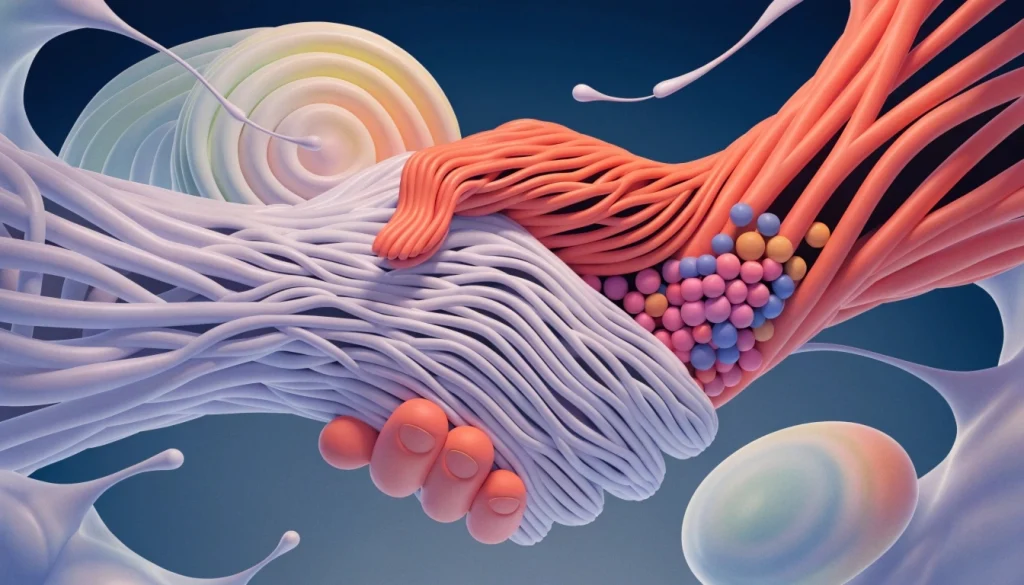
Apo-thymulin and Zn-thymulin are chemically the same peptide. They have the same sequence and molecular skeleton. Only the metal differs. Only one of them has any biological activity.
Apo-thymulin binds poorly to its target receptors and triggers no downstream signaling.
Zn-thymulin folds correctly, presents the right surface, and activates immune cells.
This isn’t unique in biology (calmodulin needs calcium, hemoglobin needs iron), but it’s unusually elegant. Thymulin is, in a sense, a zinc sensor that the body uses to tell its T-cells whether nutrition and thymic health are intact.
T-cell schooling
The thymus is where T-cells go to school. Precursors arrive from the bone marrow, get sorted by which receptors they express, and either pass selection or get destroyed. The ones that pass become naïve T-cells and emigrate into your blood. Thymulin sits in the middle of this curriculum. It promotes the maturation of double-negative thymocytes into CD4-positive helpers and CD8-positive killers. It supports the balance between helper and suppressor populations, which matters more than total T-cell count for immune tolerance.
Cytokine balance, not stimulation
This is the point most articles miss.
Thymulin is not an immune stimulant.
It’s an immune modulator. A 2008 paper by Lunin and colleagues injected mice with bacterial endotoxin and then treated them with thymulin. The thymulin-treated did not just have lower inflammatory cytokines. They had normalized cytokine profiles. All came back toward healthy ranges. Anti-inflammatory was also normalized. Thymulin put the immune system in balance instead of pushing it harder in either direction.
This makes thymulin interesting for autoimmune conditions. The problem is not too little immunity but immune signals that are stuck in the wrong gear.
Natural killer cell enhancement
In vitro studies show increased NK cell cytotoxicity after thymulin exposure. NK cells are part of the innate immune response and the first line of defense against virally infected and tumor cells.
The effect is moderate but consistent across labs.
The inflammation gateway
A 2019 study using PBCA nanoparticle-bound thymulim tells us it dampens the wires that carry chronic inflammatory signals from one cell to the next. Especially in tissues like the central nervous system that usually have quiet cytokine traffic.
The axis you have never heard of
Here’s a nugget most peptide guides skip:
Thymulin acts on the pituitary gland and stimulates the release of ACTH, the hormone that triggers cortisol production in your adrenal glands. The relationship is bidirectional. Cortisol levels track thymulin levels diurnally. The gland in your chest is talking to the gland in your head, and they are using thymulin as one of their messengers.
The stress and sleep audiences should pay attention. If your thymus is failing, one of the consequences is a quieter handshake with your stress-response system.
The Pain Story Almost Nobody Mentions
A tiny dose of thymulin injected into a rat’s paw makes it more sensitive to pain. The peptide cranks up local prostaglandin E2 and IL-1β.
A larger dose in the same paw makes it less sensitive. The peptide reverses hyperalgesia, calms inflammatory cytokines, and reduces sickness behavior.
Dose matters. This is the stuff that gets lost in Reddit threads where people scale doses without reading the underlying studies. Thymulin is not a drug where “more is more.”
If you are running thymulin in a laboratory setting and want material that comes with a third-party Certificate of Analysis on every vial, look for trusted and verified peptide sellers. Check the batch COAs and verify purity above 98% before purchasing any research peptide.
Thymulin vs the Other Thym-Peptides (Stop the Confusion)
The names blur together in forums and product copy. Most popular peptide writers use thymalin and thymulin interchangeably, which is wrong and confusing. Here is the clean version.
| Peptide | What it is | Length | Zinc-dependent? |
|---|---|---|---|
| Peptide | What it is | Length | Zinc-dependent? |
| Thymulin (FTS) | Defined nonapeptide hormone | 9 amino acids | Yes, required |
| Thymalin | Polypeptide extract from calf thymus | Multiple peptides, 1-10 kDa | No |
| Thymosin alpha-1 (Zadaxin) | Synthetic single peptide | 28 amino acids | No |
| Thymosin beta-4 (TB-500 is a fragment) | Single peptide for cytoskeleton and repair | 43 amino acids full | No |
| Thymopentin (TP-5) | Synthetic pentapeptide, active site of thymopoietin | 5 amino acids | No |
| Thymopoietin | Polypeptide from thymic epithelium | 49 amino acids | No |
| Thymic Humoral Factor (THF-γ2) | Octapeptide | 8 amino acids | No |
Thymulin vs thymalin
The single most common confusion: Thymalin is not thymulin.
Thymalin is a polypeptide extract from calf thymus, developed by the Khavinson group in St. Petersburg, and used in Russian clinical practice for decades. It contains a mixture of short peptides, not a single defined molecule.
Thymulin is a single, sequenced, zinc-dependent nonapeptide. They are different molecules with different mechanisms, evidence and vendors.
If the label says “thymalin” but the description mentions a 9-amino-acid sequence, the label is wrong.
Thymulin vs thymosin alpha-1
Both come from the thymus. Both modulate T-cells. The difference is in the mechanism.
Thymosin alpha-1 activates Toll-like receptors and pushes dendritic cells toward a Th1 immune bias. Used as an adjunct in chronic hepatitis B and was studied during COVID for severe cases.
Thymulin acts upstream. On T-cell maturation itself. Balances cytokines rather than pushing them in a single direction.
Safety, Half-Life, and What We Still Do Not Know
Half-life is short. Plasma half-life is under 10 minutes in humans. The most important pharmacological fact about thymulin. Explains why most laboratory studies use either repeated dosing, nanoparticle delivery, gene therapy, or chemical analogs like PAT.
Any commercial protocol promising “one weekly shot” of thymulin is, at minimum, optimistic about exposure dynamics.
Animal safety is good. No serious adverse events in chronic-dosing animal studies, even at high doses. No documented toxicity in the small Vickers human trial. No reports of immune overactivation in autoimmune-relevant models.
Long-term human safety is not established. No FDA approval. No large Phase 3 trial. No multi-decade pharmacovigilance database. Thymulin appears safe in the limited human exposure that has been studied, and the rest is inference from animal data.
The Zinc Insight You Can Actually Use Today
This is the most clinically actionable paragraph. Yet almost no thymulin guides preach it.
Zinc deficiency is common in adults over 65.
Estimates from the Linus Pauling Institute and several geriatric nutrition reviews put marginal zinc deficiency in 30-45% of older adults, particularly those on diuretics, with low animal-protein intake, or with reduced absorption from age-related GI changes.
Marginal zinc deficiency does not show up on routine bloodwork because serum zinc is a poor biomarker. What it does show up as is reduced thymulin bioactivity, even when the peptide itself is intact.
The 1980s and 1990s work by Ananda Prasad showed that zinc supplementation in mildly deficient older adults restored thymulin activity and improved T-cell counts. The same effect has been documented in malnourished children, anorexia nervosa patients, and patients with low protein intake.
Your zinc status is the key if you really care about your thymulin.
No need for mega-doses. Evidence on fixing deficiency says 12-25mg of elemental zinc daily with 1-2mg copper is the standard dose in adult research.
Too much zinc can cause copper depletion and neurological side effects over months.
This is the closest thing the thymulin literature has to a free lunch. Fix the zinc, and the peptide you do have starts working again.
Where Thymulin Fits in a Peptide Stack
The peptide community generally treats thymulin as a niche, research-grade member of the immune-modulating peptide family. Its more famous cousin, thymosin alpha-1, gets most of the spotlight because of its Hepatitis B approval and clinic-scale availability. Thymulin sits in the same conceptual lane, but with these distinguishing features:
- Different mechanism. Where thymosin alpha-1 pushes the immune system toward a Th1 response via TLR signaling, thymulin balances cytokine output and supports T-cell maturation upstream.
- Different evidence base. Thymulin is dominated by preclinical and small-scale human work. Thymosin alpha-1 has a real Phase 3 hepatitis literature.
- Different practical concerns. Thymulin’s short half-life and zinc dependence are protocol design concerns that thymosin alpha-1 simply does not have.
Common stack pairings discussed in research and biohacker contexts include:
- Thymosin alpha-1 + thymulin. Different but complementary mechanisms; addressed in a few small studies.
- BPC-157 + thymulin. BPC-157 has shown thymus-supportive effects in animal models; the combination is logical if you are aiming at full immune restoration.
- GHK-Cu + Zn-thymulin (topical). Both are short metal-binding peptides used in topical hair and skin research.
- TB-500 (thymosin beta-4 fragment) + thymulin. Different jobs, similar lineage, no documented incompatibility.
What the literature does not support is the use of thymulin as a daily immune-stimulant supplement. It is a modulator, not a stimulant. It is short-acting, not sustained. And its evidence base is preclinical, not clinical.
Is thymulin the same as thymosin?
No. Thymulin is a single nine-amino-acid zinc-dependent peptide. Thymosin is a family of unrelated thymus-derived peptides, most famously thymosin alpha-1 (a 28-amino-acid immune activator) and thymosin beta-4 (a 43-amino-acid repair peptide). Different molecules, different jobs.
Is thymulin the same as thymalin?
No. Thymalin is a Russian polypeptide extract from calf thymus containing many short peptides, used in clinical practice for decades. Thymulin is a single defined peptide first isolated in Paris in 1977. The names get used interchangeably in forums; they should not be.
Does thymulin require zinc to work?
Yes. Without a zinc ion bound to the peptide, thymulin has no biological activity. This has been established since 1982. Restoring zinc restores function.
At what age does thymulin start declining?
Levels begin dropping after puberty. By age 21, serum thymulin is roughly one third of childhood peak. By age 65, it is often near the lower limit of detection.
Can you increase thymulin naturally?
The best-supported lever is zinc status. Correcting mild zinc deficiency restores thymulin bioactivity. Adequate protein intake supports thymic tissue. Caloric restriction in animal studies slows thymic adipogenesis. Smoking, chronic stress, and chronic infections accelerate thymic involution and lower thymulin.
What does the thymus do in adults?
It continues to produce a small but steady supply of new T-cells, even after most of its tissue has been replaced by fat. It also secretes hormones including thymulin, thymosin alpha-1, and thymopoietin. It is not “useless” after puberty. It is doing less, but it is doing it for life.
Can the thymus regenerate?
In mice, yes. A single transcription factor, FOXN1, was shown to regenerate the involuted thymus in 2014. In humans, the TRIIM trial reported MRI-visible thymic regeneration with a combination of growth hormone, metformin, and DHEA. The field is active.
Is the thymus the same as the thyroid?
No. Different organ, different location, different hormones, different system. The thyroid is in your neck and controls metabolism. The thymus is in your upper chest and trains T-cells. The names share a Greek root, nothing more.
Where exactly is the thymus located?
In the anterior superior mediastinum, behind the breastbone, between the two lungs, and on top of the heart. In some children, the upper part extends up into the lower neck.
The Bottom Line on Thymulin
Three things are true at once.
The science is genuinely interesting. Thymulin is one of the few peptides whose mechanism, structural biology, and biomarker properties are all well-mapped. Its role as a zinc-dependent immune modulator is reproducible across labs. Its connection to thymic involution makes it a window onto immune aging, not just a candidate drug.
The clinical translation is unfinished. There is no large randomized trial. There is no FDA approval. The human evidence is small studies, historical immunology, and one open-label hair study. Anyone who promises you that thymulin will reverse aging or cure autoimmune disease is selling ahead of the data.
The most useful insight is probably the zinc one. If thymulin matters to you, your zinc status is the first thing to check. Correct a deficiency and you restore the peptide you already have. That is a lever you can pull today without buying anything from a research peptide vendor.
Hold onto the handshake. Zinc and your thymus, talking to your immune system through a nine-amino-acid messenger that turns silent the moment the metal is gone. That is what thymulin really is. Once you see it that way, the entire peptide makes sense, and the project of keeping it working for as long as possible becomes a project you can actually understand.
This article is for educational purposes and does not constitute medical advice. Thymulin is a research peptide and is not approved by the FDA or any major regulatory body for human therapeutic use.