
The peptide most researchers call “the Wolverine molecule” has accelerated wound healing in nearly every animal tissue it’s been tested on, and it has zero completed human trials to its name.
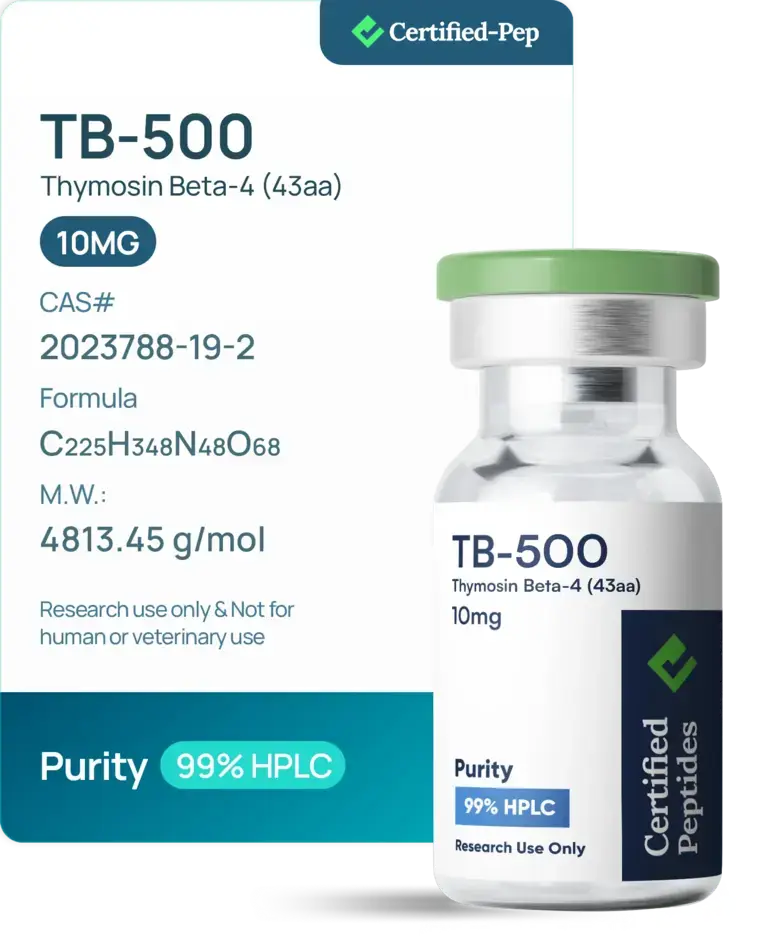
TB-500 (Thymosin Beta-4 Fragment)
17-aa peptide fragment · LKKTETQ motif · for laboratory research use
- Product testing information available for review
- 10 mg TB-500 research product
- Research-use-only product positioning
- Check the current batch documentation before ordering
Why Nootroholic lists this source: Certified Peptides offers a dedicated TB-500 10 mg research product and provides product information that buyers can review before ordering. Nootroholic does not independently assay vendor products, so we recommend checking the current batch documentation and testing information directly before purchase. To compare other suppliers, see the best peptide companies.
TB-500 is sold for research use only. Not for human or animal consumption; not intended to diagnose, treat, cure, or prevent any disease. Nootroholic does not independently test this product. Review the vendor’s current product information and batch documentation before purchasing. This is an affiliate link — Nootroholic may earn a commission at no extra cost to you. Price and availability can change; confirm the current information on the vendor’s website.
Both of those things are true at once. That tension is the entire story of TB-500, and it’s why the internet is full of confident claims that fall apart the moment you check the actual research.
This is the honest, complete guide. What TB-500 is, what the science genuinely shows, how research dosing works, the side effects, the legal status, and the buyer traps that catch almost everyone. No hype, no overstated claims, just what the evidence supports.
For in vitro laboratory research and educational use only. Not medical advice or a recommendation for human use.
What Is TB-500?
TB-500 is a synthetic peptide, a 17-amino-acid fragment of a naturally occurring protein called Thymosin Beta-4 (Tβ4). Your body already makes Tβ4, a 43-amino-acid molecule found in nearly every cell, where it plays a central role in tissue repair, cell migration, and inflammation control.
TB-500 isolates the most functionally important piece of that protein: the central actin-binding motif (the LKKTETQ sequence) responsible for Tβ4’s effects on cell movement and healing. So TB-500 is not Thymosin Beta-4 itself. It’s the working fragment of it.
This distinction sounds academic. It isn’t. It’s the most important thing to understand about this compound, and it’s where most articles, and most vendors, get it wrong or hide the truth.
TB-500 vs Thymosin Beta-4: The Difference That Matters
Here’s what almost nobody selling TB-500 will tell you plainly.
Nearly all the human clinical evidence is on full-length Thymosin Beta-4, not the TB-500 fragment. The registered trials, the ulcer studies, the eye-disease research, those used the complete protein. The TB-500 fragment itself has no completed human clinical trials.
The research-use community routinely treats the fragment and the full protein as equivalent. They share the actin-binding behavior, so the assumption is reasonable. But it has never been proven, and treating “TB-500” and “Thymosin Beta-4” as identical is an assumption, not a fact. When a vendor cites “clinical trials” for TB-500, they’re almost always borrowing the full-protein data and hoping you won’t notice.
Why does this matter to you? Because vendors blur the line constantly. Some sell the full protein as “TB-500.” Some sell the fragment. The label rarely specifies. That ambiguity is the first reason a third-party Certificate of Analysis is non-negotiable for this compound.
How TB-500 Works
The mechanism is genuinely elegant, and understanding it explains everything else about the compound, including its unusual dosing schedule.
TB-500 binds and sequesters actin, a protein essential for cell movement. By regulating the body’s pool of available actin, it promotes cell migration, the process of moving repair cells to where damage has occurred. Alongside this, preclinical research shows it upregulates actin expression, promotes angiogenesis (the formation of new blood vessels), and reduces inflammation.
The defining feature is that TB-500 works systemically. It doesn’t just act where you place it. Its mechanism depends on saturating tissues throughout the body so repair cells can migrate to any injury site.
In animal models, this translated into faster wound closure, cardiac tissue repair, better collagen organization, and improved blood-vessel growth at repair sites. Some research also points to neuroprotective effects, with Tβ4 promoting neuronal survival in stroke and brain-injury models.
That systemic nature is the key to why TB-500 is dosed the way it is.
TB-500 Benefits: What the Research Actually Shows
Let me separate what’s demonstrated from what’s claimed, because the gap is wide.
Demonstrated in animal research:
- Accelerated wound and tissue healing across muscle, tendon, ligament, and skin models
- Promotion of cell migration and new blood vessel formation
- Reduced inflammation at injury sites
- Cardiac tissue repair and improved cell survival in cardiac-injury models
- Hair follicle stem cell migration, which is why TB-500 hair growth is a frequent research topic
Claimed but not established in humans:
- Any of the above as a reliable human outcome. The fragment has no completed human trials, so every “TB-500 benefit” you read is extrapolated from animal data or from full-protein research.
This is the honest framing the ranking pages avoid. TB-500 is one of the most promising recovery compounds in preclinical research. It is also one of the least proven in humans. Both statements are true, and a serious researcher holds them together.
TB-500 and the Half-Life That Shapes Everything
This detail explains the dosing schedule and sets TB-500 apart from peptides like BPC-157.
In rats, the plasma half-life after subcutaneous or intramuscular injection is roughly two to three hours. But the downstream effects on repair-zone cells last far longer than the compound stays in the blood. Research protocols use a twice-weekly loading schedule rather than daily dosing, which indicates the biologically relevant tissue levels persist for around three to four days per injection.
In plain terms: TB-500 triggers a healing cascade that keeps running long after the peptide clears. You’re pulsing a signal, not topping up a drug that drains hourly. That’s exactly why nobody injects it daily.
TB-500 Dosage in Research Protocols
These are dosing patterns from animal research and the research-compound community, not treatment recommendations. TB-500 is not approved for human use.
Research protocols almost universally follow a two-phase structure:
- Loading phase: more frequent dosing to establish tissue saturation across the body, typically twice weekly for the first 4 to 6 weeks.
- Maintenance phase: less frequent dosing to sustain those levels, typically once weekly after loading.
The loading-then-maintenance shape exists because of the systemic-saturation mechanism. Starting with maintenance doses alone delays any measurable effect, since the body hasn’t reached baseline saturation. In published preclinical work, systemic doses span roughly 0.1 to 10 mg/kg depending on the animal model, delivered subcutaneously or intraperitoneally. Animal doses do not translate directly to any other context.
For the complete breakdown of how much TB-500 per week, per injection, and per cycle the research protocols use, see our dedicated TB-500 dosage guide.
One critical point on route: published protocols use injection (subcutaneous, intramuscular, intraperitoneal) or topical application. There is no reliable evidence of oral activity for TB-500. Unlike BPC-157, it isn’t characterized as resistant to stomach enzymes. So “TB-500 capsules” or oral TB-500 for sale is a format the research simply doesn’t support. That’s a major buyer trap.
TB-500 Side Effects and Safety
Across research, TB-500 shows a favorable safety profile with minimal reported side effects at prudent research doses. The most commonly reported effects are mild:
- Redness, irritation, or swelling at the injection site
- Mild headaches
- Fatigue or lethargy
- Rarely, allergic reactions (itching, rash)
The honest caveats matter here. Long-term safety data is limited, because there’s no long-term human research. Because TB-500 influences cell growth and migration, research-context guidance typically flags caution around active cancers, since anything affecting cell proliferation deserves scrutiny. And “minimal side effects in research” is not the same as “proven safe for humans.” Anyone claiming the latter is overstating the evidence.
TB-500 and BPC-157: The Wolverine Stack
TB-500 is rarely studied alone. It’s half of the most popular pairing in peptide research, often called the Wolverine Stack, alongside BPC-157.
The logic is complementary mechanisms. BPC-157, a 15-amino-acid fragment derived from gastric juice, is associated with growth-factor and angiogenesis pathways and is notably stable enough to survive the stomach. TB-500 is the actin-binding, cell-migration fragment that works systemically. Researchers pair BPC-157 and TB-500 because they attack tissue repair from different biological angles. People search for “BPC-157 and TB-500 benefits,” “BPC 157 TB 500,” and “buy BPC 157 and TB 500” precisely because the two are studied as a unit.
A 2026 rat study tested the stack directly: 32 rats with repaired Achilles tendons. TB-500 alone raised load to failure significantly. BPC-157 alone did not reach significance. The combination added nothing over either one. That is one small animal study, and a 2026 review found no human orthopedic data for TB-500.
A crucial difference inside the stack: BPC-157 has some evidence of oral stability, TB-500 does not. They are not interchangeable and not dosed identically. If you’re researching the pairing, see our best place to buy BPC-157 guide for the other half, and the peptide finder to compare both by research goal.
Is TB-500 Legal? FDA and WADA Status
FDA once listed TB-500 in Category 2. FDA’s Category 2 page (current as of 22 Apr 2026) now shows TB-500 as a withdrawn nomination. In July 2026, FDA’s compounding advisory committee met to review TB-500 for the 503A bulks list. An advisory vote is not approval. I found no final FDA rule, so treat TB-500 as unapproved and not cleared for compounding. It is sold strictly as a research compound, not an approved drug or supplement. The World Anti-Doping Agency (WADA) prohibits it at all times, and it is banned in competitive horse racing.
This is why responsible vendors sell TB-500 with explicit research-use-only framing, and why you should treat any vendor making human-treatment or “therapy” claims with suspicion.
How to Buy TB-500 Without Getting Burned
Given everything above, TB-500 demands a stricter buyer checklist than most peptides. Three traps catch nearly everyone shopping for “TB-500 for sale” or trying to “buy TB500”:
The relabeling trap. Because “TB-500” and full Thymosin Beta-4 get used interchangeably, demand a third-party Certificate of Analysis with mass spectrometry that confirms the compound’s identity, not just a purity percentage.
The oral trap. Skip any TB-500 capsules or oral version. The research doesn’t support oral activity. It’s a convenient-sounding format that can’t deliver.
The purity trap. Independent testing has found a large share of online peptides underdosed or mislabeled. Buy only from vendors with batch-specific, third-party COAs you can verify against your vial’s lot number.
For vendors that clear that bar with verifiable third-party testing, not in-house claims, see our guide to the best peptide vendors of 2026. Once you have a vial, the peptide reconstitution calculator handles the math.

What is TB-500 used for?
In research, TB-500 is studied for tissue repair, muscle and tendon recovery, wound healing, inflammation reduction, and cell migration. It has no approved human use.
What is the difference between TB-500 and Thymosin Beta-4?
TB-500 is a 17-amino-acid synthetic fragment of the full 43-amino-acid Thymosin Beta-4 protein. Most human clinical evidence is on the full protein, not the fragment, a distinction most vendors blur.
What are TB-500 benefits?
Animal research shows accelerated healing, angiogenesis, reduced inflammation, and cell migration. These benefits are demonstrated preclinically; the fragment has no completed human trials.
How much TB-500 per week is used in research?
Research protocols typically use twice-weekly loading for 4 to 6 weeks, then once-weekly maintenance. See our TB-500 dosage guide for the full breakdown.
Can you take TB-500 in capsules or orally?
No reliable evidence supports oral TB-500 activity. Published protocols use injection. “TB-500 capsules” aren’t supported by the research.
Does TB-500 help hair growth?
Thymosin Beta-4 plays a role in hair follicle stem cell migration in research models, which is why TB-500 hair growth is a studied topic. Evidence specific to the fragment for hair is preclinical and limited.
What are TB-500 side effects?
Reported effects are mild: injection-site redness, occasional headaches, and fatigue. Long-term human safety data doesn’t exist.
Is TB-500 the same as BPC-157?
No. They’re different compounds often paired as the “Wolverine Stack” for complementary healing pathways. BPC-157 has some oral stability; TB-500 does not.
Is TB-500 legal?
It’s sold as a research compound and is not an approved drug. FDA once listed it in Category 2, and FDA’s compounding advisory committee reviewed it in July 2026. An advisory vote is not approval, and WADA bans it. Not approved for human use.
The Bottom Line
TB-500 is one of the most fascinating recovery compounds in peptide research and one of the most misrepresented. The mechanism is real and elegant: regulate actin, drive cell migration, saturate the system, and set off a healing cascade that outlasts the compound itself. The animal data is genuinely impressive.
But the honest researcher holds the other truth too: the fragment has no completed human trials, most “evidence” is borrowed from the full protein, and the market is thick with relabeling, oral scams, and purity problems.
Understand what TB-500 actually is, demand a third-party COA that confirms it, ignore any format the research doesn’t support, and you’ll already understand this peptide better than almost everyone selling it.
Know the compound. Verify the vial. That’s the whole game.
This guide is for in vitro laboratory research and educational purposes only. TB-500 is a research compound, not approved by the FDA for human or animal consumption, and prohibited by WADA. Nothing here is medical advice or a dosing recommendation for human use. Always verify information independently and consult qualified professionals.