
The lab named on one vendor’s certificate says it never issued it. Vanguard Laboratory calls the document a complete forgery. The vendor’s retatrutide report referenced a different drug, tirzepatide.
That vendor is one of 43 entries below.
There’s two ways to lose money in this market. Vial is incorrect or never received (see fraud). And a shutdown where even a honest vendor has drawn federal attenttion and vanish with your money.
Each certificate has its own blind spot. A vendor can choose a vial to send to lab. That’s the vial verified by the lab. It might not refer to the one in your mailbox.
Is That Peptide Vendor Legit? Confirmed Scams to Avoid
Government record 13
Published FDA, DOJ and ITC actions. Each links to the original record.
Paradigm PeptidesFederal criminal case
Owner sentenced to federal prison. DOJ documented fraudulent quality claims and mislabeled products.
- Sentence
- 70 months
- Forfeiture
- $5,000,000
- Customers
- 54,000+
- Status
- Shut down 2024
Figures from DOJ announcement and contemporaneous reporting
Court record · Guilty plea and sentencing
According to the U.S. Department of Justice, Matthew Kawa and Jennifer Stechkober pleaded guilty to selling unapproved drugs with intent to defraud and mislead. Kawa was sentenced to 70 months, Stechkober to 16 months; a $5 million money judgment and $78,317.52 restitution were entered. DOJ says the business falsely claimed its products were manufactured and quality-tested in its own U.S. laboratories, while it imported products from Asia and did not test them before sale. DOJ reports that multiple SARMs products contained testosterone instead. The DOJ release supports false testing claims; it does not independently substantiate this card’s former allegation of forged COA documents.
Tailor Made CompoundingFederal criminal case
DOJ documents a guilty plea and sentencing for unlawful distribution of unapproved drugs, including BPC-157.
- Forfeiture
- $1,788,906.82
- Outcome
- Guilty plea
Figures from DOJ case reporting
Court record · Guilty plea
DOJ reports that Tailor Made Compounding pleaded guilty in October 2020 to distributing unapproved drugs, including BPC-157, and was sentenced in February 2021 to three years of probation and forfeiture of $1,788,906.82. Its owner pleaded guilty to a different charge concerning unlicensed wholesale distribution of a prescription drug. These are historical case outcomes, not evidence of the present-day status of a similarly named business.
Primary recordFDA Letters · Dec 2024FDA warning letters · four GLP-1 sellers
Four vendors cited for selling GLP-1 peptides as unapproved drugs.
- Recipients
- 4 vendors
- Dated
- 10 Dec 2024
Four companies confirmed in FDA’s December 17, 2024 roundup
FDA warning letters · 10 December 2024
FDA announced four warning letters involving Xcel Peptides (Xcel Research LLC), Swisschems, Summit Research and Prime Peptides (Prime Vitality, Inc.) over marketing unapproved GLP-1 products. A separate letter to Veronvy was also announced, but it is not counted among these four peptide sellers. Each letter is a documented agency notice, not a criminal conviction or proof of present-day noncompliance.
Primary recordITC Orders · Apr 2025ITC cease-and-desist and exclusion orders
U.S. International Trade Commission orders; check each named party and remedy.
- Relevant entities
- 5 named
- Issued
- 9 Apr 2025
Orders published on the USITC docket
ITC final orders · April 9, 2025
USITC investigation 337-1377 lists cease-and-desist orders for Arctic Peptides LLC, Strate Labs LLC and Triggered Supplements LLC, plus limited exclusion orders concerning entities including Super Human Store and AustroPeptide. Its docket shows the Commission issued the orders on April 9, 2025, not January. Scope and effect differ by respondent and order; the docket does not establish any buyer’s entitlement to refunds or the outcome of a particular package.
Primary docketUSA PeptideFDA warning letter 696885
FDA warning letter over unapproved and misbranded GLP-1 peptides.
- Action
- Warning letter
- Date
- Feb 2025
FDA warning letter 696885 · issued Feb 26, 2025
FDA warning letter · February 2025
FDA’s letter 696885 states that usapeptide.com offered unapproved and misbranded semaglutide and tirzepatide to U.S. consumers. FDA explained why “research use only” labeling did not override other evidence of intended human use. This notice is an agency finding, not a criminal verdict.
Primary recordPinnacle PeptidesFDA warning letter 719337
Warning letter issued after the FDA reviewed the company website.
- Action
- Warning letter
- Date
- Dec 2025
Letter published in the FDA warning letter database
FDA warning letter 719337 · December 12, 2025
FDA issued warning letter 719337 on December 12, 2025 to Pinnacle Professional Research, doing business as Pinnacle Peptides. Its specific cited products were SARMs, including S4 Andarine, LGD-4033 and MK-2866, rather than a confirmed peptide-quality or GLP-1 laboratory finding. FDA’s website review occurred in November 2025.
Primary recordFDA Sweep · Sept 2026FDA warning letters · dated 24 Aug 2026
Five FDA warning letters dated August 24, 2026; Peptide Partners documented individually below.
- Recipients
- 5 sellers
- Posted
- 1 Sept 2026
Letters dated 24 August 2026 · Published in the FDA database
FDA warning letters · dated 24 August 2026
FDA issued warning letters dated August 24, 2026 to Peak Performance Peptides, Royal Peptides LLC, NuScience Peptides LLC, Peptide Partners LLC and TXP Innovations LLC (Tex Peptides). Its Peptide Partners letter 735063 specifically names GLP-1 S (semaglutide), GLP-2 T (tirzepatide), GLP-3 Reta (retatrutide), SS-31, tesamorelin, PT-141 and reconstitution solution as unapproved drugs as marketed. FDA says research-use-only language did not override other evidence of intended human use, and sales of reconstitution solution alongside injectable products supported that assessment. Warning letters do not establish individual lot purity or criminal guilt.
FDA original lettersBest Peptide Supply / ICRPFederal criminal case · PNC-27
Federal guilty plea and sentencing involving PNC-27 sold under a research pretext and marketed as a cancer treatment.
- Outcome
- Guilty plea
- Sentence
- 30 months
- Forfeiture
- $900,000
- Product
- PNC-27
DOJ sentencing record · May 26, 2021
DOJ says Patrick Charles Bishop used Best Peptide Supply LLC to buy PNC-27 from a Chinese supplier and Immuno Cellular Restoration Program Inc. to sell PNC-27 products. He repeatedly represented the peptide as laboratory research material but used it to make homemade suppositories in a kitchen and warehouse and marketed them as a cancer treatment. DOJ states the facilities were not sterile and did not comply with current good manufacturing practices. This is an adjudicated criminal case, not a customer-review allegation.
Primary recordLewis Family CareFederal guilty plea · semaglutide
Clinic owner pleaded guilty after administering non-FDA-approved semaglutide obtained from unauthorized suppliers without telling patients.
- Outcome
- Guilty plea
- Plea date
- Apr 2025
- Clinic revenue cited
- $249,044.40
- Product
- Semaglutide
DOJ plea record · April 15, 2025
DOJ says physician Matthew Lewis admitted buying non-FDA-approved semaglutide from unauthorized suppliers in California and Georgia and administering it at Lewis Family Care. Some vials arrived marked for laboratory research and development only. DOJ says Lewis did not tell patients the semaglutide came from unauthorized sources and used misleading payment descriptions such as “Meal Prep.” This entry reflects the guilty plea and admitted conduct; it does not identify the unnamed upstream suppliers.
Primary recordHelix Chemical SupplyFDA warning letter 668918
FDA warning letter over semaglutide and tirzepatide sold as research products while carrying human therapeutic claims.
- Action
- FDA warning letter
- Date
- 7 Feb 2024
- Products
- Sema / Tirz
- Legal status cited
- Unapproved / misbranded
FDA warning letter 668918
FDA reviewed helixchem.com and stated that semaglutide and tirzepatide were offered as “research” products while the site used claims involving conditions and effects associated with human use. FDA concluded the products were unapproved new drugs and misbranded as marketed. A warning letter is a documented regulatory action, not a criminal conviction or a finding that every lot was chemically defective.
Primary recordFDA Peptide Letters · Mar 2026FDA warning letters · 31 Mar 2026
Five peptide sellers missing from the watchlist were each cited by FDA for unapproved injectable peptide products and related human-use marketing.
- Recipients added
- 5 sellers
- Letter date
- 31 Mar 2026
- Products included
- GLP peptides / BAC water
- Status
- FDA warnings
FDA warning letters · March 31, 2026
FDA issued separate warning letters to Gram Peptides, Lovega LLC dba Pink Pony Peptides, PekCura Labs, Prime Sciences and Mile High Compounds LLC. The cited products included retatrutide, tirzepatide, semaglutide-coded GLP products, cagrilintide/mazdutide products and bacteriostatic water. FDA relied on website evidence of intended human drug use despite research-use disclaimers. These are regulatory findings about marketing and drug-law compliance; they do not by themselves prove product substitution, contamination or criminal fraud.
FDA original lettersWholesale PeptideFDA warning letter 729447
FDA warning letter over injectable Prostamax and Gonadorelin marketed as unapproved drugs.
- Action
- FDA warning letter
- Date
- 17 Jun 2026
- Products
- Prostamax / Gonadorelin
- Domain
- wholesalepeptide.com
FDA warning letter 729447
FDA states that its May 2026 review of wholesalepeptide.com identified Prostamax and Gonadorelin products marketed in ways that made them unapproved new drugs. FDA specifically highlighted the additional public-health concern posed by injectable products. The letter establishes a regulatory violation as alleged by the agency; it is not a laboratory finding that any particular vial was impure or counterfeit.
Primary recordHarbin Jixianglong BiotechFDA warning letter 723330 · API relabeling
FDA documented semaglutide API repackaging, relabeling and source-traceability failures; two U.S.-distributed batches were recalled.
- Action
- FDA warning letter
- Date
- 1 May 2026
- Recalled batches
- 2 semaglutide API lots
- Country
- China
FDA warning letter 723330
FDA documented that Harbin Jixianglong bought semaglutide API from outside suppliers, repackaged and relabeled it, created new batch numbers and identified itself as the manufacturer rather than the actual source. FDA also documented unsupported manufacture/retest date changes and stated concern that the relabeling may have been intended to circumvent GLP-1 import safeguards. The firm voluntarily recalled two U.S.-distributed semaglutide API batches in February 2026. This is a documented supply-chain and CGMP case, not a criminal fraud conviction.
Primary record
Independent evidence 10
Findings apply to the sampled product or the tested transaction, not to every lot or order.
BiotechPeptidesPeer-reviewed test purchase · JMIR 2024
Peer-reviewed test purchase found materially more semaglutide than the label stated and a large gap between advertised and measured powder composition.
- Label dose
- 3 mg
- Measured
- 3.86 mg
- Advertised purity
- 99%
- Measured semaglutide / powder
- 7.70%
JMIR market-surveillance study · 2024
Researchers independently purchased a semaglutide vial from biotechpeptides.com. The tested vial contained a mean 3.86 mg semaglutide against a 3 mg label (+28.56%). The study reports that vendor documentation claimed 99% purity while semaglutide represented 7.70% of total powder mass in the analytical method used. No viable microorganisms were detected at testing; endotoxin was below the study’s reported quantitation figure. These results apply to the purchased sample and do not establish that every historical or current lot has the same composition.
Peer-reviewed evidenceSemaSpacePeer-reviewed testing + FDA warning letter
Peer-reviewed test purchase found dose/composition discrepancies; FDA separately warned semaspace.com over unapproved and misbranded semaglutide sales.
- Label dose
- 2 mg
- Measured
- 2.77 mg
- Advertised purity
- 99%
- Endotoxin
- 8.9511 EU/mg
Independent test purchase and FDA warning
In the JMIR controlled purchase, the SemaSpace sample contained 2.77 mg semaglutide against a 2 mg label (+38.69%); semaglutide represented 14.37% of total powder mass despite a 99% purity claim. The study measured 8.9511 EU/mg endotoxin and detected no viable microorganisms at the time of testing. Separately, FDA’s October 2, 2023 warning letter stated that semaspace.com offered unapproved and misbranded injectable semaglutide without the required prescription safeguards. The laboratory findings apply to the sampled vial, not every lot.
US Chem LabsPeer-reviewed testing + FDA warning letter
Peer-reviewed test purchase found a material dose/composition discrepancy; FDA separately cited semaglutide, tirzepatide and thymalin marketing.
- Label dose
- 1 mg
- Measured
- 1.34 mg
- Advertised purity
- 99%
- Measured semaglutide / powder
- 8.97%
Independent test purchase and FDA warning
JMIR researchers purchased a USChemLabs semaglutide sample that contained 1.34 mg against a 1 mg label (+33.58%); semaglutide represented 8.97% of total powder mass despite a 99% purity claim. No viable microorganisms were detected at the time of testing. FDA separately warned US Chem Labs in February 2024 that semaglutide, tirzepatide and thymalin were marketed as unapproved and misbranded drugs despite “research chemicals only” language. The analytical findings apply to the tested sample.
INDR LabsForged COA · independently corroborated
The laboratory named on INDR Labs certificates said it never issued them; later independent purchases also failed to confirm labeled identities.
- COA issuer
- Vanguard denied issuance
- Retatrutide COA
- Graph referenced tirzepatide
- Retail evidence
- CBS purchase
- Later testing
- Label identities not confirmed
Issuing laboratory denial + investigative purchases
Vanguard Laboratory publicly states that certificates displayed for INDR Labs were not issued by Vanguard and that INDR Labs was not its client; it describes the certificate as a complete forgery. CBS News independently reported the same issuer denial and noted that a purported retatrutide certificate showed analytical material referencing tirzepatide. In September 2026, WIRED reported independent testing of INDR-branded products bought at Brooklyn retailers in which labeled identities were not confirmed. These findings establish serious document and sampled-product problems, but they should not be generalized to unrelated peptide vendors.
GeniusPharmacyControlled purchase · nondelivery · JMIR
Peer-reviewed researchers paid for advertised Ozempic and documented nondelivery followed by a fake courier/customs-payment sequence.
- Test order
- $360 + shipping
- Product received
- None
- Courier used
- MailingOnTime
- Shipment check
- Parcel did not exist
JMIR controlled purchase
Researchers placed an Ozempic test order with GeniusPharmacy. No medicine arrived. The transaction shifted to a purported courier, MailingOnTime, and additional shipping/customs issues; the study reports that customs verification found no real parcel corresponding to the supposed shipment. This directly documents the researchers’ transaction. It does not establish what happened in every transaction ever associated with the name.
Peer-reviewed evidencePureMedsOnlineControlled purchase · nondelivery · JMIR
Peer-reviewed researchers documented an Ozempic nondelivery transaction followed by a nonexistent courier shipment and further payment demands.
- Test order
- $300 + shipping
- Product received
- None
- Courier used
- AsianaLogisticsExpress
- Shipment check
- Parcel did not exist
JMIR controlled purchase
Researchers ordered advertised Ozempic from PureMedsOnline and received no medicine. The purchase moved to a purported courier called AsianaLogisticsExpress, and the study reports that customs verification found no real parcel. This is stronger than an anonymous complaint because the researchers documented the purchase prospectively, but the finding should still be limited to the tested transaction.
Peer-reviewed evidenceWeightCrunchShopControlled purchase + FDA warning letter
Controlled academic purchase documented nondelivery and a fake GLS-style courier site; FDA later issued a separate warning letter.
- Product received
- None
- Courier clone
- GLSCourierServices
- FDA letter
- 13 Jan 2025
- Domain
- weightcrunchshop.com
JMIR purchase + FDA warning
In a peer-reviewed test purchase, researchers ordered an advertised Ozempic product from WeightCrunchShop, received no drug and were routed through a fraudulent courier website imitating legitimate GLS branding. Customs verification found that the supposed parcel did not exist. FDA separately warned weightcrunchshop.com in January 2025 for offering unapproved and misbranded semaglutide and prescription drugs without required prescriptions. The nondelivery finding directly establishes the research transaction, while the FDA letter independently establishes the cited regulatory violations.
The Private Pharmacy ClinicUK counterfeit alert · supplier culpability unresolved
UK regulators identified falsified Mounjaro 15 mg pens supplied through this online pharmacy; pharmacy intent or knowledge is not established by that fact alone.
- Falsified pens identified
- 5
- Batch
- D873576
- Regulator
- MHRA / GPhC
- Jurisdiction
- United Kingdom
MHRA counterfeit alert + GPhC conditions
MHRA reported that five falsified Mounjaro 15 mg KwikPens bearing batch D873576 had been supplied through The Private Pharmacy Clinic in Birmingham. The batch number is genuine for a different 7.5 mg strength, illustrating that a plausible batch number alone is not authentication. Separately, the General Pharmaceutical Council imposed conditions preventing the pharmacy from obtaining, selling or supplying prescription-only medicines or medical devices while safety concerns were ongoing. These records confirm the counterfeit supply event and regulatory restrictions; they do not establish that the pharmacy knowingly manufactured or intentionally sourced counterfeit pens.
Primary recordsNovabio ResearchThird-party lab record · Finnrick
Finnrick’s public record lists 12 tests of this vendor’s peptides. Eleven failed, one is incomplete, and none passed.
- Tests logged
- 12
- Failed
- 11
- Incomplete
- 1
- Finnrick rating
- 62% (#380 of 457)
Figures from Finnrick’s public vendor page, checked 8 Oct 2026 · Tests run 28 Aug to 24 Sep 2026
Finnrick public vendor record · 2026
Finnrick lists 11 retatrutide tests (10 failed, 1 incomplete) and 1 GHK-Cu test (failed) for novabioresearchlab.com. Five of the failures are dated 24 September 2026. Finnrick scores vendors on purity of 99.5% or higher and dose within ±35% of the label. Each result applies to the vial that was tested and does not establish that every lot fails. Finnrick keeps the certificate contents behind a member login, so the reasons for individual failures could not be checked here.
American PeptidesEli Lilly lawsuit · COA audit
Eli Lilly sued the company on 8 October 2026, and two of its lab certificates show a chromatogram from a different product.
- Lawsuit
- Eli Lilly, filed 8 Oct 2026
- Certificates checked
- 114
- Wrong chromatogram
- Tirzepatide 100 mg, TB-500
- Re-dated lab copies
- 66
Figures from our audit of the americanpeptides.us COA library and the Bioviridian server, checked 12 Oct 2026
Federal court docket + Nootroholic COA audit · October 2026
Eli Lilly filed a federal lawsuit against American Peptides LLC (W.D. La., No. 5:26-cv-04146) on 8 October 2026. The complaint is not yet public, so its claims are unproven. The store sells retatrutide under the code name AP-RTA-3. We checked all 114 certificates in its public library against the issuing lab’s server. The Tirzepatide 100 mg certificate displays a chromatogram labelled “QC263132 Retatrutide”, taken from the retatrutide 48 mg sample, and the TB-500 certificate shows the same trace as the BPC-157 5 mg certificate. For 66 certificates, the copy on the lab’s server carries a later date and adds a sterility result the vendor’s own copy does not show. No independent test of its products has been published, so these findings concern the documents, not proven vial contents.
Evidence
Unverified reports 20
Submissions, complaints, closure reports and scanner flags. Treat as leads, not verified misconduct.
Amino AsylumReported closure · June 2025
Reported website closure; alleged FDA raid not independently substantiated.
- Claim
- Reported closure
- Date
- June 2025
Reported enforcement action · Verify current status independently
Reported closure · unverified
The original submission alleges that Amino Asylum went offline in June 2025 after FDA action and that copycat websites subsequently appeared. We could not find a direct FDA or DOJ document supporting a raid, an official closure order, or an authenticated successor domain. This entry is retained only as an unverified closure report, not documented federal enforcement.
No case-specific FDA or DOJ record verified. Do not describe a raid as established.
Peptide SciencesReported closure · not an enforcement action
Reported closure; no company-specific enforcement record established here.
- Revenue claim
- Unverified
- Exit
- Stated voluntary
Reported figures · Company stated the closure was voluntary
Reported closure · not an enforcement action
The submitted material reports a closure notice described by the company as voluntary. We did not verify its claimed monthly revenue or establish an FDA, DOJ or ITC action against this specific company. Do not infer that a broader period of regulatory activity caused its closure.
No company-specific government enforcement document verified. Closure and revenue claims need contemporaneous independent evidence.
JEEPQuality report · endotoxin
Reported endotoxin finding in orange-cap T30 vials.
- Endotoxin
- 2,306 EU/vial
- Reference limit
- Not documented
Figures from the submitted draft · Not independently verified
Submitted allegation · Unverified
Orange-cap Tirzepatide “T30” failed endotoxin testing across three vials from three countries. No recall issued. Purity numbers were clean, which is the trap: a purity COA does not test endotoxin unless someone pays separately.
No supporting source link was included with this entry.
XTPQuality report · identity mismatch
Reported mismatch between the labeled and tested compound.
- Labeled
- 30mg Retatrutide
- Actual
- 2mg Tirzepatide
Figures from the submitted draft · Not independently verified
Submitted allegation · Unverified
Sold a batch labeled 30mg retatrutide that tested as roughly 2mg of tirzepatide. Wrong drug, wrong dose. XTP commissioned and paid for the re-test themselves.
No supporting source link was included with this entry.
Coastal PeptidesQuality report · identity mismatch
Reported semaglutide / cagrilintide identity mismatch.
- Labeled
- Semaglutide
- Actual
- Cagrilintide
Figures from the submitted draft · Not independently verified
Submitted allegation · Unverified
Sold “semaglutide” that was actually cagrilintide, an entirely different peptide. One budget lab initially missed it and had to issue corrected certificates, which tells you something about cheap testing too.
No supporting source link was included with this entry.
PeptiLabQuality report · peptide content, bacteriostatic water
Reports concerning peptide content and bacteriostatic water.
- Peptide Yield
- 0.00%
- Bact. Water
- MOLD FOUND
Figures from the submitted draft · Not independently verified
Submitted allegation · Unverified
Testing revealed no active peptide whatsoever. Their bacteriostatic water was also reported contaminated with mold. A nightmare scenario in a single vendor.
No supporting source link was included with this entry.
Phoenix LabsQuality report · contamination, impurities
Buyer allegations concerning contamination and impurities.
Submitted allegation · Unverified
Buyer reports of severe contamination and impurities.
No supporting source link was included with this entry.
Modern PeptidesDocument concern · forged certificates alleged
Allegation that laboratory certificates were fabricated.
Submitted allegation · Unverified
Forged Janoshik certificates for tests that never happened. The scary part: automated trust scanners rated the domain “safe” while the community had already caught the forgery. Do not outsource your judgment to a trust badge.
No supporting source link was included with this entry.
Simple PeptidesDocument concern · analysis reports, company history
Questions concerning analysis reports and company history.
Submitted allegation · Unverified
Inconsistent chemical analysis reports and questionable launch-date claims. A common signature of a fresh scam wearing the mask of an established brand.
No supporting source link was included with this entry.
QSC (“Tracy”)Order reports · interrupted service, forum ban
Reports of interrupted service, unresolved orders and a forum ban.
- Reported Loss
- $7,500
- Pattern
- DEC ’24 → AUG ’25 → MAR ’26
Figures from the submitted draft · Not independently verified
Submitted allegation · Unverified
Went dark December 2024. Returned August 2025 with a story about arrests and no refunds. Went dark again March 2026 on nearly the same script. MESO-Rx permanently banned them in June 2026, not for the shipping disputes but for doxxing a complaining customer.
No supporting source link was included with this entry.
Peptide UniversityOrder reports · group-buy collapse
Reported group-buy collapse and customer losses.
- Lost Funds
- $150,000
- On-Chain
- $178,146
Figures from the submitted draft · Not independently verified
Submitted allegation · Unverified
A group-buy that collapsed in July 2026, with funds traced to crypto exchanges.
No supporting source link was included with this entry.
Top PeptidesOrder reports · site down, email-only ordering
Report of an unavailable website and email-only ordering.
Submitted allegation · Unverified
Domain down. Email-only sales. When the website disappears and the only way to buy is by email, walk away.
No supporting source link was included with this entry.
Prime PeptidesOrder reports unverified · FDA letter documented
Reports concerning unfulfilled orders. Also an FDA warning letter recipient.
Submitted allegation · Unverified
Unfulfilled-order complaints in the original draft were not independently authenticated and are not findings. Separately, the FDA issued warning letter 695156 to Prime Vitality, Inc., doing business as Prime Peptides, on December 10, 2024 concerning marketed semaglutide and retatrutide. The order complaint and FDA letter are two distinct types of evidence.
Confirmed regulation onlyChangan Sheng PeptidesOrder reports · shipping origin, customs seizures
Questions concerning shipping origin and customs seizures.
Submitted allegation · Unverified
Operates mainly through Telegram, takes Bitcoin, advertises US shipping. Actually ships from Hong Kong. Customs seizures reported by buyers.
No supporting source link was included with this entry.
The Serial ChainOrder reports · three successive seller names
Alleged links between three successive seller names.
Submitted allegation · Unverified
PremiumPeptideCo → ResearchChemDirect → PeptideElite. Each vanished within months of the last, linked by shared promo accounts and payment rails. Assume the next name is the same operation.
No supporting source link was included with this entry.
Silent Deaths of 2025Order reports · four sellers offline
Reports of four sellers going offline with open orders.
Submitted allegation · Unverified
Royal Research · Peptide Tech Labs · American Research Labs · Unchained Compounds. All went offline during 2025 with no notice to customers holding open orders.
No supporting source link was included with this entry.
Optima SupplyDocument concern · COA authentication pending
5-Amino-1MQ certificate: reported content and chemistry inconsistencies.
- Label
- 25 mg
- Reported result
- 83.28 mg
- Report
- Chromate #32565
- Authentication
- Pending
Certificate figures are transcribed from the submitted research dossier, not independently authenticated.
Submitted research dossier · document not independently authenticated
The submitted dossier describes Chromate report #32565 for a 5-Amino-1MQ vial labeled 25 mg. It reports 83.28 mg, uses conflicting iodide-salt versus cation chemistry information, and calls a small molecule a peptide. PubChem independently identifies the iodide salt as 286.11 g/mol; the salt/cation mass ratio alone does not resolve the apparent 3.33× difference. Without the original lab record and the defined label/assay mass basis, the cause cannot be determined. This is NOT an authenticated finding that the vial actually contains 83.28 mg, that the COA is forged, or that the vendor committed fraud.
Source gap: original COA #32565 is described in a submitted research dossier, but its issuing laboratory has not confirmed this report. The PubChem link establishes chemistry only; it does not authenticate Optima’s certificate.
Independent context — not COA authenticationRed Fox PeptidesDocument concern · COA authentication pending
Blend COA gives an insufficiently explained combined purity and endotoxin result.
- Blend
- 4 components
- Purity shown
- 99.92%
- Report
- AST-KLOW-80-060826
- Authentication
- Pending
Certificate figures are transcribed from the submitted research dossier, not independently authenticated.
Submitted research dossier · document not independently authenticated
The submitted dossier describes a Testides certificate for a GHK-Cu, BPC-157, TB-500 and KPV blend. It reports a combined 99.92% purity without explaining how each component and impurity are accounted for. It also describes an endotoxin result below 0.125 EU/mL with a 1:16 dilution but does not clarify whether the reported value was dilution-corrected or show the maximum-valid-dilution calculation. A combined mixture metric could be meaningful if properly defined; this report’s basis requires clarification. FDA guidance explains the significance of method suitability, product interference and dilution limits. No actual endotoxin failure or certificate fabrication has been established.
Source gap: this FDA guidance covers methods in general. It does not document Red Fox, confirm the lab report, or establish that this particular sample failed.
Independent context — not COA authenticationaiopeptides.coBBB complaint · not adjudicated
BBB Scam Tracker user alleges extra shipping charges and non-delivery at a lookalike domain.
- BBB Scam ID
- 1339510
- Reported loss
- $260
- Reported
- June 30, 2026
- Domain
- .co — not .com
BBB Scam Tracker information comes from a complainant’s submitted account; it is not an adjudicated finding.
BBB customer-submitted allegation
A customer-submitted BBB Scam Tracker report dated June 30, 2026 identifies aiopeptides.co and alleges that a site resembling another business accepted payment, demanded additional shipping money, and then stopped responding after a refund request. The complainant reports $260 lost. BBB publishes consumer-submitted accounts and does not adjudicate fraud in this report. This is a complaint about the .co address ONLY. It must not be attributed to the separate aiopeptides.com vendor without evidence linking the operators.
BBB reproduces the complainant’s account. The complaint and the .co/.com ownership relationship were not independently adjudicated.
Original customer complaint — allegations unverifiedNextGenPepsThird-party signals · no enforcement found
Trust-scanner and consumer-review flags point to delivery/payment risk and lookalike confusion; no government enforcement record was established in this review.
- Trust scanner
- Gridinsoft 1/100
- Review snapshot
- 3.4/5 · 23 reviews
- Self-reported labs
- Janoshik / BioRegen
- Government action
- None found here
Scanner and review figures are third-party snapshots; they are not adjudicated fraud findings.
Consumer reports and trust scans · unverified
nextgenpeps.com markets itself as a research-peptide storefront and says products are tested by Janoshik or BioRegen. Independent review captures show a small, mixed Trustpilot footprint: one Trustpilot page showed 3.4/5 across 23 reviews, while an independent review article cited a lower 2.6 score and active scam reports. Gridinsoft’s URL scanner assigned the domain a 1/100 trust score and categorized reports as “payment accepted first, delivery issues later.” Because the site name is close to other “Next Gen” peptide domains, reviewers also warn buyers not to transfer trust from one domain to another. This entry records third-party risk signals only. No FDA warning letter, DOJ case, or ITC order naming nextgenpeps.com was found in the records checked for this update.
Source gap: trust scanners and review sites aggregate consumer reports; they do not prove a particular order was fraudulent. Ratings and scanner scores can change. Verify the current domain, batch COA, and company identity before relying on this card.
Is It Safe to Buy Peptides Online? How to Never Get Scammed
It can be, but “safe” here means three things. You get what the label says, the seller can be checked, and your money can come back if it goes wrong. You can test all three before you pay.
A certificate can’t make a research compound safe to put in a body. That’s a separate question. For most peptides nobody has the human data to answer it.
Here’s the fear most buyers have. You pay $40, a vial shows up, and you have no idea what’s in it. So the real question is the one buyers keep asking. How do I know it’s real?
Three ways buying online goes wrong
- The vial is wrong.
It’s underdosed, it’s a different compound, or it’s dirty. You can’t see any of this. White powder looks the same at 5 mg or 10 mg.
Fix: a lot-matched test - The paper is fake.
A certificate is just a PDF, and anyone can make one. Paradigm Peptides told buyers its products were “tested by third-party labs.” Its owner later admitted to forging lab certificates. He got 70 months in prison in July 2026. Prosecutors put his customer count at about 54,000 (CBS News).
Fix: verify at the lab - The money is gone.
The seller vanishes or gets shut down. If you paid by card, you can dispute it. If you paid in crypto, you can’t. The shutdown list below shows how often this happens.
Fix: pay by card
How to check a peptide vendor in 5 minutes (step by step)
- Find the lot number.
It’s on the product page or the vial label. No lot number means no test can be matched to your vial. Walk away.
- Open the certificate for that lot.
The compound, size, lot and date should all match. A certificate with no lot number is a brochure.
- Find the lab.
Look for a name, a street address and a phone number. Then look for a verification code or QR code. No code means you can’t check it.
- Type the lab’s address yourself.
Don’t click the link or QR code on the PDF. A forged PDF can carry a forged link. Search the lab’s name, open its site and enter the code.
- Compare every number.
Purity, net content, identity, endotoxin, metals, sterility and dates should match line for line. If the PDF and the lab disagree, the lab wins. Email the vendor and ask why.
- Read what the test can’t prove.
Who picked the vial? How was identity confirmed? How old is the test? The three CoA questions below cover this.
- Pay with a card.
If the order never ships, you can dispute it. Crypto can’t be reversed.
Want the long version? Our full guide to verifying a peptide COA goes deeper on each check.
Example 1: BPC-157 10 mg, lot BP0002
We ran the full check on two Amino Club lots on October 12, 2026. Amino Club’s library says it holds 112 certificates across 51 compounds. We picked BPC-157 first because it’s one of the most searched peptides there is.
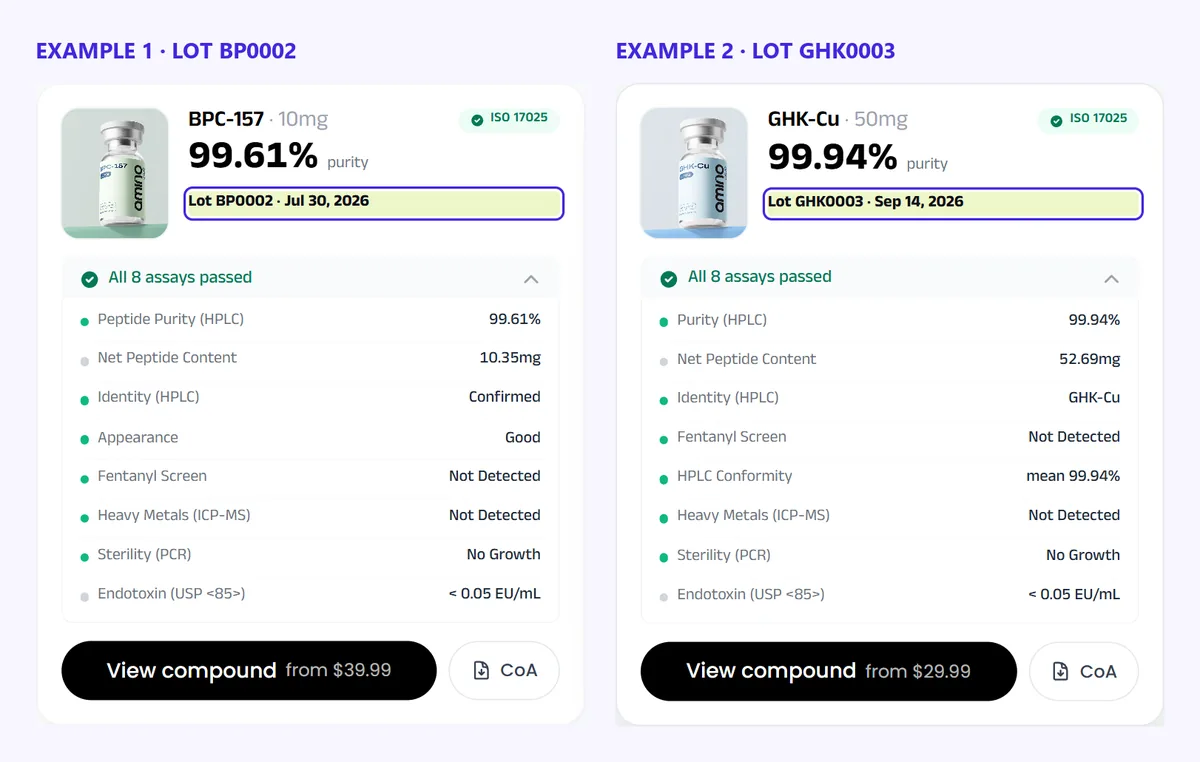
Find the lot. The BPC-157 10 mg card shows lot BP0002, tested on July 30, 2026, at 99.61% purity.
Open the PDF. The lab is ILS Laboratories in San Diego, and the certificate number is COA-2026-EDTVBY. The access code TNFS249Y sits under the QR code.
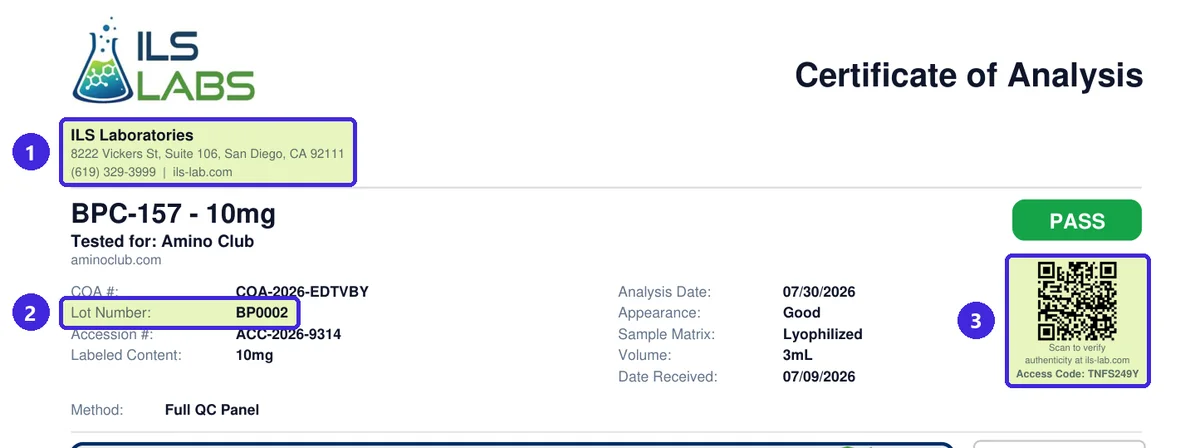
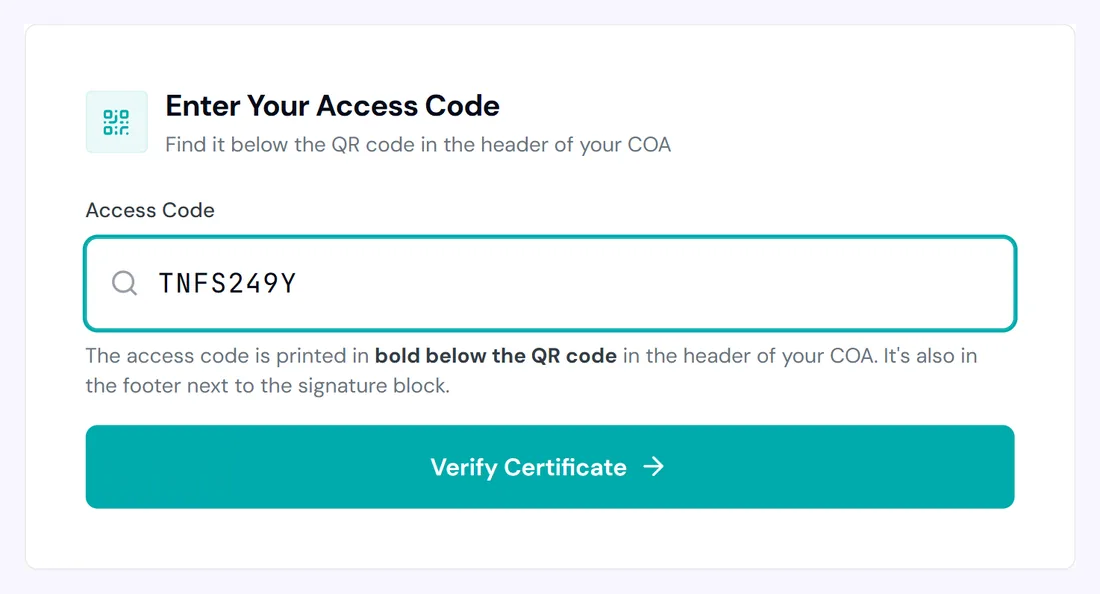
Verify it. We didn’t scan the QR code. We typed ils-lab.com into the browser and opened “Verify COA.” Then we entered TNFS249Y.
Compare. The lab’s record came back verified and names Amino Club as the client. It shows lot BP0002, received July 9 and analyzed July 30. Purity, net content, identity, fentanyl, metals and sterility match the PDF exactly. Net content is 10.35 mg on a 10 mg label, so it’s 3.5% over.
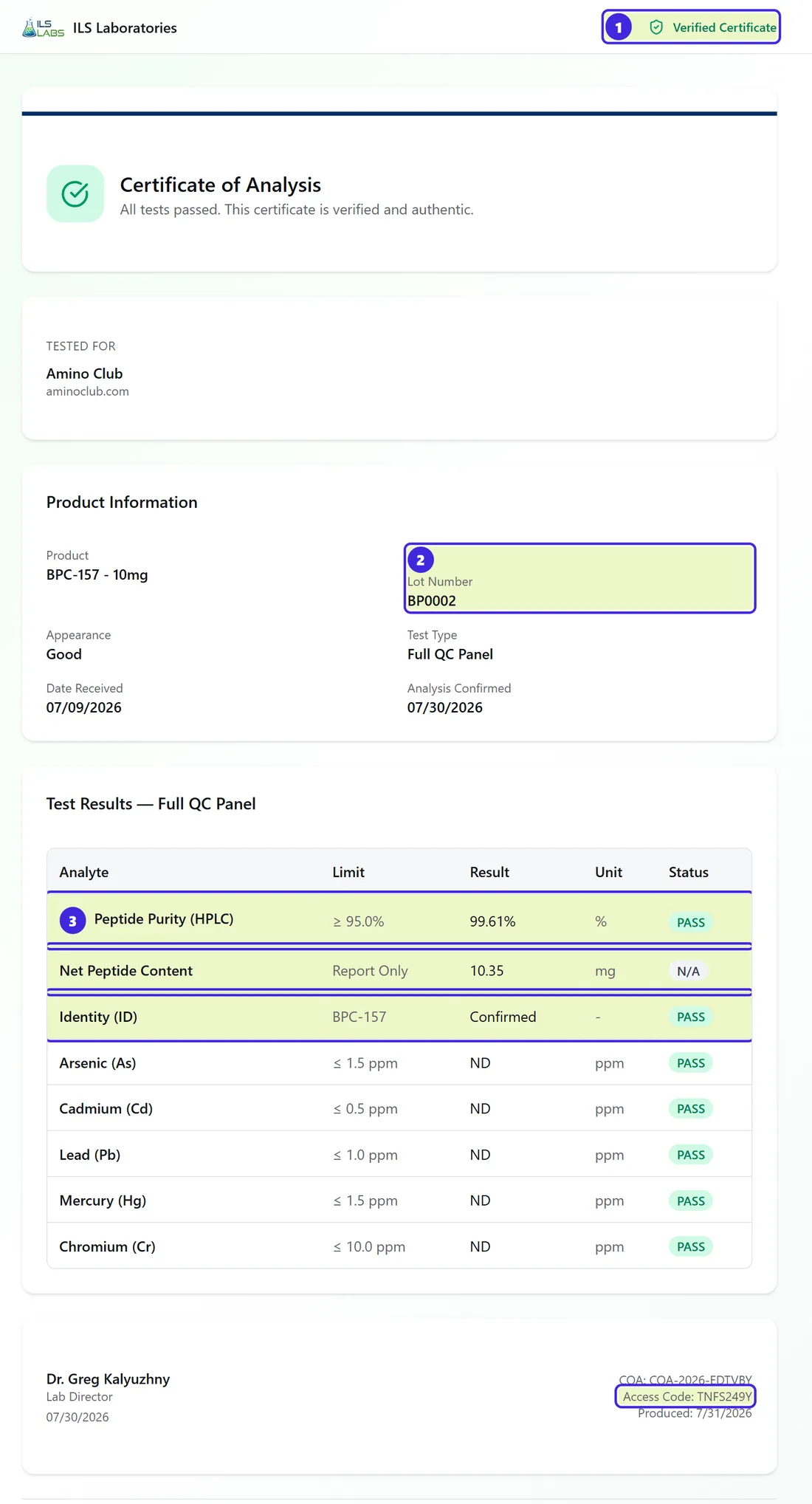
| Test | Lab record | Match | |
|---|---|---|---|
| Purity | 99.61% | 99.61% | ✓ |
| Net content | 10.35 mg | 10.35 mg | ✓ |
| Identity | Confirmed | Confirmed | ✓ |
| Fentanyl | Not detected | Not detected | ✓ |
| Metals (5) | None detected | None detected | ✓ |
| Sterility | No growth | No growth | ✓ |
| Endotoxin | Under 0.05 EU/mL, no limit listed | Under 0.05 EU/mL, limit 0.25 | ~ |
One line didn’t match. The endotoxin result is the same number in both. But the PDF lists no limit and names a turbidimetric method. The lab’s live record adds a 0.25 EU/mL limit and names a chromogenic method. It also has two disclaimer notes the July PDF doesn’t. Our read is that the lab updated its template after July. The result didn’t change. But you only see gaps like this when you check, so one email to the vendor is fair.
Verdict: pass. The PDF is real and the numbers match the lab.
Example 2: GHK-Cu 50 mg, lot GHK0003
The GHK-Cu 50 mg card shows lot GHK0003. It was tested on September 14, 2026, at 99.94% purity. We typed the access code 4VSHHX4Q into the same ILS page. The verified record came back as COA-2026-IZOIBS. The lab received it September 8 and analyzed it September 14.
This one has something the first doesn’t. The lab tested two vials from the lot, not one. Vial V0 held 52.69 mg and vial V1 held 53.67 mg. Both read 99.94% purity, and the mean is 53.18 mg on a 50 mg label.
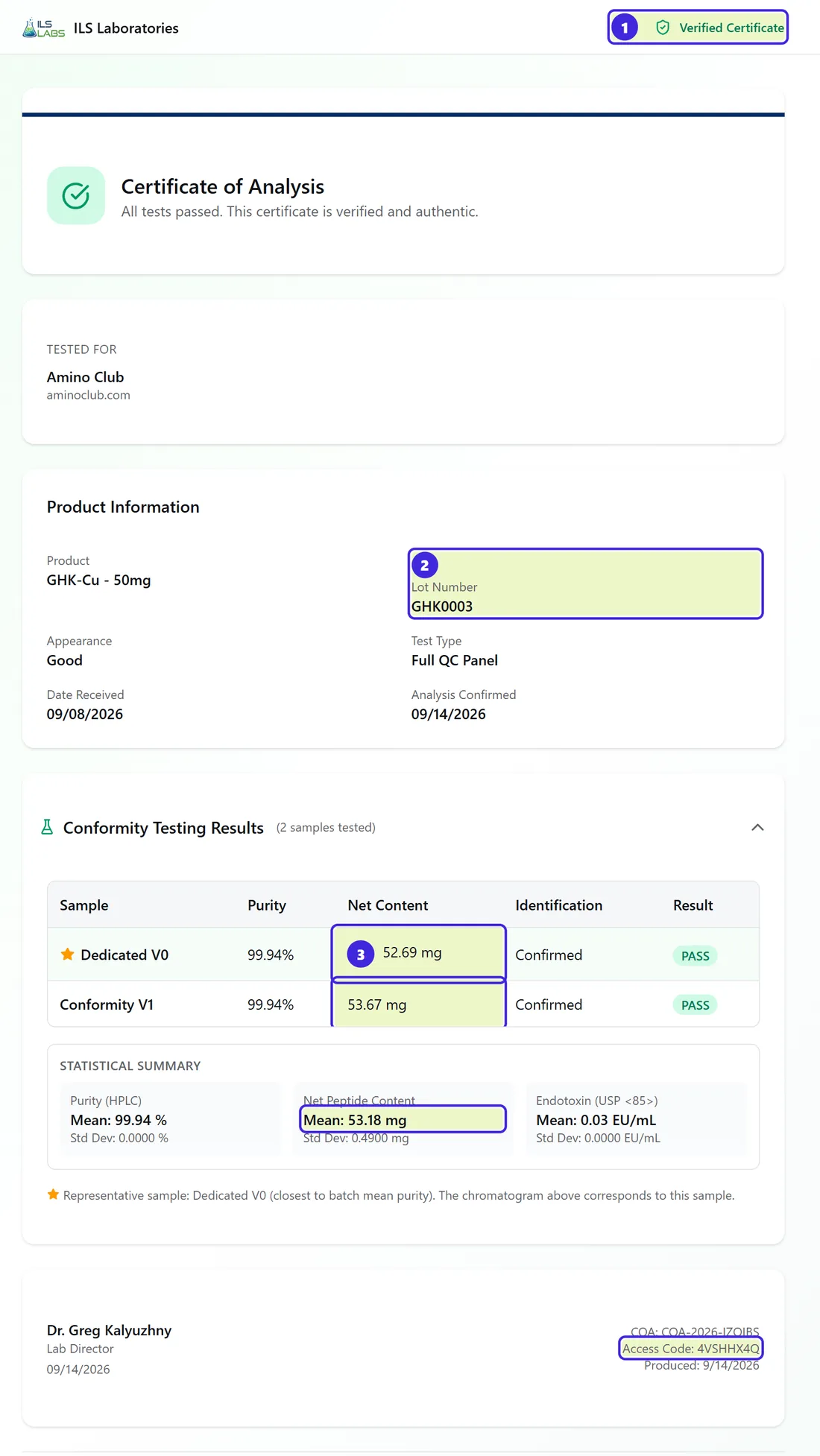
Why does a second vial matter? One vial tells you about one vial. Two vials from the same lot tell you the fill is consistent. Both came in over the label, by 5.4% and 7.3%. Over beats under, because underdosing is how cheap sellers cut costs.
The library also lists an older certificate for the same lot. It’s dated July 30, 2026, reads 99.81% and is now archived. So this lot was tested twice, 46 days apart. A recent test beats a two-year-old PDF.
Verdict: pass, with two vials behind it.
What a passing certificate can’t tell you
- The vendor picked the vials.Sampling
ILS says so on the certificate. Lot numbers and labels are “provided by the submitting party and have not been independently verified.”
- Identity was matched by HPLC retention time.Test method
The lab compared the sample to a reference standard. That’s enough to match a known compound, but it’s weaker than mass spectrometry at spotting a look-alike.
- Accreditation has a scope.ISO 17025
ILS notes its ISO 17025 accreditation covers the activities on its PJLA scope. Ask the lab if peptide HPLC is on that list.
- It doesn’t make the compound safe to use.Human data
A 2025 systematic review of BPC-157 found 35 preclinical studies and one clinical study. It found no clinical safety data.
Evidence limitation. We checked two lots from one vendor on October 12, 2026. We didn’t buy the vials or send them to a second lab.
Want to run the check yourself? Amino Club lists every lot with its lab code.
Read Amino Club’s certificates Affiliate link. We earn a commission if you order. It doesn’t change what the lab record says. For more vendors, see how their lab reports compare.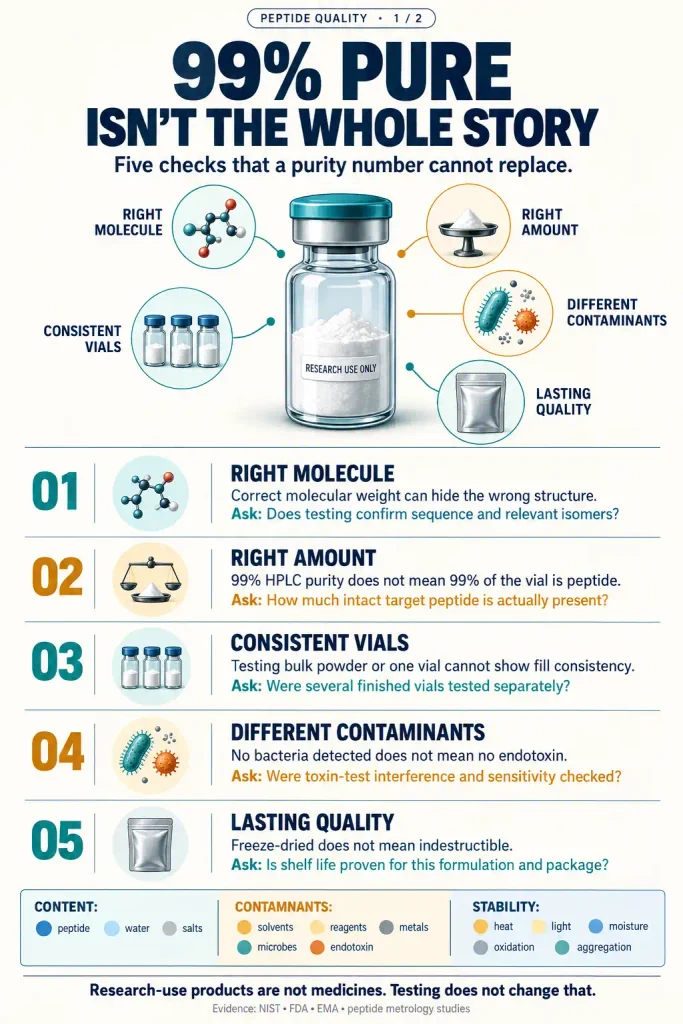
Your next wise move is to learn how to verify peptide COA.
Three Questions to Ask About a CoA
Who selected the sample?
A vendor might submit one vial from a large batch.Sample selectionThe laboratory can report the results for that sample, but it cannot automatically establish that every vial in the batch has the same contents.
A genuine certificate doesn’t prove that the sample was randomly selected or independently purchased.
Vendor-submitted testing, independent mystery-shopping and documented random sampling offer different levels of evidence about the wider product supply.
Did the laboratory use the right test?
A laboratory may accurately perform an HPLC analysis that answers a narrow question.Test methodThat analysis may still be insufficient to establish molecular identity, net content or contamination levels.
Even ISO-accredited laboratories can perform tests outside their accredited scope.
You have to check the method, material and claimed measurement—not just the laboratory’s logo.
Are you seeing every test?
Vendors generally control which reports they publish.PublicationA vendor could commission several tests and publish only favorable results.
Evidence limitation. We have not established that any vendor in this investigation engaged in selective publication.
Are peptide pills a scam
Yes. Can you take peptides orally is a question we get asked most. A peptide is a short protein your digestive trac chop proteins up, by design. Pepsin starts in the stomach. Pancreatic digestive enzymes take over in the small intestine, and enzymes on the gut lining finish the job.
Why Fake Peptides Are Worse Than a Waste of Money
A fake peptide isn’t only expensive water. That’s almost a good outcome.
A 2018 analysis of falsified peptide drugs had purity as low as 5%. The lead concentrations show ten times above safety limits. You buy lead, mystery compounds, and a vial that contains something else entirely than what it says.
I’ve seen researchers order BPC-157 and receive GHRP-2. I’ve seen Photoshopped Certificates of Analysis. The whole market runs on trust. Trust is so easy to fake, it isn’t funny anymore. There’s no regulator checking the work.
That’s the part people miss. Underdosed peptides destroy your research before you even know what went wrong. You follow a protocol and get nothing. You blame the compound. The real problem was the shady vendor.
Fake vs Real Peptides: Underdosing, Contamination and Counterfeits
A wack vendor falls into one of two buckets.
Outright scam. Fake COAs. Contaminated peptides. Exit scams when your money vanishes before you realize what happened. These are reported by real people, community profiles, and lab tests that flagged compounds as dangerous.
Shutdown risk. Not always scams. Some sold legit products. But they crossed a regulatory line and attracted federal attention, then disappeared. Your money disappears as well, whether the vendor was a crook or a casualty.
Both types of scams cost you. Here are the names in each.
Peptide Vendors Shut Down or Raided in 2025 and 2026
This is the part most “scam” lists ignore, and it’s the bigger story of 2026.
Amino Asylum. Raided by the FDA in June 2025. Site permanently gone within days. Before the raid, they clocked an estimated 400,000 monthly visitors and ranked in the top five most-searched peptide vendors in the country. Reports point to ignored warning letters. Marketing that blurred research chemicals into consumer health claims. And selling prescription-only medications. Sites keep spawning under names like aminoasylum.us and aminoasylums.shop. None are verified. Do not order from any of them. They might ride on the name to get found easily online by searchers.
Peptide Sciences. The big mac. The largest grey-market peptide vendor in the United States, doing a reported $7.4 million a month, posted a three-sentence notice and went radio-silent. Voluntary, they said. The timing tells a different story. It landed in the middle of the most aggressive enforcement period the industry has ever witnessed. Reporting tied it to FDA pressure, pharmaceutical litigation over GLP-1 copies. And failed third-party tests on Retatrutide.
Tailor Made Compounding. Prosecuted by the Department of Justice for distributing unapproved peptides including BPC-157. Forced to forfeit $1.79 million. This is the one that should make you sit up straight because it was criminal, not administrative.
The warning-letter list. In late 2024 the FDA sent letters directly to:
- Prime Peptides
- Xcel Peptides
- SwissChems
- Summit Research
A warning letter is not a death sentence. But it tells us which vendors are working in the agency’s crosshairs.
At least seven other research peptide companies closed during 2025 alone. The “research use only” label that the whole market hides behind is no longer the legal shield it once was.
How to Spot a Fake Peptide Vendor Before You Pay
You don’t have to be a chemist and know the list of peptides by heart. A checklist and ten minutes will do. Learn these red flags that catch most bad actors before they catch you.
Sells injection kits. Bacteriostatic water, syringes, alcohol swabs, dosing calculators. A vendor genuinely selling to laboratories doesn’t need to bundle the supplies for human administration. The FDA has cited exactly this in its letters, and it’s one of the fastest ways a site hands over its own intent.
No batch-specific COA. Retreat if there’s no Certificate of Analysis. And even if it’s only “available on request,” or doesn’t match the lot number on your vial. A real vendor links a batch COA right on the product page.
A perfect 99.9% purity on everything. Sounds backwards? Real HPLC testing produces variation. Honest numbers land around 98 to 99.2% and move batch to batch. A flawless score across every product is fabricated.
Crypto or gift cards only. Payment processors avoid peptide sellers. Card acceptance is therefore a genuine trust signal. And it offers you chargeback protection. Gift-card-only checkout is a remarkable scam.
Prices more than 50% below market. If everyone sells a compound for $60 and one vendor lists it at $20, they are either cutting the product or running a loss-leader exit scam. Neither helps you.
A domain younger than six months. Fresh domains with established-brand names are classic frauds. Check the site age before you trust the storefront.
Health claims or human-dosing instructions. The one This is the one that gets vendors raided. A site making therapeutic claims is telling you it does not understand or respect the line it is standing on. A candidate for the next blackout.
Recycled chemist signatures. If the same signature shows up on COAs across supposedly different labs, the documents are a hoax.
I built a full breakdown of how we score every vendor against these factors in our vendor testing methodology. If you want the system instead of the summary, that is where it lives.
What to Do If Your Vendor Just Got Shut Down
If you ordered from a vendor that went dark, move fast.
File a chargeback with your card immediately if the order hasn’t shipped. This is why card payments matter. Crypto buyers have no say here.
Don’t chase successor sites. When a raided brand shows up under a slightly different domain, it’s either opportunists living on the name or the same operation trying to dodge the heat. Neither is safe.
Then move to a vendor that survives the checklist above. We keep a current list of the legit peptide vendors that still pass third-party COA verification, and it is updated as the market shifts.
Legit Peptide Companies: How to Choose After the Shakeout
The peptide market in 2026 is a minefield. Scammers who never had peptides delivered, and real vendors who got too big or too loud and got raided.
Check out our top 10 trusted peptide vendors if you want to learn more.
The defense is the same. Demand a batch-specific COA. Verify the lab. Pay by card. Avoid the names on this page and the patterns I told you about. A vendor that can’t make it in that ten-minute checklist hasn’t earned your trust. No matter how good the price seems.
Get this part right and the rest of your research stands a solid chance. Get it wrong and you’re using lead-laced powder with a rigged certificate.
Choose the vendor like your results depend on it. They do.
Disclaimer: All peptides discussed are for in-vitro laboratory research purposes only and are not for human consumption. This article reports publicly documented enforcement actions and community-sourced accounts for informational purposes and does not constitute legal, medical, or purchasing advice. Vendor statuses change; verify current information independently before making any decision.