
The peptide pill the FDA approved for weight loss in December 2025 wastes about 98 of every 100 milligrams you swallow.
It works anyway. In its main trial, people on the Wegovy pill lost 13.6% of their body weight in 64 weeks, against 2.2% on placebo. Novo Nordisk got there by packing an absorption enhancer into the tablet, setting a strict empty-stomach routine and raising the dose to roughly 70 times the weekly shot.
Now look at a BPC-157 capsule. It has no absorption enhancer, no ring structure and no trial behind it. When FDA staff reviewed BPC-157 in July 2026, they couldn’t find a single study that gave it to humans by mouth.
We read the FDA approval letters and every human trial we could find, then graded each oral peptide on human evidence. Mouse studies and influencer stacks don’t count.
This is research, not medical advice. Prescription peptides belong with a clinician. Nothing here is a dosing guide.
Jump to: What they are · The ranking · Weight loss · Muscle growth · Oral vs injectable · BPC-157 · Cancer risk · Legal status · FAQ
What Are Oral Peptides?
Oral peptides are peptides you swallow as a tablet, capsule or drink instead of injecting. A peptide is a short chain of amino acids, and digestion breaks most of them apart before they reach the blood. Only a few engineered drugs, such as oral semaglutide, get enough through to work.
Products sold as oral peptides fall into three groups: FDA-approved prescription drugs with large human trials, food-based supplements like collagen and whey with small measured effects, and unapproved “research” capsules such as BPC-157 that have no human evidence when swallowed.
Do Oral Peptides Work? The Ranking, Graded on Human Evidence
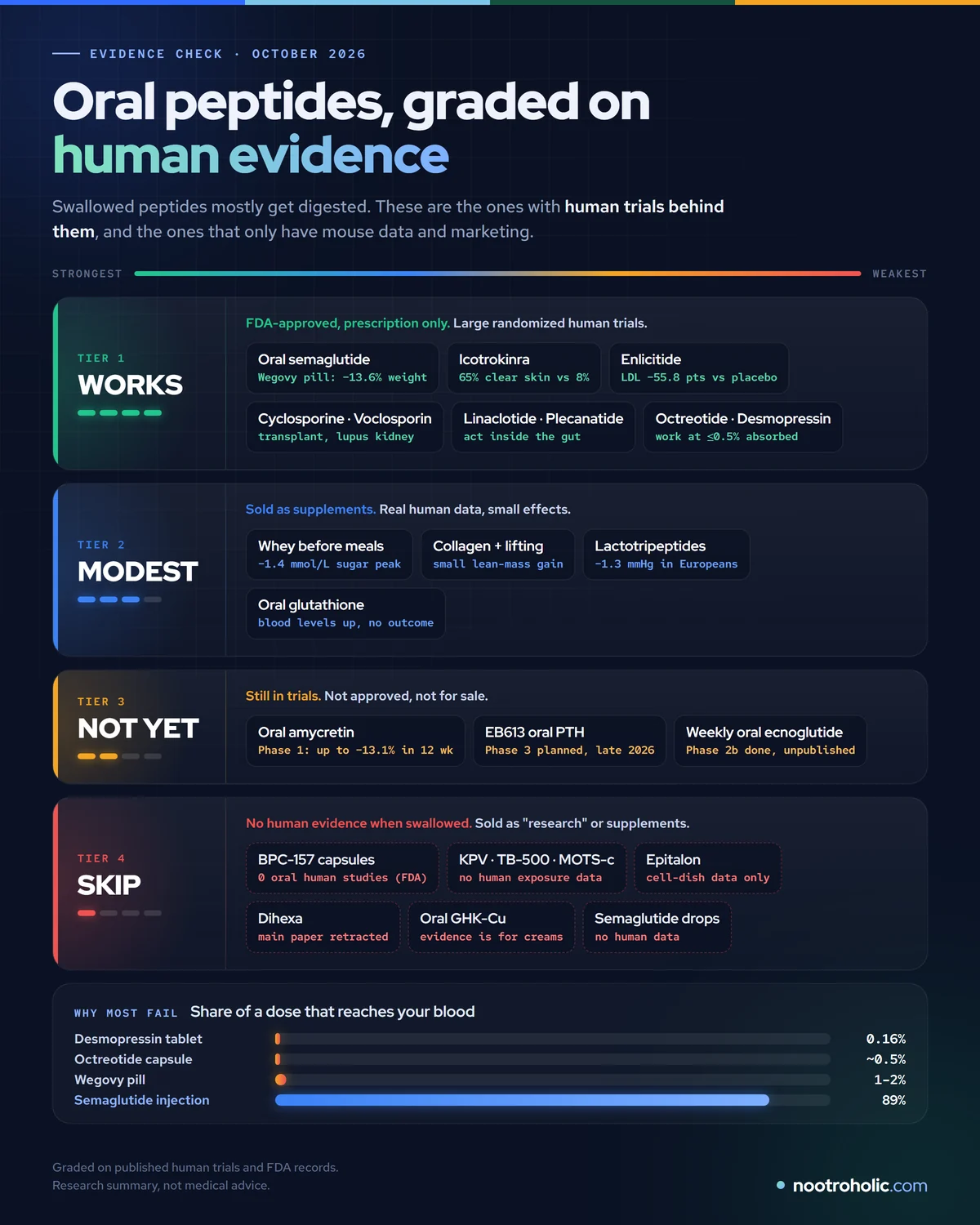
A few do. Oral semaglutide, icotrokinra and enlicitide, plus older prescription drugs like cyclosporine and linaclotide, have large human trials and FDA approval. Collagen, whey and a few other supplements show small effects. BPC-157, KPV, TB-500 and other “research” capsules have no human evidence when swallowed.
Tier 1: Works. Oral peptide drugs with big human trials
1. Oral semaglutide (Rybelsus, Wegovy pill)
A GLP-1 drug for type 2 diabetes and weight loss. In the OASIS 4 trial, people lost 13.6% of their body weight in 64 weeks. Placebo lost 2.2%. In SOUL, a trial of 9,650 people with type 2 diabetes and heart or kidney disease, Rybelsus cut the combined risk of heart attack, stroke and cardiovascular death by 14% (a relative cut, over about four years).
It’s the only oral peptide with that kind of outcome data. GLP-1 drugs are also what people mean when they say the “food noise” went quiet, because appetite reduction is how they work. If the weight won’t budge no matter how much you run and lift, this is the drug class to raise with your doctor.
- Status: Rybelsus approved since 2019. Wegovy pill FDA-approved December 22, 2025. Our GLP-1 oral pill breakdown compares the Wegovy pill, Foundayo and the Ozempic pill.
- The catch: It absorbs 1 to 2%, so it has to be taken on an empty stomach. In its main trial, GI side effects hit 74% of users versus 42% on placebo.
2. Icotrokinra (Icotyde)
A 13-amino-acid ring-shaped peptide that blocks the IL-23 receptor, the same pathway injected psoriasis antibodies hit. In ICONIC-LEAD, 65% of patients got clear or almost clear skin by week 16. Placebo: 8%. It beat deucravacitinib, an approved oral psoriasis drug, head to head, and its tablet works without an absorption enhancer. In a phase 2b ulcerative colitis trial, 63% responded at 12 weeks versus 27% on placebo, though it isn’t approved for that yet.
- Status: FDA-approved March 17, 2026. EU-approved September 18, 2026.
- The catch: Safety data covers about a year, pooled from about 2,400 patients. The label tells doctors to consider testing for TB first.
3. Enlicitide (Lipfendra)
The first FDA-approved oral PCSK9 inhibitor. It cut LDL (“bad”) cholesterol by 55.8 percentage points more than placebo at 24 weeks in a trial of 2,909 people. In people with inherited high cholesterol, the drop held at a year: 61.5 points more than placebo.
- Status: FDA-approved July 15, 2026.
- The catch: The heart-attack outcome trial (14,500+ people) hasn’t reported. Lower LDL is established. Fewer heart attacks isn’t, yet.
4. Cyclosporine and voclosporin
Cyclosporine is the original oral peptide: an 11-amino-acid ring from a fungus, used since the 1980s to stop organ rejection. Its cousin voclosporin nearly doubled the kidney response rate in lupus nephritis at one year, 41% versus 23%, on top of standard treatment.
- The catch: Boxed warnings for infection, cancer and kidney damage. These are serious immunosuppressants.
5. The gut-only peptides: linaclotide, plecanatide, oral vancomycin
These are built to stay in your gut. Linaclotide and plecanatide treat constipation and IBS-C by pulling water into the bowel. Oral vancomycin kills C. difficile inside the colon.
- The catch: Linaclotide’s benefit is real but modest. On FDA’s main measure in two 12-week IBS-C trials, about 34% responded versus 14 to 21% on placebo.
6. Octreotide capsules and desmopressin tablets
Pill versions of hormone drugs. Desmopressin absorbs about 0.16% of the dose. Octreotide absorbs about 0.5%: a 20 mg capsule gives roughly the same exposure as a 0.1 mg injection. Both still work, because the molecules are potent enough that a trace does the job.
Tier 2: Real but modest. Oral peptide supplements with human data
7. Whey protein before meals
Across 16 small crossover trials, whey taken before a meal lowered the post-meal blood sugar peak by 1.4 mmol/L, and more in type 2 diabetes. That’s ordinary protein at work, and long-term effects are unknown.
8. Collagen peptides plus lifting
Collagen does get in. Its Pro-Hyp fragments peak in your blood an hour or two after you take it. Across 19 studies and 768 people, collagen plus resistance training added a small amount of extra fat-free mass.
- The catch: About half of those trials come from one German research group, and the fat-free-mass trials compared collagen with a protein-free placebo. In older men, whey raised muscle-building rates over a week and collagen didn’t. Strength gains were tiny.
9. Lactotripeptides (IPP and VPP from fermented milk)
They lower office systolic blood pressure by about 5.5 mmHg in Japanese trials. In Europeans the drop is about 1.4 mmHg, and 24-hour blood pressure barely moves. The EU’s food safety authority rejected the health claim in 2011 and again in 2012.
10. Oral glutathione
A 6-month trial raised blood glutathione 30 to 35% at 1 gram a day. A 4-week trial found nothing. No trial has shown a health outcome.
Tier 3: Promising, not here yet
- Oral amycretin (zenagamtide, Novo Nordisk): A GLP-1 plus amylin pill. In a small phase 1 trial, people lost up to 13.1% of body weight in 12 weeks. Bigger trials still have to confirm it.
- EB613 oral PTH: A bone-building tablet that raised spine bone density 2.7% over placebo in 6 months. Phase 3 is planned for late 2026. No fracture data yet.
- Weekly oral ecnoglutide: Designed to be swallowed once a week. Its Phase 2b trial (EVOLVE-2, 206 people) finished in July 2026, and the results haven’t been published yet.
Tier 4: Skip. Oral peptides with no human proof
- BPC-157 capsules: FDA found no human study of oral BPC-157.
- KPV, TB-500, MOTS-c: FDA found no clinical studies or human exposure data.
- Epitalon and “bioregulators”: Telomere claims come from cell dishes. The human studies are few, small and short, mostly from one Russian research group.
- Dihexa: The main paper behind it was retracted in 2025. A related drug, fosgonimeton, failed its Phase 2/3 Alzheimer’s trial.
- Oral GHK-Cu: The evidence is for skin creams. Nobody has shown it works swallowed.
- Sublingual semaglutide drops: No human data. When researchers ordered semaglutide vials online without a prescription, the three that arrived held 29 to 39% more drug than the label stated, and all three contained bacterial endotoxin.
Oral Peptides for Weight Loss: What Actually Works
Two pills have large weight-loss trials behind them, and only one of them is a peptide. The Wegovy pill (oral semaglutide) led to 13.6% weight loss in 64 weeks, and Foundayo (orforglipron, a small molecule) to 11.2% in 72 weeks. Both need a prescription, and no over-the-counter peptide capsule has trial evidence for weight loss.
| Pill | What it is | Main trial result | Self-pay price, Oct 2026 |
|---|---|---|---|
| Wegovy pill (oral semaglutide) | Peptide. FDA-approved December 2025 | 13.6% weight loss vs 2.2% on placebo, 64 weeks | $149 to $299 a month (NovoCare) |
| Foundayo (orforglipron) | Not a peptide. A small molecule that hits the same GLP-1 receptor. FDA-approved April 2026 | 11.2% vs 2.1% on placebo, 72 weeks, highest dose | $149 to $349 a month (LillyDirect) |
| Oral amycretin (zenagamtide) | Peptide, still in trials | Up to 13.1% in 12 weeks, in a small phase 1 trial | Not for sale |
| “Peptide” weight-loss capsules sold online | Usually research-only or unlabeled | We found no human weight-loss trial | Varies |
These trials ran for different lengths and were never head to head. A higher, unapproved 50 mg dose of oral semaglutide reached 15.1% versus 2.4% over 68 weeks (OASIS 1), with stomach side effects in 80% of people. For scale, injected semaglutide averaged about 15% weight loss over 68 weeks (STEP 1), and injected tirzepatide up to about 21% over 72 weeks (SURMOUNT-1).
Foundayo belongs on this list even though it isn’t a peptide. Lilly sidestepped the problem with a small molecule that survives the stomach, and unlike the Wegovy pill it has no food or water rules. If you want a pill because you’d rather not inject, these two are the options with real trials. Both need a prescription.
For weight loss, the over-the-counter side is thin. Whey before meals blunts blood sugar spikes (#7 above), but we found no oral peptide supplement with a trial showing weight loss beyond placebo.
Oral Peptides for Muscle Growth: The Honest Answer
The most any swallowed peptide has shown for muscle in people is a small gain in fat-free mass from collagen taken alongside lifting. Whey does better. MK-677, the most-hyped “oral peptide” for muscle, added more lean mass in one trial, but it isn’t a peptide and it didn’t make anyone stronger.
- Whey protein: The most-studied option. It’s ordinary food protein, and in older men it raised muscle-building rates where collagen didn’t.
- Collagen plus lifting: A small amount of extra fat-free mass across 19 studies, about half from one research group and mostly against a protein-free placebo.
- MK-677 (ibutamoren): Sold as an oral peptide, but it’s a small molecule that mimics the hunger hormone ghrelin. In a trial of 65 healthy adults aged 60 to 81, fat-free mass rose about 1.1 kg after a year, while it dipped slightly on placebo. Strength and function didn’t change. Fasting blood sugar rose and insulin sensitivity fell. Not FDA-approved, and banned in sport.
- Sermorelin, ipamorelin and CJC-1295 capsules or troches: We couldn’t find a published human trial of any of them taken by mouth. They’re 5 to 30 amino acids long, the size your gut chops up.
- BPC-157 and TB-500: No human muscle data, swallowed or otherwise.
If muscle is the goal, the version with evidence is boring: lift, eat enough protein, and use whey when food falls short.
Oral vs Injectable Peptides: Why Most Pills Fail
Your stomach exists to destroy peptides.
That’s its job. Acid unfolds them, enzymes chop them into pieces, and your gut wall blocks whatever survives.
A swallowed peptide has to get past stomach acid, pepsin, pancreatic enzymes, a mucus layer and a gut wall that blocks large molecules. Most peptides don’t get past all five. Even the most carefully engineered pills reach the blood at roughly 1 to 2%, compared with 89% when the same semaglutide is injected. (Full breakdown: can you take peptides orally?)
How Much of Each Pill Reaches Your Blood
| Oral peptide | Share of dose absorbed |
|---|---|
| Desmopressin tablet | 0.16% |
| Octreotide capsule | ~0.5% |
| Rybelsus (semaglutide) | 0.4 to 1% |
| Enlicitide (Lipfendra) | ~1% |
| Wegovy pill (semaglutide) | 1 to 2% |
| Injected semaglutide, for comparison | 89% |
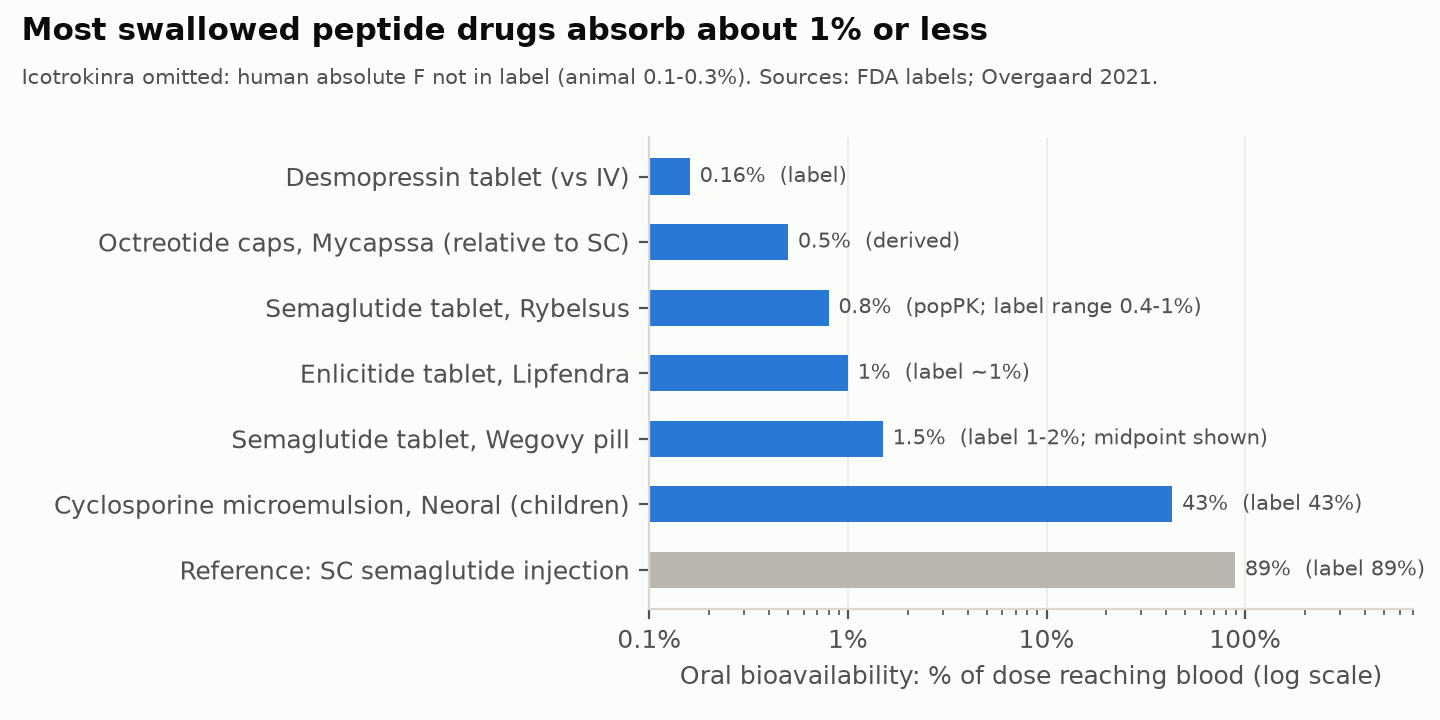
That’s why the Wegovy pill uses 25 mg a day while the injection uses 2.4 mg a week. You swallow about 70 times more drug to get a similar effect.
Small fragments are different. Your gut has a transporter, PEPT1, that pulls in pieces two or three amino acids long. That’s how collagen’s Pro-Hyp gets in. It doesn’t help a 15-amino-acid peptide like BPC-157, and no human data shows BPC-157 gets through intact.
How the Winners Beat Your Stomach
Most of the oral peptides that work cheat digestion, in one of four ways.
Absorption enhancers. SNAC buffers acid right around the semaglutide tablet and briefly opens the stomach lining. Sodium caprate does the same job for enlicitide in the small intestine.
Ring structures. Tie a peptide into a ring, swap in unusual amino acids, and enzymes can’t grip it. Cyclosporine did this naturally. Icotrokinra does it by design and needs no enhancer at all.
Long half-life. Semaglutide binds to albumin in the blood and lasts about a week. Small, uneven daily doses stack into steady levels.
Don’t get absorbed. Linaclotide and oral vancomycin work on the gut lining itself, so poor absorption is the point.
A capsule of powdered BPC-157 uses none of these.
Oral Peptides for Skin and Joints: What Collagen Really Does
For skin, independent trials show no measurable benefit from collagen, and for joints the evidence is mixed and mostly industry-funded. Collagen is the clearest test case among oral peptides: it really is absorbed, and the marketing still outruns the evidence.
For skin, early meta-analyses looked positive. Then a 2025 analysis of 23 trials split them by funding. Trials paid for by companies showed benefits. Independent trials showed no effect on hydration, elasticity or wrinkles, and high-quality trials showed none either. The authors concluded there’s “no clinical evidence” collagen prevents or treats skin aging.
For joints, the European Food Safety Authority rejected the claim in 2011. A 2025 trial with no industry funding found collagen no better than placebo for knee osteoarthritis, while pooled, mostly industry-run trials show a small effect on pain. The muscle data is better, and it’s modest.
If you take collagen, take it for the small body-composition edge alongside lifting. Don’t buy it as a face cream you drink.
Can BPC-157 Be Taken Orally? What the FDA Found
BPC-157 can be swallowed, but there’s no evidence it works that way in people. FDA’s 2026 review found no human study that gave it by mouth, and it isn’t approved for any use in the US.
BPC-157 is the most searched peptide out there, at about 301,000 US Google searches a month. Almost none of that interest is backed by human data.
In July 2026, FDA reviewed it for its compounding advisory committee. Its staff found five human studies in total, including rectal enemas, a knee-injection chart review, a bladder pilot and a 2-person IV safety pilot. None of them gave it orally. FDA’s staff wrote that they found no studies giving it to humans by mouth, under the skin, in the nose or through the skin. The only oral human trial ever registered, a 42-person safety study from 2015, never posted results.
Then the advisory panel voted 8 to 6, with one abstention, to recommend letting pharmacies compound it anyway, against FDA staff’s advice. That vote is only a recommendation, and FDA hasn’t acted on it.
- Not FDA-approved. Not for any use.
- Not “cleared.” It came off FDA’s safety-risk list in April 2026 because the people who nominated it withdrew the nomination. FDA didn’t decide it was safe.
- Banned in sport. It’s on the 2026 WADA prohibited list by name.
- Unknown safety. There’s no long-term human data. A systematic review published in October 2026 found three human studies with 30 people in total, all of poor quality, and rated the evidence “very low.”
If you’re stuck in physical therapy and hoping a capsule will fix your tendon, no human study supports that.
“Research use only” on the label doesn’t change any of this. FDA treats the seller’s website claims as proof of intended human use, and in August 2026 it sent warning letters to five online “research use only” peptide sellers saying exactly that.
Can Oral Peptides Cause Cancer?
Cancer is the safety fear people raise most about peptides. Approved oral peptides print their known cancer risks on the label, such as semaglutide’s thyroid tumor warning from rodent studies. For unapproved ones like BPC-157, nobody knows, because no long-term human or cancer studies exist.
- Oral semaglutide (Wegovy pill, Rybelsus): Carries a boxed warning. Semaglutide caused thyroid C-cell tumors in rodents, and it isn’t known whether it does in people. Anyone with a personal or family history of medullary thyroid cancer, or the MEN 2 syndrome, shouldn’t take it.
- Cyclosporine and voclosporin: Boxed warnings for cancer, including lymphoma, because they suppress the immune system.
- BPC-157 and other unapproved peptides: Nobody knows, because nobody has run long-term human studies. The worry people raise is that BPC-157 helped grow new blood vessels in rat and cell studies, and tumors need new blood vessels too. That’s a reason for caution, not proof of harm. FDA’s own review noted that no cancer studies of BPC-157 exist, and for epitalon it warned that pushing telomeres too long could raise cancer risk.
Approved drugs print their cancer risks on the label. Unapproved ones can’t, because the data doesn’t exist. More on that in our guide to long-term peptide risks.
Are Oral Peptides Legal? Status as of October 2026
Approved oral peptide drugs are legal with a prescription, and collagen, whey and glutathione are sold legally as supplements. BPC-157, KPV, TB-500 and MOTS-c are not FDA-approved for any human use, and sellers who market them for people can receive FDA warning letters.
| Peptide | FDA status |
|---|---|
| Oral semaglutide, icotrokinra, enlicitide | Approved, prescription only |
| Linaclotide, plecanatide, oral vancomycin, cyclosporine | Approved, prescription only |
| Collagen, whey, glutathione, lactotripeptides | Sold as supplements. Supplements aren’t approved for efficacy |
| Oral amycretin, EB613 | Investigational. Not for sale |
| BPC-157, KPV, TB-500, MOTS-c, Epitalon | Not approved. Advisory vote pending FDA action |
| Retatrutide | Phase 3. Not approved |
Who should not touch unapproved oral peptides: anyone under 18, anyone who competes in a tested sport (WADA bans BPC-157 by name, along with growth hormone secretagogues like MK-677), and anyone pregnant or breastfeeding.
5 Questions That Expose a Fake Oral Peptide Claim
You’re right to be skeptical. Under one of 2026’s biggest peptide videos, 11,000 people liked a comment saying half the people hyping BPC-157 are selling it. Run any claim through these:
- Was it tested in humans? Mouse data tells you where to look. It doesn’t tell you what happens to you.
- Was it tested orally? An injection study says nothing about a capsule.
- Who paid for the trial? The collagen skin effect disappeared once industry-funded trials were set aside.
- What’s in the vial? Ask for the batch’s lab report, from a named lab, with a lot number you can check. Here’s how to verify a peptide COA. In July 2026 the owner of Paradigm Peptides got 70 months in prison. His company had forged its lab certificates.
- Is it approved for this use? “FDA-approved ingredient” and “clinically proven” are phrases FDA has cited in warning letters.
A seller who can’t answer all five hasn’t earned your money.
Before you buy from any seller, read peptide scams to avoid and our guide to verifying a COA. If you’re weighing the prescription pills, read the GLP-1 pill comparison.
FAQ
Do oral peptides work?
A few do. Oral semaglutide, icotrokinra, enlicitide, cyclosporine and the gut-acting peptides have large human trials behind them. Most supplement peptides have small or mixed evidence, and most “research” peptides have none.
Does oral BPC-157 work?
There’s no human evidence it works when swallowed. FDA’s 2026 review found zero oral human studies.
What is the Wegovy pill?
It’s oral semaglutide 25 mg, FDA-approved for weight management on December 22, 2025. In its main trial, people lost 13.6% of body weight versus 2.2% on placebo.
Are collagen peptides worth it?
For skin, independent trials show no benefit. With resistance training, they add a small amount of fat-free mass. Whey protein does more for muscle.
Are oral peptides safe?
The approved ones have known, labeled side effects and are prescribed with monitoring. Unapproved peptides have no long-term human safety data, so nobody can tell you they’re safe.
Are oral peptides as effective as injections?
Only when they’re engineered for it. The Wegovy pill needs about 70 times more drug than the weekly shot to get a similar effect, because only 1 to 2% gets absorbed. Plain peptide capsules have none of that engineering and no human data.
Are there oral peptides for weight loss?
Yes, by prescription. The Wegovy pill (oral semaglutide) led to 13.6% weight loss versus 2.2% on placebo over 64 weeks. Foundayo (orforglipron) is a GLP-1 pill too, but it’s a small molecule, not a peptide.
Can oral peptides build muscle?
Not much. Collagen peptides taken alongside lifting add a small amount of fat-free mass, and whey protein does more. MK-677 raised fat-free mass in older adults without making them stronger, and it isn’t a peptide, isn’t FDA-approved and is banned in sport.
What are oral peptides?
Oral peptides are peptides taken by mouth as a tablet, capsule or drink instead of an injection. Digestion breaks most of them apart, so only a few engineered drugs, such as oral semaglutide, get enough into the blood to work.
Are oral peptides legal?
Approved oral peptide drugs like the Wegovy pill are legal with a prescription, and collagen and whey are legal supplements. BPC-157, KPV, TB-500 and MOTS-c are not FDA-approved for any human use as of October 2026.
Sources
Show all 56 sourcesTrials, FDA labels & records
- Wharton S, et al. Oral semaglutide 25 mg in adults with overweight or obesity (OASIS 4). N Engl J Med. 2025. doi:10.1056/NEJMoa2500969
- McGuire DK, et al. Oral semaglutide and cardiovascular outcomes (SOUL). N Engl J Med. 2025. doi:10.1056/NEJMoa2501006
- FDA. Wegovy tablets prescribing information, 2026. accessdata.fda.gov
- Bissonnette R, et al. Oral icotrokinra for plaque psoriasis (ICONIC-LEAD). N Engl J Med. 2025. doi:10.1056/NEJMoa2504187
- Stein Gold L, et al. Icotrokinra vs deucravacitinib (ICONIC-ADVANCE). Lancet. 2025. doi:10.1016/S0140-6736(25)01576-4
- FDA. Icotyde approval letter, March 17, 2026. accessdata.fda.gov
- EMA. Icotyde product page. ema.europa.eu
- Navar AM, et al. Oral PCSK9 inhibitor enlicitide (CORALreef Lipids). N Engl J Med. 2026. doi:10.1056/NEJMoa2511002
- FDA. Lipfendra approval letter, July 15, 2026. accessdata.fda.gov
- Rovin BH, et al. Voclosporin for lupus nephritis (AURORA 1). Lancet. 2021. doi:10.1016/S0140-6736(21)00578-X
- Overgaard RV, et al. Clinical pharmacokinetics of oral semaglutide. Clin Pharmacokinet. 2021. doi:10.1007/s40262-021-01025-x
- Drucker DJ. Advances in oral peptide therapeutics. Nat Rev Drug Discov. 2020. doi:10.1038/s41573-019-0053-0
- Smedegaard S, et al. Whey protein premeal and postprandial glucose: meta-analysis. Am J Clin Nutr. 2023. doi:10.1016/j.ajcnut.2023.05.012
- Bischof K, et al. Collagen peptides with long-term training: meta-analysis. Sports Med. 2024. doi:10.1007/s40279-024-02079-0
- Myung SK, Park Y. Collagen supplements and skin aging: meta-analysis of RCTs. Am J Med. 2025. doi:10.1016/j.amjmed.2025.04.034
- Fekete AA, et al. Casein-derived lactotripeptides and blood pressure: meta-analysis. Nutrients. 2015. doi:10.3390/nu7010659
- Richie JP Jr, et al. Oral glutathione supplementation on body stores: RCT. Eur J Nutr. 2015. doi:10.1007/s00394-014-0706-z
- Tripto-Shkolnik L, et al. Oral PTH(1-34) tablets (EB613): phase 2. J Bone Miner Res. 2024. doi:10.1093/jbmr/zjae057
- FDA. Pharmacy Compounding Advisory Committee briefing document: BPC-157, July 2026. fda.gov
- FDA. Bulk drug substances that may present significant safety risks. fda.gov
- World Anti-Doping Agency. Prohibited List 2026. wada-ama.org
- Benoist CC, et al. Angiotensin IV-derived peptides and HGF/c-Met (retracted 2025). J Pharmacol Exp Ther. 2014. doi:10.1124/jpet.114.218735
- Ashraf AR, et al. Quality and safety of semaglutide sold online without prescription. J Med Internet Res. 2024. doi:10.2196/65440
- CBS News. Peptides seller sentenced to prison for selling unapproved drugs, July 30, 2026. cbsnews.com
- Wharton S, et al. Orforglipron, an oral small-molecule GLP-1 receptor agonist for obesity treatment (ATTAIN-1). N Engl J Med. 2025. doi:10.1056/NEJMoa2511774
- Lilly. FDA approves Foundayo (orforglipron), April 2026. investor.lilly.com
- NovoCare. Wegovy pill self-pay pricing, checked October 18, 2026. novocare.com
- LillyDirect. Foundayo self-pay pricing, checked October 18, 2026. lilly.com
- Gasiorek A, et al. Amycretin, a GLP-1 and amylin receptor agonist: first-in-human phase 1 trial. Lancet. 2025. doi:10.1016/S0140-6736(25)01176-6
- Wilding JPH, et al. Once-weekly semaglutide in adults with overweight or obesity (STEP 1). N Engl J Med. 2021. doi:10.1056/NEJMoa2032183
- Jastreboff AM, et al. Tirzepatide once weekly for the treatment of obesity (SURMOUNT-1). N Engl J Med. 2022. doi:10.1056/NEJMoa2206038
- Nass R, et al. Effects of an oral ghrelin mimetic on body composition and clinical outcomes in healthy older adults: a randomized trial. Ann Intern Med. 2008. doi:10.7326/0003-4819-149-9-200811040-00003
- Panou T, et al. New amylin-based agonists for the treatment of obesity and type 2 diabetes (zenagamtide, formerly amycretin). Diabetes Ther. 2026. doi:10.1007/s13300-026-01921-0
- AJMC. FDA panel backs 6 peptides for compounding (BPC-157, KPV, TB-500, MOTS-c, Semax, epitalon), July 31, 2026. ajmc.com
- Hsieh MJ, et al. Therapeutic potential of pro-angiogenic BPC157 is associated with VEGFR2 activation and up-regulation. J Mol Med. 2017. doi:10.1007/s00109-016-1488-y
- Entera Bio. Second quarter 2026 results: EB613 Phase 3 planned to begin late 2026. investors.enterabio.com
- ClinicalTrials.gov. EVOLVE-2: weekly oral ecnoglutide (VRB-101) Phase 2b, NCT07281937 (completed July 2026, no results posted). clinicaltrials.gov
- FDA. Neoral (cyclosporine) prescribing information, boxed warning. accessdata.fda.gov
- FDA. Lupkynis (voclosporin) prescribing information, boxed warning: malignancies and serious infections, 2024. accessdata.fda.gov
- Novo Nordisk. FDA approves Ozempic tablets as the name for oral semaglutide, February 4, 2026. novonordisk-us.com
- Knop FK, et al. Oral semaglutide 50 mg once daily in adults with overweight or obesity (OASIS 1). Lancet. 2023. doi:10.1016/S0140-6736(23)01185-6
- Lebwohl MG, et al. Safety of icotrokinra through 1 year: pooled ICONIC phase 3 trials. Dermatol Ther. 2026. doi:10.1007/s13555-026-01885-w
- Abreu MT, et al. Phase 2 trial of icotrokinra for ulcerative colitis (ANTHEM-UC). N Engl J Med. 2026. doi:10.1056/NEJMoa2604435
- Ballantyne CM, et al. Oral PCSK9 inhibitor enlicitide in heterozygous familial hypercholesterolemia. JAMA. 2026. doi:10.1001/jama.2025.20620
- Rao S, et al. Linaclotide in IBS-C: 12-week trial. Am J Gastroenterol. 2012. doi:10.1038/ajg.2012.255
- Chey WD, et al. Linaclotide in IBS-C: 26-week trial. Am J Gastroenterol. 2012. doi:10.1038/ajg.2012.254
- Iwai K, et al. Food-derived collagen peptides in human blood after collagen hydrolysate ingestion. J Agric Food Chem. 2005. doi:10.1021/jf050206p
- McKendry J, et al. Whey, pea and collagen protein and myofibrillar protein synthesis in older males: RCT. Am J Clin Nutr. 2024. doi:10.1016/j.ajcnut.2024.05.009
- Yuenyongviwat V, et al. Combined collagen supplementation in knee osteoarthritis: RCT. Sci Rep. 2025. doi:10.1038/s41598-025-17505-0
- Liang Y, et al. Collagen derivatives for osteoarthritis: trial sequential meta-analysis. Osteoarthritis Cartilage. 2024. doi:10.1016/j.joca.2023.12.010
- EFSA. Scientific opinion on IPP/VPP and blood pressure (rejected claim), 2012. doi:10.2903/j.efsa.2012.2715
- Poolton JT, et al. Human evidence for BPC-157: systematic review. Acta Orthop Belg. 2026. doi:10.52628/92.3.15837
- ClinicalTrials.gov. PCO-02 oral BPC-157 safety and pharmacokinetics trial, NCT02637284 (no results posted). clinicaltrials.gov
- FDA. PCAC briefing documents for KPV, MOTS-c, TB-500 and epitalon, July 2026. fda.gov
- FDA. Warning letter to Peptide Partners LLC, August 24, 2026 (one of five research-use-only sellers). fda.gov
- US Department of Justice. Paradigm Peptides owner sentenced to 70 months, July 30, 2026. justice.gov