
The plant chemicals you want may not be in your muira puama extract. Stems from a different tree are frequently sold as muira puama.
This article include all benefit findings and eight checks before you buy so you get authentic muira pauma extract.
What to look for in a muira puama extract
Before you buy muira puama extract, use this full checklist if you want the real plant.
- Botanical name: Ptychopetalum olacoides (or P. uncinatum) written on the label. “Muira puama” alone isn’t enough.
- Plant part: root, or root and stem bark, stated. Bark-only labels with no species is a red flag.
- Solvent: water, ethanol or a water-ethanol mix. These are the methods documented in patents and the one characterized lab extract.
- Ratio and amount: milligrams of extract per capsule, with the ratio. A ratio alone is meaningless.
- Marker: a named marker such as magnoflorine or menisperine. Almost no consumer label gives one.
- Testing: a named lab, or an NSF Contents Certified or USP Verified seal, plus a batch certificate of analysis. “Third-party tested” with no lab named means little.
- Single herb or blend: every ingredient amount disclosed. A proprietary blend can hide a token amount of muira puama.
Start here: Nutricost Muira Puama Extract 120 Capsules (10:0) or milder; Muira Puama Capsules – 550 mg Concentrated (4:1)
Ultimate guide begins here. Jump to:
- The short version
- What muira puama extract is
- What the herbal reference books say about muira puama benefits
- Extract types compared
- What the research shows
- Dosage: why sources disagree
- Muira puama side effects and safety
- How to choose a muira puama extract
- Muira puama and damiana, maca root or ashwagandha: what’s been tested?
- Muira puama extract vs muira puama and catuaba
- Muira puama extract FAQ
The short version
- What it is: an extract of Ptychopetalum olacoides, a small tree from Amazona called potency wood. Traditional use is real.
- Human evidence: all studies tested a blend, never muira puama alone. Benefits for men and women are limited, uncontrolled and confounded. No human data for Testosterone, memory and mood.
- Dose: arond 125 mg inside a blend to 1,500 mg a day, and each figure describes a different preparation. Follow the label.
- Ratios: 4:1, 10:1 or 20:1 tells you how much herb inside. Says nothing about how strong it is.
- Safety: Pregnancy and breastfeeding safety isn’t established. Interactions with cholinesterase inhibitors, antidepressants and yohimbine are theoretical. France lists the root and stem bark on its “adverse effects may outweigh benefit” list.
What muira puama extract is
The plant
A small tree from the Amazon with fragrant white flowers. The main species is Ptychopetalum olacoides Benth., family Olacaceae. Grows in Brazil, French Guiana, Guyana and Suriname.
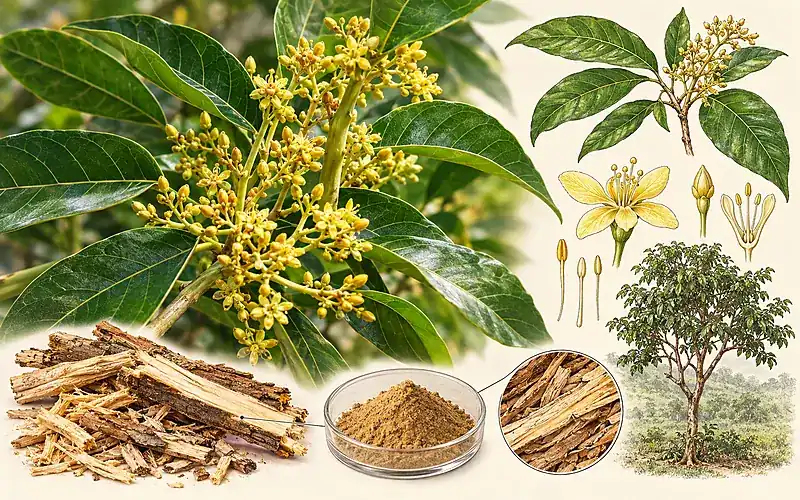
Names keep showing up: potency wood, marapuama, muirapuama, muiratam, pau-homen, and Potenzholz in German.
Two lookalikes are sold and why some people get no benefits:
- P. uncinatum Anselmino is used interchangeably. It has less lupeol, with no numbers attached.
- Liriosma ovata Miers is also sold as muira puama. Patents treat it as a stand-in, but whether it’s a true synonym is unresolved, and a 2005 herbal handbook says its chemistry differs.
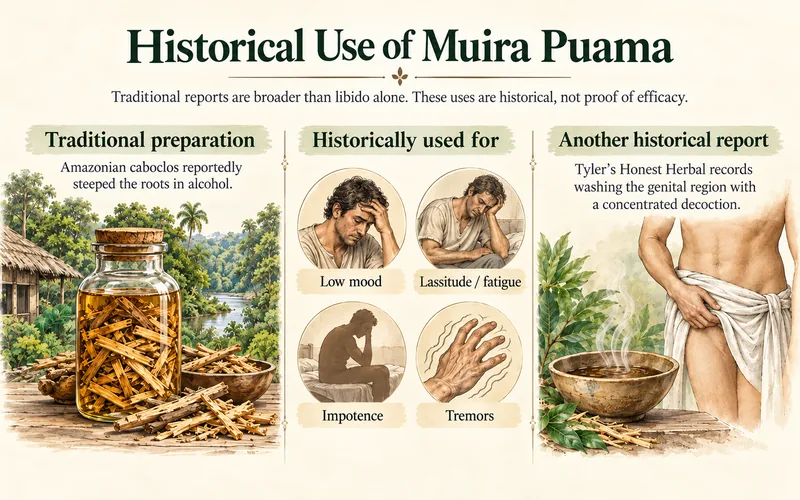
Traditional Use
European interest can be traced back to the 1930s when it was promoted as a male stimulant. Found in Brazils pharmacopoeia in 1956. The British Herbal Pharmacopoeia listed it for dysentery and impotence.
Muira puama bark or root: which part is used?
Muira puama bark and muira puama root aren’t the same. There’s a dissagrement on which part to use.
Tyler’s Honest Herbal names stem wood and root, a 2005 handbook names root and bark, Tian’s chemistry paper used bark, and Trindade’s extract used root.
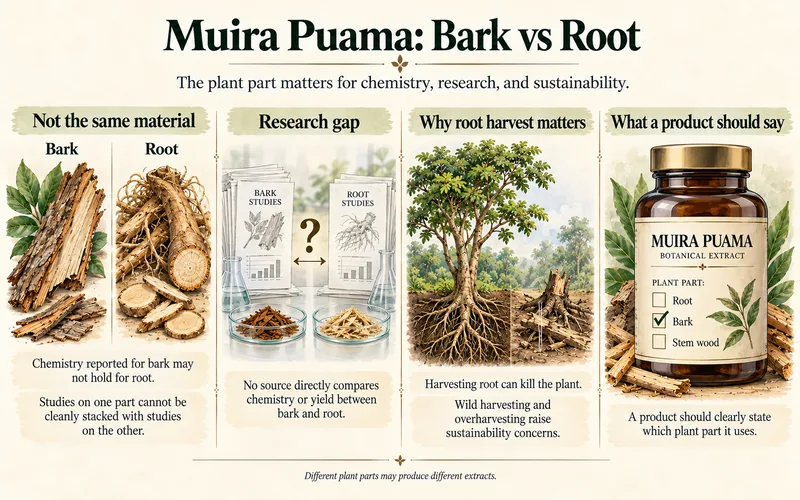
The plant is wild-harvested. Brazilian sources report overharvesting has reduced natural populations, and an Embrapa conference record is titled around a muirapuama “at risk of extinction”.
Extract types compared
| Form | Typical ratio | How taken | Notes |
|---|---|---|---|
| Tincture or fluid extract | 4:1 in older references | Drops or millilitres | Ethanol (or glycerin) extraction. Duke cites 4:1. No standardization data exist |
| Extract capsule | 4:1 to 10:1 on consumer labels | Swallowed, 250 to 500 mg per capsule | The most common form. The ratio is an input figure, not potency |
| Dry (spray-dried) extract | 10:1 up to 100–250:1 | Powder or capsule | A carrier is often added. One characterized extract used silica 1:1 |
| Raw powder | None | Capsules or tea | Lowest concentration. Substitution hides most easily here |
| Decoction (tea) | None | Simmered root or bark | Water only. Traditional, untested |
Muira puama tea: does a decoction count?
Muira puama tea is a decoction: root or bark simmered in water. It’s the oldest form. Brazilian sources describe infusions and medicinal baths from the root. Duke records one cup of root-bark decoction a day, with no cup size or bark weight given. Water gives a different extract from the ethanol ones in the patents. Nobody has tested tea for any effect.
What’s Inside
How to read it. Verified: confirmed in a primary paper. Plausible / Claimed: named in secondary sources only. Secondary / Unexplained: database-level or unexplained data. Not found / Unsourced: no source located.
| Compound or class | Status |
|---|---|
| Magnoflorine and menisperine (alkaloids) | VerifiedTogether 75.96% of the quantified analytes in bark |
| Flavonoids (luteolin and methylated quercetin types) | Verified |
| Phenolic acids (caffeic, ferulic, vanillic, syringic, protocatechuic) | Verifiedat most 1.04 mg/g in bark |
| Clerodane diterpenoids | VerifiedStructures verified. Two of four tested enhanced NGF-mediated neurite outgrowth in a cell line |
| Lupeol | PlausibleUsed as a reference compound, but no primary isolation paper was found |
| Behenic esters of lupeol and sitosterol | Claimedin a German lexicon, and in Tyler’s Honest Herbal as a 0.4–0.5% ester fraction. No primary paper seen, and Tyler’s own sentence is chemically ambiguous |
| Caffeine, theobromine, theophylline | UnexplainedFound in commercial samples. Source unexplained: plant, substitute or spiking |
| Muirapuamine | Not foundin PubChem, ChEMBL or PubMed. No structure, no isolation paper |
What the research shows
Every verified human study on record tested a blend, not muira puama alone.
| Study | Design | Product | Result | Main limit |
|---|---|---|---|---|
| 1Waynberg & Brewer, 2000 | Open, uncontrolled, 1 month, 202 women with low sex drive | Muira puama + ginkgo (“Herbal vX”) | 65% had higher total questionnaire scores | No placebo, self-reported, blend. A double-blind study was “planned.” None found |
| 2Nguyen, Rajfer & Shaheen, 2018 | Open pilot, 54 men with ED, 3 months | Ginger, muira puama, guarana, plus 1.6 g L-citrulline | Median erectile score rose from 16 to 21 at month 1, among completers | No control. About 70% dropped out by month 3. L-citrulline is a confound. Muira is roughly 125 mg of a 500 mg dose |
| 3Oliveira et al., 2005 | Open safety study, healthy adults, 28 days | Catuama (guarana, catuaba, muira puama, ginger) | No severe reactions or lab changes in the abstract | Multi-herb. Sample size not in abstract |
| 4Spanemberg et al., 2012 | Double-blind RCT, 72 patients, 8 weeks | Catuama | More symptom relief for burning mouth | Not a sexual or cognitive outcome |
| 5Chiavaroli et al., 2026 | Retrospective series, n=59, plus mouse tissue | Epilobium, muira puama, ginkgo and others | Better urinary and sexual outcomes in the abstract | Retrospective, non-randomized, many co-medications |
The 2018 pilot comes from a UCLA group that has published a whole series on the same blend. Two more of their studies are registered on ClinicalTrials.gov.
Muira puama benefits for men
Men take it for desire and erections. The support is the 54-man blend pilot above, plus unverified 1990s French reports covered below.
Muira puama benefits for women
The whole human record is the 202-woman survey above. With no placebo group, a benefit can’t be separated from the ginkgo or from expectation.
What about the “262 men” and “100 men” numbers?
You’ll see “262 men, 1 to 1.5 g a day, about 60% improved libido” attributed to Waynberg in 1994. The paper exists as a record (“Yohimbine vs. muira puama in the treatment of sexual dysfunction,” Am J Nat Med 1994;1:8–9). Its text couldn’t be retrieved. The numbers online come from retailer pages and disagree with each other.
A 2005 herbal handbook cites two French reports. One covers 262 men. The other covers 100 men on 1.5 g of extract a day, with 85% reporting more libido. Both are subgroup self-reports with no placebo, no blinding and no stated duration, cited from a 1990 conference talk and a 1995 item with incomplete details.
Does it raise testosterone?
No data say so. No human or animal study measuring testosterone, LH or FSH after muira puama alone turned up in PubMed. A 2025 rat preprint claims a rise, but it doesn’t describe the extract, contradicts itself on methods and isn’t peer reviewed.
Lupeol, a compound sometimes listed in the plant, inhibited androgen receptor activity in prostate cancer cells and mice. That’s a different setting and says nothing about people taking the plant. But it gives a testosterone claim no support. A docking study found eight muira compounds that fit estrogen receptors in a computer model. That’s a hypothesis, not a finding.
Can you trust the long lists of “actions”?
Often not, because they mix evidence of different strength. Duke lists 18 properties for lupeol, including antitumor, antiviral and antimalarial, and an anti-inflammatory activity of “1/3 indomethacin” with no assay stated. A property of an isolated compound doesn’t transfer to an extract holding an unknown amount of it. For scale, a topical Liriosma ovata extract ran about 8 times weaker than indomethacin in a mouse ear test.
The 2005 handbook’s hypotensive claim leans on a rabbit study of a different species, Liriosma ovata. Keep three categories apart: root-extract findings, historical whole-herb claims, and isolated-compound activities.
Evidence grade by claimed use
How to read it. Limited: some human data, but uncontrolled or in blends. None: no human data at all.
| Claimed use | Grade | What exists |
|---|---|---|
| Libido in men | Limited | Unverified 1990s reports and one uncontrolled blend pilot |
| Erectile function | Limited | Same pilot. 70% dropout, L-citrulline confound |
| Libido in women | Limited | One open, uncontrolled blend survey (n=202) |
| Testosterone | None | No verified human or animal data |
| Memory and cognition | None in humans | Mouse studies from one lab |
| Mood, stress, depression | None in humans | Mouse behavior tests, and one contrary anxiety result |
| Fatigue, hair loss, pain, cholesterol | None | Folk use, patents, blend studies |
| Neuroprotection | None in humans | Rat slices and cell lines |
Primary sources in Chinese, Russian, and some French and Japanese databases weren’t reachable, so they aren’t covered here.
Dosage: why sources disagree
You’ll find five or more dose figures online. They look like they contradict each other. They don’t, because each describes a different preparation.
How to read it. Unverified: no primary text found. Derived / Secondary: calculated or copied from another source. Patent / Blend / Historical: not a single-herb trial dose.
| Source | What it says | Caveat |
|---|---|---|
| Natural Medicines, via WebMD and RxList | 500–1,050 mg a day for up to one month, “possibly safe” | SecondarySecondary mirror. No dose range established |
| Examine.com | 1,000–1,500 mg of a 4:1 extract | DerivedDerived from rodent doses |
| Waynberg, 1994 | 1–1.5 g a day | UnverifiedUnverified. Text not retrieved |
| Taisho patent | 50–1,500 mg a day (10–5,000 mg as the outer range) | PatentA drafting range for a combination, not a trial result |
| Revactin pilot | About 125 mg inside a 500 mg blend | BlendFour ingredients. L-citrulline is the larger part |
| 2005 herbal handbook | 2–4 mL of a 4:1 tincture, twice daily. 1.5 g of extract daily in a 100-man French report | HistoricalHistorical description, not a medical recommendation |
| Duke, 2009 | Fluid extract 15–25 drops, 2–3 times a day. Liquid root extract 2–4 mL or 0.5–5 mL. One cup of root-bark decoction daily | HistoricalDroppers and cups aren’t specified. No mg of dry extract anywhere |
Why no dose is established
The human studies are blends, so a muira dose can’t be isolated. The extracts differ, so 1.5 g of one study extract, 2–4 mL of a tincture and a 4:1 capsule aren’t shown to be equivalent. The best-known single-herb figure can’t be traced to a primary paper, and the only controlled-design data are animal doses, which don’t convert. Duke’s entry has no dose in mg of dry extract, no solvent percentage and no standardized lupeol percentage. So nobody, this article included, can give you a number backed by high-quality human research.
Label rule
Follow the product label and check with a clinician before you start, especially if you take medication or have a health condition. If you try it anyway, keep the trial short. The only dose figure here with a time frame, from Natural Medicines, covers one month.
Muira puama side effects and safety
There’s little safety data, and that’s different from showing the plant is safe.
- What was observed in people. A 28-day Catuama study reported no severe reactions or lab changes. In the Revactin pilot, 5 of 54 men reported mild dyspepsia, heartburn or migraine.
- Reassuring-sounding ratings. Duke gives it his “++” rating, roughly “as safe as coffee,” and cites an American Herbal Products Association class 1 rating, but calls the symbol subjective. The 2005 handbook lists “none reported” for cautions, based on what was known then. Tyler’s Honest Herbal rated safety inconclusive.
- A flag from the other side. As of July 2007, the FDA Poisonous Plant Database held two titles referring to possible toxicity of this species. Duke doesn’t identify them. That proves nothing, but it can’t be skipped either.
- Not found: pharmacokinetics, chronic toxicity, liver or kidney studies, genotoxicity, and any pregnancy or breastfeeding data. Brunetti’s 2020 review concluded that most herbal sexual enhancers appear safe at normal doses, with drug interactions and unstandardized products as the bigger worry. Whether muira puama is among the plants covered couldn’t be confirmed.
Is it safe in pregnancy or while breastfeeding?
Safety isn’t established. WebMD and the Natural Medicines database advise avoiding it. No data means no data. It isn’t evidence of harm, and it isn’t permission.
Who should talk to a doctor first?
Anyone on medication or with a health condition. Persistent erectile problems can signal cardiovascular disease or diabetes, and herbal references say so directly. A capsule isn’t a diagnosis.
What about interactions?
Nothing has been tested in people. These concerns are theoretical, but they follow from animal data:
- Cholinesterase inhibitors such as donepezil. Oral doses inhibited acetylcholinesterase in mouse brain, so stacking is a concern in principle.
- Antidepressants and other mood medication. The antidepressant-like effect in mice involved catecholamine pathways.
- Yohimbine. In Duke’s experiment the extract increased yohimbine-associated lethality in the animal model. No safe interval is known.
- PDE5 inhibitors. Seven patients in the 2026 blend series were on them, but no interaction was assessed.
- Blood pressure drugs. The hypotensive claim is weak, so treat this as an open question, not a documented effect.
How to choose a muira puama extract
See our recommendation at the beginning if you want the real thing.
| Check | What you want | Why |
|---|---|---|
| 1Botanical name | Ptychopetalum olacoides (or P. uncinatum) on the label | “Muira puama” or “marapuama” alone is ambiguous, because a Croton is sold under that name in Brazil |
| 2Plant part | Root, or root and stem bark, stated | Sellers disagree on it |
| 3Solvent | Water, ethanol, or a water-ethanol mix | Documented in the patents and the one characterized lab extract |
| 4Extract ratio | Milligrams of extract per capsule, with the ratio | A ratio is input herb, not strength |
| 5Marker | A named marker such as magnoflorine or menisperine | Almost no consumer label gives one |
| 6Third-party testing | A named lab, or a seal like NSF Contents Certified or USP Verified | “Third-party tested” with no lab named means little. An “NSF certified facility” isn’t a certified product |
| 7Certificate of analysis | A batch COA with identity, heavy metals and microbes | No muira-specific contamination data exist, so the COA is your only check |
| 8Blends | Every ingredient amount disclosed | A proprietary blend can hide a token amount |
Which form is best?
No form has trial support, so this ranks quality, not proven effect. Best documented is an ethanol-water root extract with species, plant part, named marker and batch COA, and no consumer product found meets all of it.
The same without a marker is acceptable if the seller supplies a COA with identity testing. A tincture has unknown potency. Plain powder is weakest, because it’s the lowest concentration and the easiest place for a substitute to hide. Skip proprietary blends, ratio-only labels, “clinically proven” with no citation, and prices far below raw-material cost.
Which marketing claims should you ignore?
| Claim | Verdict | What the record shows |
|---|---|---|
| “Clinically proven to boost libido” | No proof | Proof needs a controlled trial of muira puama alone. None was found |
| “Boosts testosterone” | No data | No verified human or animal hormone data. Lupeol blocks androgen receptors in cancer models |
| “20:1 is twice as strong as 10:1” | Unsupported | No paper links a ratio to marker content |
| “Contains muirapuamine” | Unverifiable | The compound can’t be found in chemistry databases |
| “Used for centuries, so it’s safe and effective” | Not evidence | Traditional use shows interest, not efficacy |
| “Natural, so no side effects” | Misleading | Safety data are close to absent, which isn’t reassuring |
Muira puama and damiana, maca root or ashwagandha: what’s been tested?
People stack muira puama with other herbs. Here’s what the research holds for each pairing.
| Pairing | What exists | Verdict |
|---|---|---|
| Muira puama and damiana | A 1999 Dutch patent (NL1011082C2) combines the two and cites the Taisho patent. No trial | Patent only |
| Muira puama and maca root | Maca has one small RCT (n=50) in a review of herbal erectile-dysfunction trials, with a “very preliminary” positive result. No study pairs it with muira puama | No combo data |
| Muira puama and ashwagandha | Ashwagandha alone shows a positive testosterone signal in one review and lower cortisol in a 23-RCT meta-analysis. No study pairs it with muira puama | No combo data |
| Damiana and blue lotus tea | Nothing in the research covers this pairing, with or without muira puama | No data |
Stacking multiplies the unknowns. Muira puama alone has no established dose and no interaction data, so a mix has neither. Even the blends that were studied, Catuama and Revactin, couldn’t separate muira puama’s contribution from the other ingredients.
Damiana and blue lotus together, as tea or any other form, aren’t covered by anything here. For the lotus half, see our blue lotus guide.
Muira puama extract vs muira puama and catuaba
Plain muira puama is the root, bark or wood. The extract is a processed form of it. They aren’t interchangeable, because processing changes what you get and the label may not tell you how.
Catuaba is a different tree, often paired with muira puama. The papers call it T. catigua. Catuaba bark and catuaba extract are sold on their own too, but none of the trials above tested catuaba alone. The Brazilian herbal product Catuama combines guarana, catuaba, muira puama and ginger, so a Catuama result belongs to the blend.
Take the one catuaba finding in this research. Catuama reverted ventricular fibrillation in an isolated rabbit heart, and the authors credited mainly T. catigua. That’s tissue work with no bearing on catuaba benefits in people. A 2024 review of Brazilian plants for male sexual dysfunction also notes adulteration of catuaba and calls for standardization, so substitution isn’t unique to muira puama. No source covers catuaba and damiana together.
Read the full comparison in our muira puama vs catuaba guide.
Muira puama extract FAQ
What is muira puama extract used for?
People take it mostly for libido, erectile function and energy. That’s the traditional use, and the human evidence behind it is limited to blends and uncontrolled reports. Older sources also list nervous weakness, mood, memory and hair loss, but those rest on folklore and mouse studies.
How much muira puama extract should I take?
No dose is established by high-quality human research. Sources give anything from about 125 mg inside a blend to 1,500 mg a day, and each figure describes a different preparation. Follow the product label and check with a clinician, especially if you take medication.
Is muira puama extract safe?
Nobody knows well. A 28-day study of a blend reported no severe reactions, and 5 of 54 men in a blend pilot had mild stomach or migraine complaints. But chronic toxicity, liver, kidney and pregnancy data don’t exist, and the plant is sometimes substituted. Avoid it during pregnancy and breastfeeding.
How long does muira puama take to work?
No source establishes a timeline. The blend trials checked results at one month, and the men’s pilot at one, two and three months. The 1990s reports of fast effects can’t be verified. If you try it, keep the trial short and stop if side effects appear.
Is muira puama extract better as a powder or capsule?
A capsule is a container, not an ingredient, so the real question is extract versus raw powder. Powder is the lowest concentration and the easiest place to hide a substitute. One herbal handbook argues alcohol extraction releases more of the active compounds, but no trial compares them. Choose on label quality: species, plant part, solvent and a batch COA.
Sources
Retrieved as abstracts, pages or patent records during research. Most were read at abstract level only. Prices and product pages are point-in-time (11 October 2026).
- Drugs.com. Muira puama. https://www.drugs.com/npp/muira-puama.html
- WebMD / Natural Medicines database (as mirrored by WebMD and RxList). Muira puama.
- Waynberg J, Brewer S. Effect of Herbal vX on libido and sexual activity in premenopausal and postmenopausal women. Adv Ther 2000;17(5):255–62. PMID 11186145.
- Nguyen S, Rajfer J, Shaheen M. Safety and efficacy of daily Revactin in men with erectile dysfunction: a 3-month pilot. Transl Androl Urol 2018;7(2):266–73. doi:10.21037/tau.2018.03.22
- Oliveira CH et al. Clinical toxicology study of Catuama. Phytother Res 2005. PMID 15798997.
- Spanemberg JC et al. Catuama for burning mouth syndrome. Oral Surg Oral Med Oral Pathol Oral Radiol 2012. PMID 22669143.
- Chiavaroli A et al. Retrospective series of an Epilobium, muira puama and ginkgo supplement. Phytother Res 2026. doi:10.1002/ptr.70438
- ClinicalTrials.gov. NCT05595915; NCT07469475.
- Siqueira IR et al. Anticholinesterase activity of Ptychopetalum olacoides. Pharmacol Biochem Behav 2003;75(3):645–50. PMID 12895682.
- Figueiro M et al. Acetylcholinesterase inhibition in brain areas after oral P. olacoides. Phytomedicine 2010;17(12):956–62. doi:10.1016/j.phymed.2010.03.009
- Figueiro M et al. Aβ1-42 mouse model. Phytomedicine 2011;18(4):327–33. doi:10.1016/j.phymed.2010.07.013
- da Silva AL et al. Memory retrieval in adult and aged mice. J Ethnopharmacol 2004;95:199–203. doi:10.1016/j.jep.2004.07.019
- da Silva AL et al. MK801 and scopolamine amnesia. Psychopharmacology 2008;202:165–72. doi:10.1007/s00213-008-1272-y
- da Silva AL et al. Anxiogenic properties of P. olacoides. Phytother Res 2002;16(3):223–6. PMID 12164265.
- Piato AL et al. Antidepressant profile. Phytother Res 2009;23(4):519–24. doi:10.1002/ptr.2664
- Piato AL et al. Chronic mild stress. J Ethnopharmacol 2008;118(2):300–4. doi:10.1016/j.jep.2008.04.018
- Siqueira IR et al. Oxygen-glucose deprivation in hippocampal slices. Life Sci 2004. doi:10.1016/j.lfs.2004.06.001
- Siqueira IR et al. Pharmacological properties of Ptychopetalum olacoides. Pharm Biol 1998;36(5):327–34 (as described in Duke 2009).
- Duke JA, Bogenschutz-Godwin MJ, Ottesen AR. Duke’s Handbook of Medicinal Plants of Latin America. CRC Press, 2009, pp. 587–588.
- Taylor L. The Healing Power of Rainforest Herbs. Square One, 2005, pp. 47–50, 136–137, 353–356, 496.
- Foster S, Tyler VE. Tyler’s Honest Herbal, 4th ed. Haworth Herbal Press, 1999, pp. 263–264, 410–411.
- Tian X et al. Qualitative and quantitative analysis of chemical constituents of P. olacoides. Nat Prod Res 2018;32(3):354–7. PMID 28750557.
- Tang W et al. Clerodane diterpenoids from P. olacoides. J Nat Prod 2008;71(10):1760–3 (PMID 18821798); Bioorg Med Chem Lett 2009;19(3):882–6 (PMID 19095451); Nat Prod Commun 2011;6(3):327–32 (PMID 21485268).
- Trindade EP et al. Laboratory-scale preparation and characterization of dried extract of muirapuama. Molecules 2020;25(5):1095. doi:10.3390/molecules25051095
- Novello CR et al. Morphoanatomy and pharmacognostic study of the wood of Croton echioides, the Northeastern Marapuama. Rev Bras Farmacogn 2012;22(5). https://www.scielo.br/j/rbfar/a/wPsqfPtnRSBZfHX8388Rr7d/
- Siddique et al. Lupeol and androgen receptor in prostate cancer models. Clin Cancer Res 2011. doi:10.1158/1078-0432.ccr-11-0916
- Hanawa M, Kitajima H, Tsunoda K (Taisho). US Patent 6,024,984, 2000. https://patents.google.com/patent/US6024984
- Taisho Pharmaceutical. WO1994002160A1, “Tonic.” https://patents.google.com/patent/WO1994002160A1/en
- Cherksey BD. US Patent 5,516,516, 1996. https://patents.google.com/patent/US5516516
- Durmaz et al. Molecules 2022;27:5902 (doi:10.3390/molecules27185902); Naldi et al. Molecules 2021;26:4376 (doi:10.3390/molecules26144376).
- Ichim MC, Booker A. Chemical authentication of botanical ingredients: a review of commercial herbal products. Front Pharmacol 2021.
- ANSM. Liste B des plantes médicinales utilisées traditionnellement, January 2023, p. 11.
- Segovia JFO et al. A muirapuama sob risco de extinção. Embrapa Amapá, 2001; Portal Amazônia, “Marapuama.”
- Borrelli F et al. Herbal products for erectile dysfunction. Drugs 2018. doi:10.1007/s40265-018-0897-3
- Leisegang et al. Tongkat ali and testosterone meta-analysis. Medicina 2022;58:1047. doi:10.3390/medicina58081047
- Suharyani et al. Tribulus meta-analysis. Int J Impot Res 2026. doi:10.1038/s41443-025-01086-7
- Wibowo et al. Yohimbine meta-analysis. Turk J Urol 2021. doi:10.5152/tud.2021.21206
- Smith et al. Herbal supplements and testosterone. Adv Nutr 2021. doi:10.1093/advances/nmaa134
- Brunetti P et al. Adverse effects of herbal sexual enhancers. Pharmaceuticals 2020;13(10):309. doi:10.3390/ph13100309
- Examine.com. Muira puama. https://examine.com/supplements/muira-puama/
- Mendes FR, Carlini EA. Brazilian plants as possible adaptogens. J Ethnopharmacol 2007. doi:10.1016/j.jep.2006.08.024
- Searches of PubChem, ChEMBL and PubMed for “muirapuamine,” 11 October 2026; Inverma Johannes Lange wood dry extract specification, via GNH India.
- Powers CN, Setzer WN. Molecular docking of phytochemical estrogen mimics. In Silico Pharmacol 2015. doi:10.1186/s40203-015-0008-z
- Adeyemi AK et al. bioRxiv preprint, 2025, doi:10.1101/2025.09.21.677620 (not peer reviewed); Ajao J et al. Acta Bioscientia 2025;1(1):22–9, doi:10.71181/actabioscientia12140.
- Colombo R et al. Validated HPLC method for standardisation of P. olacoides commercial extracts. Rev Bras Farmacogn 2010;20(5):781–8.
- Picerno P et al. Isoprenoid glycosides from Liriosma ovata. J Nat Prod 2008;71:265–8. doi:10.1021/np0704405
- Teixeira TM et al. Brazilian plants for male sexual dysfunction. J Ethnopharmacol 2024. doi:10.1016/j.jep.2023.116876
- Catuama and rabbit corpus cavernosum. Phytother Res 2001. doi:10.1002/ptr.861
- FDA MedWatch. https://www.fda.gov/medwatch
- Ferrini et al. Nitric Oxide 2018, doi:10.1016/j.niox.2018.03.010; Sex Med 2025, doi:10.1093/sexmed/qfaf001.
- Waynberg J. Yohimbine vs. muira puama in the treatment of sexual dysfunction. Am J Nat Med 1994;1:8–9 (citation record only; text not retrieved).