
One of the scientists who discovered MOTS-c told the Los Angeles Times in August that tens of thousands of people are injecting it, and that he strongly objects.1
“Turns out that tens of thousands of people are injecting themselves with MOTS-c… I strongly object to that.”
Pinchas Cohen, USC, Los Angeles Times, August 18, 2026
Cohen co-discovered the peptide. He says he would rather see it quality-controlled and prescriber-supervised, and his own effort to develop it as a drug has stalled. He also has a stake in the answer. CohBar, the company that developed the analog discussed below, describes him as its founder,2 and ideally he wants an FDA-approved version.1
That is an unusual thing for a discoverer to say about his own molecule. Here is what the evidence gives you to weigh his objection against, from what MOTS-c is to where the FDA stands as of October 2026 and what could go wrong. Every health claim carries a grade.
Status: Not FDA-approved. Not on the FDA’s compounding list.
Evidence: Animal and cell studies. No completed human trial of MOTS-c itself.
Main risks and unknowns: Injection-site reactions in the one analog trial, unverified reports of severe allergic reactions, unknown long-term safety and cancer effects, product quality.
Not for: Under 18 · tested athletes · pregnancy.
On this page
What Is MOTS-c?
Most proteins are built from instructions in the DNA inside the cell nucleus. This one comes from the small genome inside mitochondria, the structures that turn food into cellular energy. Cells translate a 51-base-pair stretch of the mitochondrial 12S rRNA gene into the 16-amino-acid peptide.3 Researchers call peptides like it mitochondrial-derived peptides. Humanin is another.
Is the peptide real, or an artifact of a nuclear copy of mitochondrial DNA? The discovery paper tested that. No nuclear copy matched fully, rats have none, and removing mitochondrial DNA or RNA erased the signal.3 What stays open is how the transcript leaves the mitochondrion and how cells regulate it.3, 4
How Does MOTS-c Work?
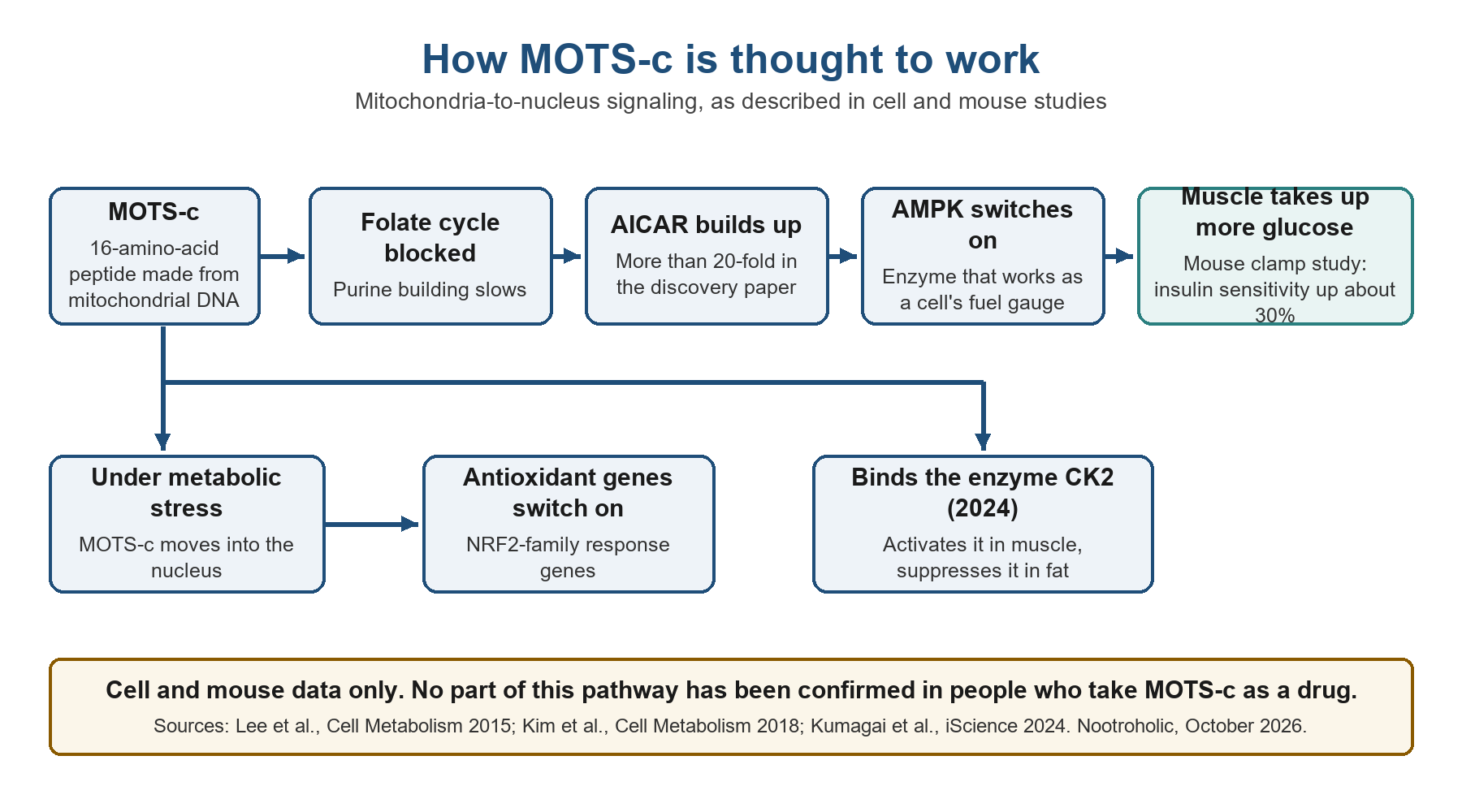
In cell and mouse studies, MOTS-c blocks the folate cycle and purine building. AICAR piles up (more than twentyfold in the discovery paper), and AICAR switches on AMPK, an enzyme that works as a cell’s fuel gauge.3 AMPK explains only part of the effect. In cell experiments, knocking it down cut the response by 30 to 40 percent, and a second pathway through SIRT1 is also involved.3
Under metabolic stress, MOTS-c travels to the nucleus and switches on antioxidant-response genes of the NRF2 family.5 In 2024, researchers named its first direct binding partner, the enzyme CK2, which MOTS-c activates in muscle and suppresses in fat.6 In a seven-day mouse clamp study, the glucose infusion rate needed to hold blood sugar steady rose about 30 percent while the liver’s own glucose output did not change, which points to muscle as the main target.3
Researchers call MOTS-c an “exercise mimetic” because it reproduces some effects of exercise in mice. Read that as a hypothesis. No human trial has shown it, and no cell-surface receptor has been identified, so pages that talk about “receptor desensitization” have no receptor to point to.3, 5
MOTS-c, Exercise, Aging and Metabolism
Does exercise raise MOTS-c?
In a 2021 Nature Communications study, ten sedentary young men did ten one-minute maximal cycling intervals. MOTS-c in their muscle rose about 11.9-fold. Blood levels rose about 1.5 to 1.6-fold and were back to baseline within four hours.7 That is the peptide your own body makes, not an injection, and the study is small and all young men. Adults with cerebral palsy had normal baseline levels and no or only modest change after running, so the rise is not universal.8 Grade: Human, small.
Does MOTS-c fall with age?
Blood levels fall with age. Muscle levels move the other way: muscle MOTS-c is about 1.5 times higher in older men.4 A low reading in blood does not tell you what is happening in the tissue.
Is MOTS-c low in obesity?
The direction is contested, with studies reporting lower, unchanged and higher levels. In a 2025 Mayo Clinic study co-authored by Cohen, people with obesity had higher levels (273 versus 223 pg/mL), and levels did not change six months after bariatric surgery. The authors suggested a compensatory response.9 That cuts against the common pitch that you are low and need more.
Can a blood test measure it?
Not reliably yet. A WADA-accredited lab in Cologne built a validated mass-spectrometry method and found that ELISA “normal” values of 45.9 to 218.5 ng/mL “could not be confirmed by LC/MS.”10 Published “normal” values range from about 0.48 ng/mL in one study to about 560 ng/mL in another.11, 12 A “test your MOTS-c level” offer has no agreed baseline to compare against.
What does a gene variant say about it?
A variant common in East Asian populations (m.1382A>C, called K14Q) changes the peptide. It appears in 6.5% of sprint and power athletes, 5.1% of controls and 2.9% of endurance athletes, and men who carry it had higher leg torque.13 In a meta-analysis of 27,527 people, men who carried it and were the least physically active had more type 2 diabetes.14 Grade: Human, observational. It shows the peptide matters to muscle biology. It does not show that adding more helps.
MOTS-c Benefits: The Evidence Ladder
Not every benefit claim stands on the same rung. “Animal” means mouse or rat unless stated.
| Claim | Grade | What it shows | Our read |
|---|---|---|---|
| Better insulin sensitivity, less diet-induced obesity | Animal | In mice on a high-fat diet, MOTS-c prevented obesity and high insulin at equal food intake.3 | Plausible in mice. Untested in people. |
| More exercise capacity | Animal | In young mice, only the higher of two tested doses improved running, and only after ten days. Old mice on the higher dose ran about twice as long.7 One injection raised untrained mice’s run time by 12%.15 | Plausible in mice. No human trial. |
| Longer life | Animal | Treatment started late in life produced a borderline survival effect (p = 0.05).7 | Not shown. |
| Less muscle wasting | Animal | Less atrophy and fat infiltration in mice with an immobilized limb.16 | Early. One lab. |
| Stronger bones | Animal | Less bone loss in ovariectomized mice.17 One MOTS-c bone paper has been retracted.18 | Weak. |
| Heart protection | Animal | Smaller infarct size in isolated rat hearts.19 Less heart enlargement in diabetic rats.20 | Early. Few labs. |
| Memory and brain effects | Animal | Injected MOTS-c does not cross the blood-brain barrier. The mouse memory benefit needed injection into the brain, or an engineered analog given through the nose.21 | Not supported for native MOTS-c. |
| Works as a pill | Animal | Oral MOTS-c “did not result in any significant improvements” in a head-to-head test with injection. Only an engineered analog worked orally.22 | Not supported. |
| Weight loss in people | Human, small (analog) | The analog CB4211 produced a weight trend that did not reach significance in 11 treated adults.23, 24 | No data for MOTS-c itself. |
| Less liver fat in people | Human, small (analog) | Liver fat fell 5.03% on the analog and 4.88% on placebo.23, 24 | No benefit over placebo. |
| Longer or healthier life in people | None | No human lifespan or healthspan data exist. | Unsupported. |
A mouse result is a reason to run a human trial, not a reason to expect the same result in you. No one has published how MOTS-c moves through a human body.25
Immune and Antibacterial Findings
MOTS-c also acts as a cationic host-defence peptide. It killed E. coli and MRSA in lab tests and neutralized MRSA infection in a mouse model of peritonitis.26 That is cell and mouse data. It says nothing about whether taking MOTS-c helps or disturbs immunity in a person.
Human Trials: What Exists Now
Two human programs matter, and neither is a completed trial of native MOTS-c. A registry search on October 17, 2026 found no other trial giving a MOTS-c-family peptide as a treatment. The other entries that mention MOTS-c only measure it in the blood.27, 28
CB4211: an analog, not MOTS-c
CohBar’s CB4211 is what its maker called a “novel and improved analog of MOTS-c.” The changes were never published, so it is a different molecule.23 The registered Phase 1a/1b trial (NCT03998514) enrolled 88 people and finished in April 2021. The registry has posted no results.27
Phase 1a, healthy volunteers. The company’s slides report:24
- Injection-site reactions were the most common side effect: 79% of people on the drug and 33% on placebo. The company called them mostly mild to moderate and reported no serious adverse events.
- The drug lingered under the skin. In the company’s words: “Persistent local deposition of drug at injection site led to interruption of study to modify formulation.” The study paused, the formulation was reworked, and later cohorts used the new version.
- Pharmacokinetic data were listed as “pending” and never appeared. No antibody results were ever reported.27
Phase 1b, obese adults with fatty liver. Participants took CB4211 for four weeks (11 people) or placebo (9). The company’s own results:24
- Liver fat fell 5.03% on the drug and 4.88% on placebo. The company wrote that liver fat “was reduced substantially in both active and placebo arms.”23
- Liver enzymes and glucose improved: ALT fell 21% (placebo rose 4%), AST fell 28% (placebo fell 11%) and fasting glucose fell 6% (placebo 0%).
- Weight showed a trend toward reduction that did not reach statistical significance.
What happened next is public record. In its first-quarter 2023 filing, CohBar said the Phase 1b formulation was not considered suitable for further development and that “efforts to develop an improved formulation have not been successful to date.”29 In November 2023 it said its planned merger had been terminated and that it intended to start liquidating the company.30
Grade: Human, small, company-reported, analog. With 11 treated people in the efficacy phase, none of this is a verdict on MOTS-c. It is the only human data any MOTS-c-family drug has produced.
MOTS-MET: the first trial of the real peptide
According to ClinicalTrials.gov (NCT07505745), MOTS-MET is a Phase 2a randomized, double-blind, placebo-controlled trial of MOTS-c in 120 adults aged 18 to 65 with prediabetes and a body mass index of 27 to 40. Hudson Biotech sponsors it at one site, Peking University Shenzhen Hospital. Participants receive MOTS-c or placebo by injection for 12 weeks. The main outcomes are insulin sensitivity (the Matsuda index) and adverse events, with follow-up to 16 weeks. A secondary outcome is anti-drug antibodies, which would be the first such data for any MOTS-c molecule. The trial excludes anyone who used metformin, a GLP-1 drug or an SGLT2 inhibitor in the past three months.28
It started February 2, 2026. Primary completion is estimated for February 14, 2027. The record was last updated April 1, 2026, and it does not state the amount given.28 Until it reports, there is no human result for MOTS-c itself.
Is MOTS-c Legal and FDA Approved?
Short answer: no FDA approval, no place on the FDA’s compounding list, and a regulatory picture that changed several times this year. This page does not give legal advice. Status as of October 17, 2026:
| Date | What happened |
|---|---|
| Sept 29, 2023 | FDA puts MOTS-c on its 503A Category 2 list of substances with significant safety risks.31 |
| Jan 1, 2025 and Jan 1, 2026 | The WADA Prohibited List names MOTS-c as an AMPK activator under S4.4.1, prohibited at all times.32, 33 |
| April 2026 (reported April 16) | FDA announces 12 peptides, including MOTS-c, are leaving Category 2 because their nominations were withdrawn. This is not a safety finding and it is not approval.34, 35 |
| May 11, 2026 | FDA’s briefing memo proposes not adding MOTS-c or MOTS-c acetate to the 503A Bulks List. Its reasons include a lack of human safety data and immunogenicity risk.25 |
| July 23, 2026 | FDA’s advisory committee votes 7 yes, 5 no, 2 abstaining to recommend it, for obesity and osteoporosis uses. The vote is non-binding.36 |
| Aug 24, 2026 | FDA sends five warning letters to online peptide vendors. A “research use only” label did not outweigh evidence of human use. We found none naming MOTS-c.37 |
| Oct 14, 2026 | An “Interim Access Policy for Compounding Using Certain Peptides” (RIN 0910-ZD94) reaches the White House budget office. It is not issued, and its peptide list is not public, so no one can say yet whether MOTS-c is on it.38 |
| Oct 17, 2026 | No proposed rule is in the Federal Register. The next formal step is notice-and-comment rulemaking, possibly in 2027 or later.36, 37 |
The vote was split. FDA staff recommended against listing MOTS-c, and the advisory committee backed it anyway. The vote is advice, and the agency has not acted.25, 36
What “research use only” means
The label places a substance in the category of lab reagents, not medicines for people. Sellers use it, and many clinics advertise “compounded” MOTS-c anyway. The US Anti-Doping Agency states that “during the evaluation process, there is no legal basis to include MOTS-c in any compounded medication.”39 Holland & Knight, a law firm, writes that the interim policy “has not been issued, so none yet authorizes compounding.”37 If a clinic tells you its MOTS-c is legally compounded, ask which FDA document says so.
Other countries and sport
Australia’s TGA warned in April 2026 about unapproved peptides (MOTS-c was not named).40 A June 2026 injunction in Québec barred the sale of unauthorized injectable peptides.41 In sport, MOTS-c is prohibited at all times, USADA says no therapeutic-use exemption is available, and a WADA-accredited mass-spectrometry test exists.39, 10 Some pages label it S2. The WADA list places it in S4.4.1.33
Side Effects and Safety Concerns
Nobody can call MOTS-c safe, because no one has run the studies that would show it. What exists is a set of signals of different strength, each graded.
Can MOTS-c cause cancer?
Nobody knows. No study shows that MOTS-c causes tumors, and none shows it is safe for someone with cancer. The signals point both ways. In a mouse ovarian cancer model, MOTS-c had anti-tumor effects.42 It works partly through NRF2, a pathway that protects healthy cells and can also help established tumors survive. A 2026 lung review noted preliminary reports of higher MOTS-c in lung cancer and said they need validation.43 Grade: Animal and cell. If you have a cancer history, this is a question for your oncology team.
Injection-site reactions
The analog trial’s healthy-volunteer phase saw reactions in 79% of people on the drug versus 33% on placebo, and a pause for a new formulation (details above). The Alzheimer’s Drug Discovery Foundation reports that mitochondrial peptides “tend to persist at the injection site.”44 Grade: Human, small (analog).
Allergic reactions
The most-engaged MOTS-c threads on Reddit describe hives and, in a few posts, anaphylaxis, sometimes after a first injection and sometimes months into use. These are unverified anecdotes and cannot show cause. They do match a concern FDA wrote down. Its Category 2 rationale said compounded MOTS-c “may pose significant risk for immunogenicity,” and its briefing memo said it lacked information “to assess its immunogenic safety risk.”35, 25 MOTS-MET plans to measure antibodies, which no MOTS-c study has reported yet.28 Hives, throat tightness or trouble breathing after any injection means emergency care. Grade: Anecdote, plus a regulator’s stated concern.
Heart rate, sleep and fever
USADA lists effects reported by people who say they bought MOTS-c online: faster heart rate or palpitations, injection-site irritation, insomnia, local or whole-body immune reactions and fever.39 In one rat study MOTS-c lowered resting heart rate, so the rat data and the user reports disagree.45 Grade: Anecdote versus Animal.
Blood sugar and GLP-1 drugs
Some people combine MOTS-c with GLP-1 drugs such as retatrutide, and a few posts describe night-time lows recorded on a continuous glucose monitor. These are anecdotes. They are plausible, because MOTS-c raises insulin-independent glucose uptake in mouse muscle.3 MOTS-MET excludes anyone who recently used a GLP-1 drug, metformin or an SGLT2 inhibitor.28 Metformin also works through AMPK, yet it did not change circulating MOTS-c in a randomized comparison.46
Inflammation and aging cells
A 2018 review reported that MOTS-c and humanin amplified inflammatory signals (IL-6, IL-1β, IL-8, TNF-α) from senescent cells.47 In 2026, MOTS-c blunted the repair ability of human stem-like stromal cells, including cells from healthy donors.48 Grade: Cell and Animal. They argue against the idea that more MOTS-c is simply better.
Is the vial real?
Of 83 MOTS-c samples listed by Finnrick, a public testing aggregator, between February and October 2026, 27 passed, 53 failed and 3 were incomplete. Its standard is strict: purity of at least 99.5% and an amount within 35% of the label.49 A fail is not the same as dangerous, and the data come from one aggregator. FDA noted that most public certificates of analysis report purity only, with no endotoxin data, and that MOTS-c contains two methionines that oxidize, so oxidized material can still test as pure.25, 49 A certificate answers one question. Read our guide to what a COA can and cannot prove before you trust one.
FDA’s adverse-event database held no MOTS-c reports through March 2025.25 Absence of reports is not evidence of safety.
Is There an Official MOTS-c Dose?
No. FDA’s briefing document found no human studies of MOTS-c by any route, and USADA says there are “no completed human clinical trials.”25, 39 MOTS-MET’s registry entry lists how long people take it but not how much.28
So every number you see online comes from one of four places: a mouse or rat study, a different molecule (the analog), a clinic’s marketing, or forum convention. None is a studied human dose. One highly ranked page cites a “Phase I” trial for its figures, and the reference behind it is a review of resveratrol. We do not publish a number, because no trial supports one, and this page is not a guide to using an unapproved compound.
Take the registry entry (NCT07505745) and this page to a licensed clinician and ask what evidence exists for this compound in a person like you. A clinician who cannot cite a human trial is giving an opinion, and you are entitled to know that.
MOTS-c vs Other Peptides
People compare MOTS-c with drugs that share its vocabulary: mitochondria, metabolism, energy. This table puts them on the same dimensions.
| Compound | What it is | FDA status | Best human evidence | How it overlaps with MOTS-c |
|---|---|---|---|---|
| MOTS-c | Peptide made from mitochondrial DNA | Not approved. Not on the compounding list. | None completed for native MOTS-c. One analog trial, paused for a new formulation. | n/a |
| Semaglutide | GLP-1 receptor agonist | Approved medicine | Human RCT: about 15% mean weight loss at 68 weeks (STEP-1)50 | Often discussed together for weight and energy. Different mechanism. Some users report low blood sugar when combined (anecdote). |
| SS-31 (elamipretide) | Peptide drug that targets mitochondria | Approved for Barth syndrome only | The trials behind that single approval | Marketed together as “mitochondrial peptides.” No study tests combining them. |
| Humanin | Another peptide from mitochondrial DNA | Not covered on this page | Not reviewed here | Cell data suggest it amplifies inflammatory signals from aging cells, as MOTS-c did.47 |
| Tesamorelin | Prescription peptide drug | Approved for HIV lipodystrophy only | Approval trials for that condition | Appears in forum “stacks” with MOTS-c. No shared mechanism or study. |
A shared word (“peptide”) lends the trust earned by approved drugs to compounds without it. Ask of any compound which of four things it is: an approved medicine for its indication, an approved medicine for something else, a compounded product, or an investigational compound with early evidence. MOTS-c is the last. For more on this family, see our overview of mitochondrial peptides.
Who Should Avoid It
Do not use or seek out MOTS-c if you are:
- Under 18. No data exist, and this page is not written for you.
- Pregnant or trying to conceive. Only two animal studies, both of treatment effects, have used MOTS-c in pregnancy, no reproductive toxicology exists, and both human trials excluded pregnant people.51, 27, 28
- A tested athlete. It is prohibited at all times in WADA-covered sport.
Talk to a clinician first if you:
- Have or had cancer. The effect on tumors is unknown.
- Take diabetes medicines or GLP-1 drugs. MOTS-MET excludes recent users of metformin, GLP-1 drugs and SGLT2 inhibitors, and some users report low blood sugar.
- Have had severe allergic reactions. FDA flagged immunogenicity, and the allergy reports are unresolved.
- Cannot confirm what is in the vial. Quality is a risk on its own.
What We Know, What Remains Uncertain, and What Would Change Our Confidence
What we know
- MOTS-c is a real peptide made from mitochondrial DNA, described in 2015.3
- In mice it affects glucose handling, exercise capacity and several tissues, with some results from a single lab.3, 7
- Exercise raises it in human muscle in one small study.7
- It is not FDA-approved, and its regulatory status is unsettled.25, 38
What remains uncertain
- Whether MOTS-c does anything useful in people.
- How it moves through the human body, how long it lasts and whether people make antibodies to it.
- Long-term safety and cancer effects.
- What is in the vials sold online.
What would change our confidence
- MOTS-MET results, with primary completion estimated for February 2027, including the first antibody data.28
- An FDA proposed rule on the 503A Bulks List, possibly in 2027 or later.36
- The text of the interim peptide access policy and whether it names MOTS-c.38
- Independent batch tests that include endotoxin and sterility.
- A second lab replicating the mouse exercise results.
MOTS-c FAQ
Is MOTS-c safe?
We cannot call it safe. No completed human trial of MOTS-c exists, and the one analog program saw injection-site reactions in 79% of people on the drug in its first phase. Allergic-reaction reports are unverified but match a concern FDA wrote down. Treat it as an unapproved compound with unknown long-term risks.
Is MOTS-c a steroid?
No. It is a chain of 16 amino acids made from mitochondrial DNA, and steroids are a different chemical class. It is still prohibited in sport, because the WADA list covers AMPK activators.
Does MOTS-c burn fat?
In mice on a high-fat diet it prevented weight gain at equal food intake.[3] No human trial of MOTS-c has reported weight data, and the analog trial saw a weight trend that did not reach significance.
Does MOTS-c build muscle?
Not in any human trial. In mice with an immobilized limb it reduced muscle atrophy.[16] Sprint athletes carry a variant of the peptide more often than endurance athletes, but that is a correlation and does not show that more MOTS-c builds muscle.[13]
Can you take MOTS-c orally?
Not as far as the evidence shows. In a head-to-head rodent test, oral native MOTS-c produced no significant improvement, and only an engineered analog worked orally.[22] Our research found no verified oral MOTS-c product.
How does MOTS-c make you feel?
Reports vary and cannot show cause. Some people describe more energy, others poor sleep, a racing heart or fatigue, and some feel nothing. Most people who post about it use several other compounds at once, so no single effect can be pinned on MOTS-c.
Bottom Line
MOTS-c is a real peptide with real mouse data and no completed human trial of its own. The first trial of the peptide itself is registered and still running, with primary completion estimated for February 2027. The only human data from a MOTS-c-family drug came from an analog whose trial paused because the drug lingered at the injection site. FDA staff recommended against listing MOTS-c, an advisory panel backed it 7 to 5 with two abstentions, and the agency has not acted.
You do not have to resolve that today. If a seller or clinic tells you MOTS-c is legally compounded, ask them to show you the FDA document that says so. We found none as of October 17, 2026, and the interim policy’s peptide list is not public.
Next, read how to verify a peptide COA, or see the peptide scams to avoid.
How We Graded the Evidence
- Human RCT: randomized trial in people for this use.
- Human, small: pilot, case series or open-label.
- Human, observational: measurements or genetics in people, with no treatment given.
- Animal: mice or rats.
- Cell: lab dish.
- Anecdote: forum posts and personal reports. They cannot show cause.
Sources are primary where possible: journal papers, ClinicalTrials.gov, SEC filings, FDA and White House budget office records, and USADA. Orrick and McDermott Will & Schulte (law firms) carry some regulatory dates, and the advisory committee vote tally comes from the law firm report, not FDA minutes.
Changelog
- October 17, 2026: First version. Checked against ClinicalTrials.gov, reginfo.gov, SEC filings, the FDA briefing document and USADA.
- The verdict box carries no date by editorial choice. The legal sections and table carry the dates.
- Next update triggers: the White House budget office clears the interim peptide access policy, FDA publishes a proposed rule, or MOTS-MET posts results.
Sources
Show all 51 sources
- Purtill C. From mice to gym rats: unregulated use of peptides. Los Angeles Times (via News Tribune), August 18, 2026. www.newstribune.com/news/2026/aug/18/from-mice-to-gym-rats-unregulated
- CohBar press release via BioSpace, August 10, 2021 (describes Dr. Pinchas Cohen as CohBar’s founder). www.biospace.com/cohbar-announces-positive-topline-results-from-the-ph
- Lee C et al. Cell Metabolism 2015;21:443-454. PMID 25738459. pubmed.ncbi.nlm.nih.gov/25738459/
- D’Souza RF et al. Aging 2020;12:5244. PMID 32182209. pubmed.ncbi.nlm.nih.gov/32182209/
- Kim KH et al. Cell Metabolism 2018;28:516. PMID 29983246. pubmed.ncbi.nlm.nih.gov/29983246/
- Kumagai H et al. iScience 2024;27:111212 (CK2). PMID 39559755. pubmed.ncbi.nlm.nih.gov/39559755/
- Reynolds JC et al. Nature Communications 2021;12:470. DOI 10.1038/s41467-020-20790-0. pubmed.ncbi.nlm.nih.gov/33473109/
- Horwath O et al. Experimental Physiology 2026 (adults with cerebral palsy). PMID 42349896. pubmed.ncbi.nlm.nih.gov/42349896/
- Yoon SH et al. Journal of Clinical and Translational Endocrinology 2025;43:100429. PMID 41551324. pubmed.ncbi.nlm.nih.gov/41551324/
- Knoop A, Thomas A, Thevis M. Rapid Communications in Mass Spectrometry 2019;33:371-380. PMID 30394592. pubmed.ncbi.nlm.nih.gov/30394592/
- Cataldo et al. Journal of Investigative Medicine 2018. PMID 29593067. pubmed.ncbi.nlm.nih.gov/29593067/
- Du et al. Pediatric Diabetes 2018. PMID 29691953. pubmed.ncbi.nlm.nih.gov/29691953/
- Kumagai H et al. Biochimica et Biophysica Acta, General Subjects 2022;1866:130048. PMID 34728329. pubmed.ncbi.nlm.nih.gov/34728329/
- Zempo H et al. Aging 2021;13:1692. PMID 33468709. pubmed.ncbi.nlm.nih.gov/33468709/
- Hyatt JK. Physiological Reports 2022;10:e15377. PMID 35808870. pubmed.ncbi.nlm.nih.gov/35808870/
- Kumagai H et al. American Journal of Physiology, Endocrinology and Metabolism 2024;326:E207. PMID 38170165. pubmed.ncbi.nlm.nih.gov/38170165/
- Ming W et al. Biochemical and Biophysical Research Communications 2016;476:412. PMID 27237975. pubmed.ncbi.nlm.nih.gov/27237975/
- Retraction: MOTS-c and fracture healing (FOXF1), European Review for Medical and Pharmacological Sciences, 2019 paper retracted 2021. PMID 31858528. pubmed.ncbi.nlm.nih.gov/31858528/
- Santhanam SS et al. Naunyn-Schmiedeberg’s Archives of Pharmacology 2026. PMID 41593376. pubmed.ncbi.nlm.nih.gov/41593376/
- Pham T et al. Frontiers in Physiology 2025;16:1602271. PMID 40661667. pubmed.ncbi.nlm.nih.gov/40661667/
- Jiang J et al. ACS Chemical Neuroscience 2021;12:1506. PMID 33861582. pubmed.ncbi.nlm.nih.gov/33861582/
- Jiang J et al. European Journal of Pharmacology 2023;939:175469. PMID 36528071. pubmed.ncbi.nlm.nih.gov/36528071/
- CohBar press release, August 10, 2021 (SEC Exhibit 99.2). www.sec.gov/Archives/edgar/data/1522602/000121390021041377/ea145151ex9
- CohBar corporate presentation, August 10, 2021 (SEC Exhibit 99.3). www.sec.gov/Archives/edgar/data/1522602/000121390021041377/ea145151ex9
- FDA. Briefing document for the Pharmacy Compounding Advisory Committee, July 23-24, 2026 (MOTS-c; memo dated May 11, 2026). www.fda.gov/media/193347/download
- Rice MC et al. eLife 2026;12:RP87615 (MOTS-c as a host-defence peptide). PMID 42611943. pubmed.ncbi.nlm.nih.gov/42611943/
- ClinicalTrials.gov. NCT03998514 (CB4211, Phase 1a/1b). clinicaltrials.gov/study/NCT03998514
- ClinicalTrials.gov. NCT07505745 (MOTS-MET, Phase 2a), record last updated April 1, 2026. clinicaltrials.gov/study/NCT07505745
- CohBar Form 10-Q, quarter ended March 31, 2023. www.sec.gov/Archives/edgar/data/1522602/000121390023039321/f10q0323_co
- CohBar Form 8-K, November 1, 2023 (merger terminated; plan to liquidate). www.sec.gov/Archives/edgar/data/1522602/000121390023081954/ea187569-8k
- FDA. 503A Categories Update, September 29, 2023 (copy hosted by A4PC). join.a4pc.org/hubfs/PDFs/503A-Categories-Update-for-September-2023-FIN
- USADA. What’s New on the 2025 WADA Prohibited List? October 16, 2024. www.usada.org/spirit-of-sport/new-2025-wada-prohibited-list/
- German Sport University Cologne. S4 hormones and metabolic modulators, reproducing the 2026 WADA Prohibited List. www.dshs-koeln.de/en/universitaet/organisation/institute-einrichtungen
- Orrick. FDA announces removal of 12 peptides from Category 2, April 16, 2026. www.orrick.com/en/Insights/2026/04/FDA-Announces-Removal-of-12-Peptide
- FDA. Certain bulk drug substances for use in compounding that may present significant safety risks (page current April 22, 2026). www.fda.gov/drugs/human-drug-compounding/certain-bulk-drug-substances-
- McDermott Will & Schulte. Bulk list bound: PCAC backs majority of peptides in two-day public meeting, July 27, 2026. www.mcdermottlaw.com/insights/bulk-list-bound-pcac-backs-majority-of-p
- Holland & Knight. Peptides at a crossroads: what wellness providers need to know, October 16, 2026. www.hklaw.com/en/insights/publications/2026/10/peptides-at-a-crossroad
- White House Office of Management and Budget (OIRA). Interim Access Policy for Compounding Using Certain Peptides, RIN 0910-ZD94, received October 14, 2026. www.reginfo.gov/public/do/eoDetails?rrid=1568964
- USADA. What is the MOTS-c peptide? (modified August 2026). www.usada.org/spirit-of-sport/what-is-mots-c-peptide/
- RACGP newsGP. TGA issues warning against unapproved peptides, April 14, 2026. www1.racgp.org.au/newsgp/professional/tga-issues-warning-against-unapp
- Gowling WLG. Peptides in Canada, September 9, 2026. gowlingwlg.com/en/insights-resources/articles/2026/peptides-in-canada
- Yin Y et al. Advanced Science 2024;11:e2405620 (ovarian cancer, mice). PMID 39321430. pubmed.ncbi.nlm.nih.gov/39321430/
- 2026 review of mitochondrial-derived peptides in lung disease. PMID 42243958. pubmed.ncbi.nlm.nih.gov/42243958/
- Alzheimer’s Drug Discovery Foundation. Cognitive Vitality report: MOTS-c (updated September 17, 2025). www.alzdiscovery.org/uploads/cognitive_vitality_media/MOTS-c.pdf
- Yuan J et al. Life Sciences 2023;315:121330. PMID 36584915. pubmed.ncbi.nlm.nih.gov/36584915/
- Cuyas E et al. Aging 2022 (metformin and circulating MOTS-c). PMID 36490309. pubmed.ncbi.nlm.nih.gov/36490309/
- Mendelsohn AR, Larrick JW. Rejuvenation Research 2018;21:369. PMID 30058454. pubmed.ncbi.nlm.nih.gov/30058454/
- Xing L et al. Inflammation and Regeneration 2026;46:35. PMID 42324588. pubmed.ncbi.nlm.nih.gov/42324588/
- Finnrick Analytics. MOTS-c test results (accessed October 17, 2026). www.finnrick.com/products/mots-c
- STEP-1 trial of semaglutide. New England Journal of Medicine 2021. PMID 33567185. pubmed.ncbi.nlm.nih.gov/33567185/
- Chen D et al. International Journal of Molecular Medicine 2026;57:26 (pregnancy model, mice). PMID 41268602. pubmed.ncbi.nlm.nih.gov/41268602/