
Stomach acid destroys almost every peptide. KPV is intentionally absorbed by it.
A transporter that pulls protein out of food grabs the KPV peptide and carries it straight into inflamed cells. Hence why capsule form works when most peptides require a needle, and also why it targets the gut better than almost anything else.
KPV Peptide – Choose Your Form
Pure KPV, delivered as vials or capsules for research purposes
KPV 10mg
Platinum Biolabs
- Format: Vial
- Content: 10mg per vial
- Purity: 99%+ standard
- Certificate: Horizon Analytical, checkable by report number
Pure KPV made in Houston, Texas. Lab reports are tied to your lot, and you can check each one on the lab’s own verify page.
KPV 10mg
Elite Edge Biotech
- Format: Vial (liquid)
- Concentration: 10mg per vial
- Purity: Research-grade
- Certificate: Independent third-party COA
Pure KPV peptide in liquid form. Ideal for researchers who prefer direct dosing without additional compounds. Includes certificate of analysis from US-based independent lab.
KPV Capsules
SwissChems
- Format: Capsules (60 count)
- Dose: 250 mcg per capsule
- Total Content: 15mg per bottle
- Shelf Life: 36 months
Pure KPV in convenient capsule form with no fillers. Freeze-dried for extended stability and purity. Comprehensive third-party testing with quality guarantee – satisfaction or full refund plus test cost.
The clinics selling this peptide forgot to tell us:
Research on the gut and skin is real. Human trials don’t exist. This is what the science proves, what it doesn’t, and how to buy KPV peptide so the mailman won’t deliver mislabeled powder to you.
What Is KPV Peptide?
Three amino acids: lysine, proline, valine. A specific synthetic fragment of the hormone alpha-MSH.
Alpha-MSH calms inflammation, kills microbes, and darkens skin.
KPV Peptide only does the two and won’t darken skin. This is the whole point of this peptide.
Melanotan peptide comes from the same hormone and works on skin pigment receptors.
KPV harnesses the anti-inflammatory power of alpha-MSH. No tan. No freckles. No libido side effects. Studied since the 1980s, so this is old science getting a new look, not some untested mystery powder.
How Does KPV Peptide Work?
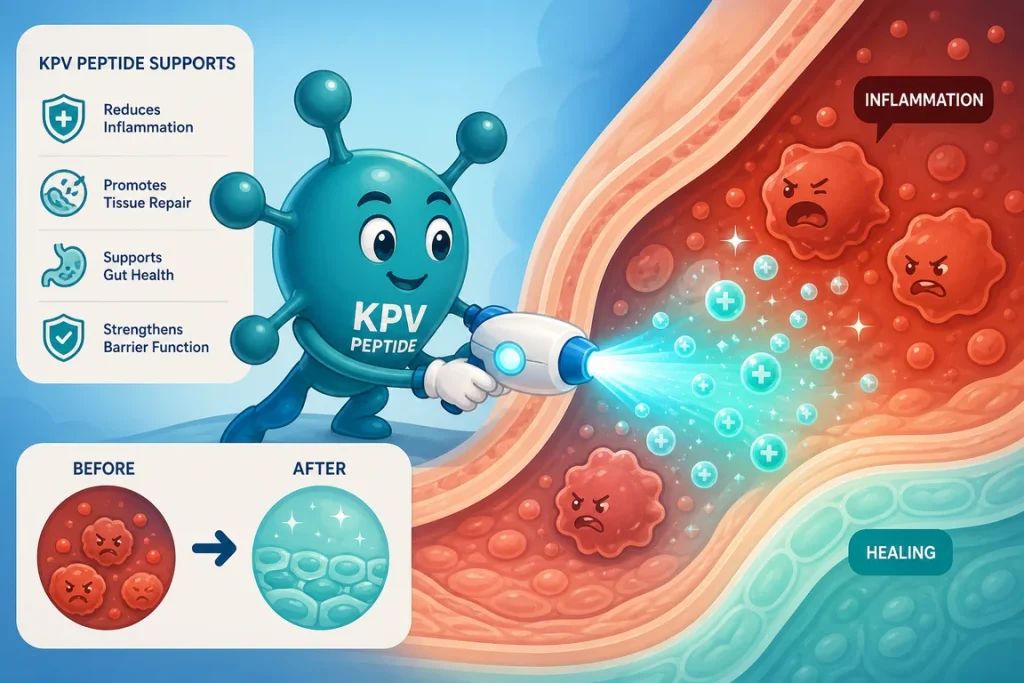
The mechanism is the most interesting thing KPV peptide offers.
The Gut Doorway Called PepT1
Your small intestine transporter (PepT1) pulls protein fragments out of your food. KPV is small enough to come through intact. That’s why it works orally. PepT1 barely exists in a healthy colon.
Dalmasso, Gastroenterology, 2008 (PMID 18061177)
What It Does Inside The Cell
KPV jams the master inflammation switch NF-kB. When NF-kB fires, your cells pour inflammatory signals, but KPV peptide blocks the switch before it reaches the nucleus. The signals are never made.
Less switch, fewer signals means less inflammation.
What Is KPV Peptide Used For?
The research splits into “proven in mice,” “tested in a dish,” and “a clinic blog said so.” I’ll label every claim.
Gut Health, IBD, Leaky Gut
The strongest evidence KPV peptide has.
Mice with induced colitis given oral KPV cut their gut inflammation roughly in half and dropped the inflammatory cytokines.
Study shows KPV reduced colitis-driven tumor growth in mice. Tight mechanism, consistent animal data, and PepT1 make the gut its natural home. This is also why KPV peptide is stacked with autoimmune and lupus protocols in clinics: the same NF-kB brake, aimed at the same overactive immune signaling.
The catch? Zero completed human trials in IBD, Crohn’s, ulcerative colitis, or leaky gut. Strong in mice, unproven in people. Anyone claiming it treats your IBD is selling.
Skin: Acne, Psoriasis, Eczema
KPV kills two bugs that worsen skin conditions, Staph aureus and Candida (Cutuli, PMID 10670585), and calms the inflammation behind eczema and psoriasis. This is why KPV peptide cream and topical formulas keep showing up for acne and red, angry skin.
But a 2017 study (Pawar, PMID 28343991) found plain KPV cream barely penetrates skin. You need microneedling or a mild electric current to push it through. So a basic cream probably underdelivers, and that fact alone saves you money. Strong rationale, real antimicrobial action, no finished human trials.
KPV And BPC-157: Why People Stack Them
BPC-157 grows blood vessels and rebuilds tissue. KPV shuts down inflammation. Different jobs, which is exactly why people run KPV BPC-157 together for gut repair.
KPV calms the inflamed gut lining while BPC-157 rebuilds it. Fire out, house repaired. Most people run both oral, both on an empty stomach. It’s the most popular KPV stack there is, and the BPC KPV combo is the one I see asked about most.
(Vet your BPC-157 source the same way; the peptide vendor guide covers it.)
How Much KPV Peptide Should You Take?
Research and community framing. Not a prescription. The route is the real decision, not just the number.
Oral capsules or spray: 250 to 1,000 mcg per day, usually 500 mcg, on an empty stomach. Best for gut targets, because PepT1 lives in the gut. KPV peptide capsules are the most common form people start with.
Subcutaneous injection: 250 to 500 mcg per day, in the morning. Best for whole-body inflammation.
Topical cream or spray: a 0.1 to 1% formula twice daily, ideally with a penetration enhancer. Best for a specific eczema or psoriasis patch.
Gut problem, go oral. Skin problem, go topical. Whole-body, inject.
How To Reconstitute Injectable KPV
10 mg of powder plus 2 mL of bacteriostatic water gives 5,000 mcg per mL. A 500 mcg dose is 0.1 mL, or 10 units on a U-100 insulin syringe. Run your numbers through a reconstitution calculator before drawing, because dosing math errors are how people inject a tenth of what they meant to.
How Long Does KPV Take To Work?
Some users report gut and skin relief in one to two weeks. Most judge results at four weeks, chronic conditions at 6 to 12. Ignore the “30-minute half-life” figure floating around; no published study backs it, so treat it as a rumor.
KPV Peptide Side Effects
KPV is reported as well tolerated. The honest version: there’s never been a completed human safety trial, so “well tolerated” comes from animal studies and clinic notes, not real data.
Reported effects are mild: injection-site redness, occasional nausea with oral use, local irritation with topical. No organ toxicity in animal models even at high doses.
Skip it in pregnancy and active cancer; no data either way. And because it comes from the melanocortin family, play it safe with a melanoma history, even though KPV doesn’t meaningfully hit the pigment receptor.
Is KPV Legal? The 2026 FDA Situation
This is the part about to change, and the timing is everything.
KPV isn’t FDA-approved. Right now it’s sold as a research compound. But the ground is shifting fast.
On April 15, 2026, the FDA pulled KPV off its Category 2 “do not compound” list, along with 11 others, including BPC-157, TB-500, and Epitalon. On July 23, 2026, an FDA committee meets to decide whether pharmacies can legally compound it.
Read this twice, because vendors will twist it: coming off the restricted list is not approval. July is the real decision. A yes opens legal access. A no sends it backward. Watch the date.
How Much Does KPV Peptide Cost, And Where To Buy It
The compound is never the real risk. The seller is.
KPV comes three ways: injectable vials (roughly $30 to $100), KPV peptide capsules (around $109 to $150 for 60), and creams or sprays. Capsules are the easiest start, since the oral route actually works here, which is rare for a peptide. Don’t bother searching KPV peptide on Amazon, real research peptides aren’t sold there, and what is gets pulled or faked.
Before you buy KPV anywhere, demand this:
- A batch-specific lab report whose lot number matches your vial. Not a generic PDF.
- HPLC purity of 98% or higher, plus mass-spec identity.
- An endotoxin test if you’re injecting.
Red flags that close the tab: recycled reports with no lot number, “in-house tested” with nothing independent, crypto-only with no business address, and prices far below the market. Cheap KPV is cheap for a reason.
For research-grade KPV with independent reports on every batch, Particle Peptides tests to European Pharmacopoeia standards and ships globally. For capsules, Integrative Peptides and Limitless Life both run the oral KPV format. Whoever you pick, match the batch number to the report before you trust a milligram.
KPV Peptide FAQ
What is KPV peptide?
A tripeptide of lysine, proline, and valine, the tail fragment of the hormone alpha-MSH. Studied for calming gut and skin inflammation, without the skin-darkening of related peptides like melanotan.
What is KPV peptide used for?
Research focuses on gut inflammation (IBD, leaky gut), skin conditions (eczema, psoriasis, acne), wound healing, and antimicrobial action. Clinics also use it for autoimmune and allergy support, though human proof is thin.
How does KPV peptide work?
It enters cells through the PepT1 transporter and blocks the NF-kB inflammation switch, cutting signals like TNF-alpha and IL-6. In the gut, inflamed tissue absorbs more of it, so it self-targets the damage.
How much KPV peptide should I take per day?
Research protocols commonly use 250 to 500 mcg per day, up to 1 mg. Oral for gut, injection for whole-body, topical for skin. There’s no FDA-approved human dose, these are community figures.
How long does KPV take to work?
Some users report relief in one to two weeks. Most judge results at four weeks; chronic conditions can take 6 to 12 weeks.
Can you take KPV orally?
Yes, that’s its rare advantage. KPV absorbs intact through the gut’s PepT1 transporter, so capsules and sprays work. Oral is the preferred route for gut inflammation.
KPV vs BPC-157?
KPV calms inflammation by blocking NF-kB. BPC-157 rebuilds tissue by growing blood vessels. Stacked together for gut repair: KPV puts out the fire, BPC-157 rebuilds the lining.
Does KPV cause tanning?
No. It comes from alpha-MSH but lacks the part that activates the pigment receptor. Unlike melanotan, it won’t darken your skin.
Is KPV peptide safe?
Reported as well tolerated, with mild injection-site or digestive effects. But no completed human safety trial exists, so long-term safety isn’t established.
Conclusion
KPV survives your gut on purpose, hunts the inflamed cells, and shuts down the inflammation switch without darkening your skin or needing a needle. The gut and skin science is promising. The human trials don’t exist yet. Hold both at once, and you’re already ahead of most of the internet on this.
Chase the proof. Never the promise.