
A Certificate of Analysis (COA) is the lab’s record of what was in one tested batch: identity, purity and, on better reports, contaminants. For topical peptides it is often the only quality check you get, because the FDA doesn’t pre-approve cosmetic ingredients.
So you are trusting the manufacturer, and the COA is your main protection against an underdosed, mislabeled or contaminated product. Janoshik and MZ Biolabs are lab names you will see often, but a familiar lab name doesn’t prove the report is real.
This guide covers what each section of a COA means for serums and creams. To check whether a certificate is authentic with the lab itself, see our 7 checks to verify a peptide COA.
How to read COA for topical peptides: core elements
Every credible COA has specific sections. Know what each means for confident sourcing and avoiding expensive guesswork.
Product identity and batch matching
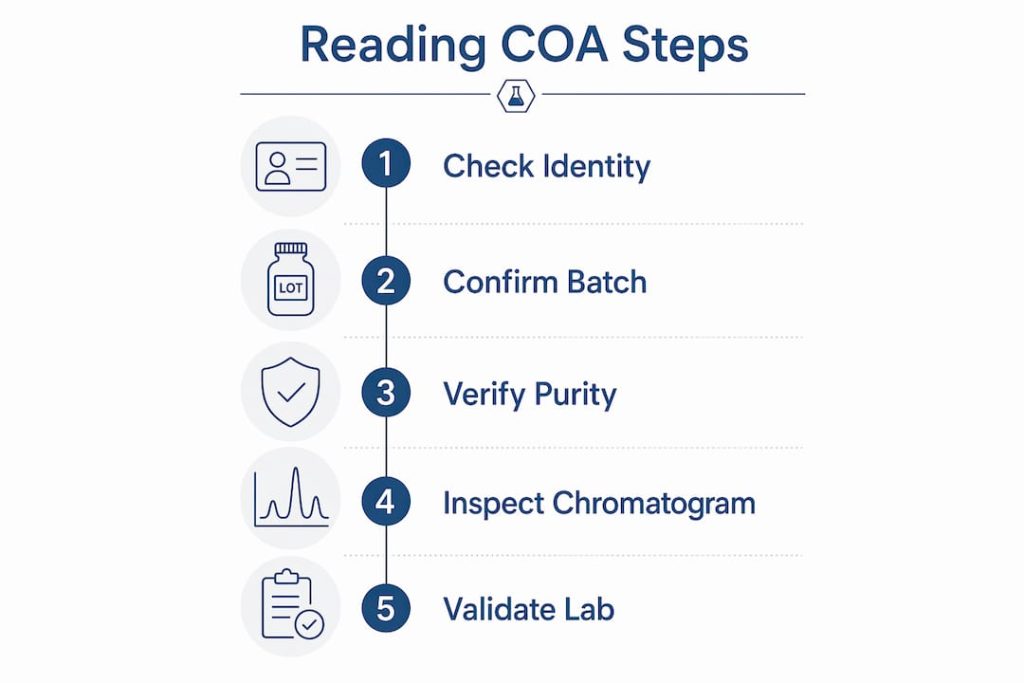
Check if the product name matches the INCI (International Nomenclature of Cosmetic Ingredients) or CAS number on the COA. For GHK-Cu, the CAS number is 49557-75-7. For BPC-157, it is 137525-51-0. If those numbers are absent or wrong, stop reading and contact the supplier.
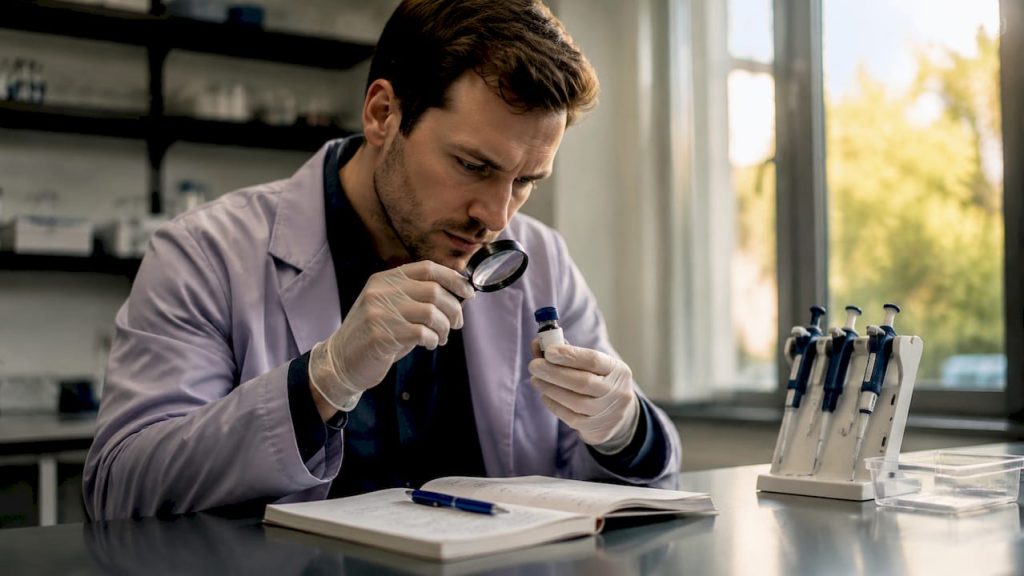
Numbers must match the print on your product vial or package.
Sounds obvious.
Many vendors recycle a single COA across many productions. A mismatched number means the document isn’t for your specific batch. Dispose. Once you can read a COA, you can judge the best peptide companies for yourself.
Key COA data points at a glance
A credible COA also has testing dates, analyst signatures, and chromatogram images.
Missing any of these is a bad sign. Probably document falsification or template reuse.
| COA Field | What to Look For | Why It Matters |
|---|---|---|
| HPLC Purity | ≥95%, ideally ≥98% | Confirms active peptide concentration |
| Mass Spectrometry | Molecular weight match | Confirms correct peptide identity |
| Heavy Metals | Lead, arsenic, cadmium, mercury | Safety for topical skin contact |
| Water Content | ≤8% for lyophilized powder | Affects stability and shelf life |
| Counter-Ion Type | Acetate or TFA listed | Affects solubility and absorption |
HPLC purity: the benchmark that matters most
Topical peptides should reach at least 95% HPLC purity, with premium actives reaching 98%. Impurities dilute the active peptide concentration and can introduce unknown compounds onto skin.
HPLC chromatogram is visual proof. Look for a dominant peak with minimal secondary peaks. A clean chromatogram with one sharp peak and a flat baseline indicates genuine purity.
How do you verify a peptide COA is authentic?
Peptide fraud is common. Photoshopped COAs. Recycled lab reports. And vendor-issued documents with no third-party verification.
Here’s how to confirm:
- Cross-reference the report number. Laboratory portals like Janoshik.com allow you to enter a unique report number and pull up the original lab record. If the number does not return a result, the document is likely fabricated.
- Check the lab’s accreditation status. ISO 17025 accreditation is the recognized standard for analytical testing laboratories. A lab without this credential has not been independently audited for testing accuracy or procedural integrity.
- Look for analyst signatures. A legitimate COA carries the name and signature of the analyst who ran the tests. Generic templates with no named analyst are a warning sign.
- Compare COAs across batches. If a supplier’s COA for batch 001 and batch 047 are pixel-identical except for the lot number, the document was templated, not generated from actual testing.
- Distinguish marketing certifications from batch testing. GMP (Good Manufacturing Practice) and ISO 9001 describe facility processes. Batch-specific third-party COAs are a stronger indicator of actual product quality than any facility-level certification.
Pro Tip: Request COAs for two different batch numbers and compare them side by side. Legitimate labs produce reports with slightly different chromatogram profiles between batches. Identical reports across different batches confirm template fraud.
Vendor-issued COAs, documents the supplier makes themselves without sending samples to an independent lab, carry no evidentiary weight. They confirm nothing except that they understand a word processing software like Microsoft Word.
Step-by-step: interpreting the analytical data
Once you have confirmed the COA is authentic, you need to interpret what the data actually says about the product.
- Evaluate the HPLC chromatogram for purity and impurity peaks. The main peptide peak should account for ≥95% of the total area. Secondary peaks represent impurities. A single dominant peak with a flat baseline is the target. Multiple secondary peaks above 1–2% of total area indicate a poorly synthesized or degraded batch.
- Interpret the mass spectrometry result. Mass spectrometry confirms molecular identity by measuring the molecular weight of the compound. The reported mass should match the theoretical molecular weight of the peptide within a margin of ±1 Dalton. For GHK-Cu, the expected molecular weight is approximately 340.4 g/mol for the peptide component. A mismatch here means the compound is not what it claims to be.
- Check peptide content and counter-ion impact. Counter-ion identity and water content directly affect formulation stability and skin absorption rates. TFA (trifluoroacetate) counter-ions are common in synthesis but can be irritating in topical applications. Acetate counter-ions are preferred for skin-contact products. The COA should specify which counter-ion is present and at what percentage.
- Assess water content. Lyophilized peptide powders should contain no more than 8% water by weight. Higher water content reduces the actual peptide content per milligram and accelerates degradation. This figure appears as a loss-on-drying (LOD) result on most COAs.
- Review heavy metals results. Heavy metals including lead, arsenic, cadmium, and mercury are contamination risks in fermentation-produced peptides. Passing results on all four confirms the batch is safe for topical use. Failing results on any one of them disqualifies the product for skin application regardless of purity.
| Analytical Test | Acceptable Result | Concern Threshold |
|---|---|---|
| HPLC Purity | ≥95% | Below 90% |
| Water Content (LOD) | ≤8% | Above 10% |
| Lead | <10 ppm | Any detection above limit |
| Arsenic | <3 ppm | Any detection above limit |
| Mass Spec Match | ±1 Dalton | Any mismatch |
- Combine all data points for a final quality assessment. A peptide with 98% HPLC purity but a mass spec mismatch is not the right compound. A peptide with correct identity but 15% water content is underdosed. All five data categories must pass together for the batch to qualify as fit for topical use.
Common mistakes when reading a peptide COA
Even experienced buyers make errors when reviewing COA documents. These are the most frequent ones.
- Treating purity as the only metric. HPLC purity confirms the proportion of the main compound, but it does not confirm which compound that is. Mass spectrometry handles identity. Both are required.
- Ignoring batch-specific matching. A COA with no lot number, or a lot number that does not match your product, is not evidence of your product’s quality. It is evidence of a different product’s quality.
- Assuming GMP or ISO certifications guarantee purity. Many consumers mistakenly equate GMP or ISO certifications with batch safety. These certifications describe manufacturing processes and facility standards. They say nothing about whether your specific batch was tested or passed.
- Skipping lab credential verification. A COA is only as reliable as the lab that issued it. If the lab name is unfamiliar, search for its ISO 17025 accreditation status before trusting the results.
- Accepting incomplete COA sections without follow-up. If a COA is missing heavy metals data or has no chromatogram, contact the supplier and request the full report. Independent ISO 17025-accredited lab testing costs $150–300 per sample and is the most reliable fallback when a vendor’s COA is incomplete or suspicious.
- Not verifying the report online. If the lab offers a public verification portal, use it. Skipping this step when it is available is the single easiest mistake to avoid.
Key takeaways
Verifying a topical peptide COA requires checking identity, purity, batch matching, and lab accreditation together. No single data point is sufficient on its own.
| Point | Details |
|---|---|
| Confirm batch matching | The lot number on the COA must match the number on your product vial exactly. |
| Require HPLC and mass spec | Purity alone does not confirm identity. Both tests together confirm what you have. |
| Verify lab accreditation | Only accept COAs from ISO 17025-accredited labs or portals like Janoshik with public verification. |
| Check heavy metals for topicals | Lead, arsenic, cadmium, and mercury must all pass before any peptide contacts skin. |
| Reject facility certs as proof | GMP and ISO 9001 describe processes, not batch results. Demand batch-specific lab reports. |
Why COA literacy is the most underrated skill in peptide sourcing
I have reviewed hundreds of COAs across vendors selling BPC-157, GHK-Cu, and Khavinson bioregulators. The most consistent pattern I see is buyers who check purity and stop there. They see “98.2% HPLC” and feel confident. That number is meaningful, but it is not the whole story.
The cases that concern me most are the ones where purity looks perfect but mass spectrometry data is absent. That absence is not an oversight. It is a choice. A vendor who skips mass spec is a vendor who does not want you confirming the compound’s identity. In the topical peptide space, where GHK-Cu and similar actives are expensive to synthesize correctly, substitution with cheaper analogs is a real risk.
The other pattern I see is buyers trusting GMP-certified vendors without demanding batch-specific reports. GMP certification tells you the facility has documented procedures. It does not tell you whether your specific vial was tested. Those are completely different claims.
My recommendation is straightforward. Before you buy any topical peptide, request the COA, find the lab name, look up its accreditation status, and enter the report number into the lab’s verification portal. If any of those steps fail, do not buy. The $150 you might spend on independent verification through an ISO 17025 lab is far cheaper than applying an unverified compound to your skin for months.
Properly reading a peptide COA requires understanding formulation stability and efficacy implications, not just checking numbers. That deeper layer of analysis is what separates informed buyers from everyone else.
FAQ
What does HPLC purity mean on a peptide COA?
HPLC purity measures the percentage of the main compound relative to all detected substances in the sample. A result of ≥95% is the accepted minimum for research-grade topical peptides, with ≥98% preferred for premium actives.
How do i know if a peptide COA is real?
Enter the report number into the issuing lab’s verification portal, such as Janoshik.com, and confirm the record exists. A legitimate COA will also include analyst signatures, chromatogram images, and a lot number that matches your product.
Is GMP certification enough to trust a peptide supplier?
GMP certification confirms a facility follows documented manufacturing procedures. It does not confirm that your specific batch was tested or passed analytical standards. Always require a batch-specific COA from an independent lab.
What heavy metals should a topical peptide COA test for?
A complete heavy metals panel for topical peptides covers lead, arsenic, cadmium, and mercury. These four are the primary contamination risks in fermentation-produced peptides and must all pass before the product is considered safe for skin application.
What is the difference between a vendor COA and a third-party COA?
A vendor COA is issued by the supplier and carries no independent verification. A third-party COA is issued by an accredited lab that received the sample directly and ran the tests independently. Only third-party COAs from ISO 17025-accredited labs provide reliable quality assurance.