
Tesofensine has one large published obesity trial, and the journal that published it later put an Expression of Concern on the paper. FDA hasn’t approved the drug. In December 2025 it said compounded drugs made from tesofensine are ineligible for the section 503A exemptions.
This page covers what the trial found, where tesofensine stands with FDA, Mexico and anti-doping rules, how to read a seller’s paperwork, and where to look at a listing.
Quick takeaways
| Topic | What the sources say |
|---|---|
| What it is | Small-molecule triple reuptake inhibitor (NS-2330), not a peptide (1, 2) |
| Main trial | 203 adults, 24 weeks: 11.3 kg lost at 0.5 mg against 2.2 kg on diet and placebo, 9.2% of body weight more than placebo (2, 15) |
| Weak point | Lancet Expression of Concern, April 2013 (4) |
| Heart rate | Up 7.4 beats per minute at 0.5 mg (2) |
| FDA | Not approved. December 2025 letter: ineligible for compounding (7) |
| Mexico | Favorable non-binding opinion in 2023. Approval not granted in 2024 (8, 9) |
| WADA | S6 stimulant, banned in competition (11) |
| Main buying risk | No way to verify contents without a batch-specific COA |
What tesofensine is
Tesofensine isn’t a peptide. It’s a small molecule, code-named NS-2330, with CAS number 195875-84-4 (1). Sellers list it beside peptides and call it “tesofensine peptide,” and our tesofensine peptide page covers that mix-up.
It blocks the reuptake of noradrenaline, dopamine and serotonin (2). Boehringer Ingelheim ran phase II trials of it in Parkinson’s disease and Alzheimer’s disease (3). NeuroSearch ran the obesity trial (3).
What the main trial found
Astrup and colleagues published a 2008 trial that randomized 203 adults with obesity at five Danish centres. Everyone got an energy-restricted diet. They took tesofensine or placebo once daily for 24 weeks (2).
| Dose, once daily | People | Mean weight loss at 24 weeks | Beyond placebo, % of body weight |
|---|---|---|---|
| Placebo and diet | 52 | 2.2 kg | None |
| 0.25 mg | 52 | 6.7 kg | 4.5% |
| 0.5 mg | 50 | 11.3 kg | 9.2% |
| 1.0 mg | 49 | 12.8 kg | 10.6% |
These are the doses the trial tested, not a recommendation. Of the 203 people, 161 (79%) finished. The most common side effects were dry mouth, nausea, constipation, hard stools, diarrhoea and insomnia. At 0.5 mg, heart rate rose 7.4 beats per minute (p=0.0001). Blood pressure didn’t rise significantly at 0.25 or 0.5 mg (2).
The authors wrote that 0.5 mg “might have the potential” to produce twice the weight loss of approved drugs, and that phase III trials had to confirm it (2).
In April 2013, The Lancet published an Expression of Concern about the paper (4). That’s a journal’s notice that readers should treat a paper with caution. The concern was about how adverse events were recorded, and the authors’ own reply to it is titled “Under-reporting of adverse effects of tesofensine” (16). The side-effect and heart-rate figures above may understate harm.
What came after the trial
A 2022 randomized trial tested Tesomet, a pill that pairs tesofensine with metoprolol. It enrolled 21 adults with hypothalamic obesity for 24 weeks. Tesomet added 6.3% more weight loss than placebo (p=0.017). Heart rate and blood pressure didn’t differ significantly between groups. One person stopped after a treatment-related serious adverse event, worsened anxiety (5).
Metoprolol is a beta-blocker, and the developer also ran a phase I study of how the combination affects 24-hour heart rate (3).
Medix, the company holding the Mexican rights, ran a phase III trial in 372 patients. In December 2018, Saniona announced that 0.25 mg and 0.5 mg both beat placebo, with about 10% average weight loss over 24 weeks (6). That figure comes from a company announcement. It doesn’t give the placebo-adjusted result.
Who should be careful
Heart rate rose in the main trial, so anyone with heart disease or high blood pressure should talk to a clinician first. Tesofensine blocks serotonin reuptake, as SSRIs do, so check with a prescriber before combining it with an antidepressant.
Where it stands with FDA, Mexico and sport
United States. FDA hasn’t approved tesofensine. On 8 December 2025 it sent a warning letter to Darmerica, a company that supplies active ingredients to compounders. The letter lists tesofensine among them and says drugs compounded from these ingredients are ineligible for the exemptions in section 503A (7).
Mexico. In February 2023, the technical committee of Mexico’s regulator, COFEPRIS, gave a favorable but non-binding opinion on tesofensine for obesity (8). In November 2024, Saniona reported that Medix hadn’t received approval (9). In February 2025, it said Medix was revising the application and planned to resubmit it (10).
Sport. WADA lists tesofensine under S6 stimulants, banned in competition only (11). USADA says it was added as an example in the 2025 list, and it tells athletes to watch for it in supplements (12). In a 2026 study, six volunteers took 483 µg as a dietary supplement. Metabolites stayed detectable for up to 500 hours (11).
Why the seller is the risk
No tesofensine product is approved for sale in the US, so a seller’s paperwork is the main evidence of what’s in a capsule. The 2026 anti-doping study notes tesofensine is “marketed online as a dietary supplement” (11).
Weight-loss products have turned up with hidden drugs before. In 2021, FDA wrote to Amazon after buying 26 sexual-enhancement products there between December 2019 and February 2020. It said every product it tested held undeclared drugs. In March 2021 it bought two additional, different sexual-enhancement products and one weight-loss product, Miss Slim, which contained sibutramine that wasn’t on the label (13).
FDA withdrew approval of sibutramine, sold as Meridia, on 21 December 2010. The SCOUT trial had randomized 9,804 adults aged 55 and older with heart disease, type 2 diabetes or both. Primary cardiovascular events happened in 11.4% on sibutramine and 10.0% on placebo (hazard ratio 1.16), with more non-fatal heart attacks and strokes (14).
That letter isn’t about tesofensine, and it doesn’t show that tesofensine capsules are spiked. It shows why a label alone isn’t proof.
How to read a certificate of analysis
A certificate of analysis (COA) describes one lot. Before you trust one, check these:
- Batch number. It matches the number on your bottle.
- Identity. Confirmed by mass spectrometry (LC-MS), not only a purity percentage.
- CAS number. 195875-84-4 on the report, the listing and the label.
- Independent lab. Not the seller’s own, with a name, date and test method you can look up.
- Chromatogram. The HPLC trace itself, not only a number.
- Verification. The lab lets you confirm the report on its own site.
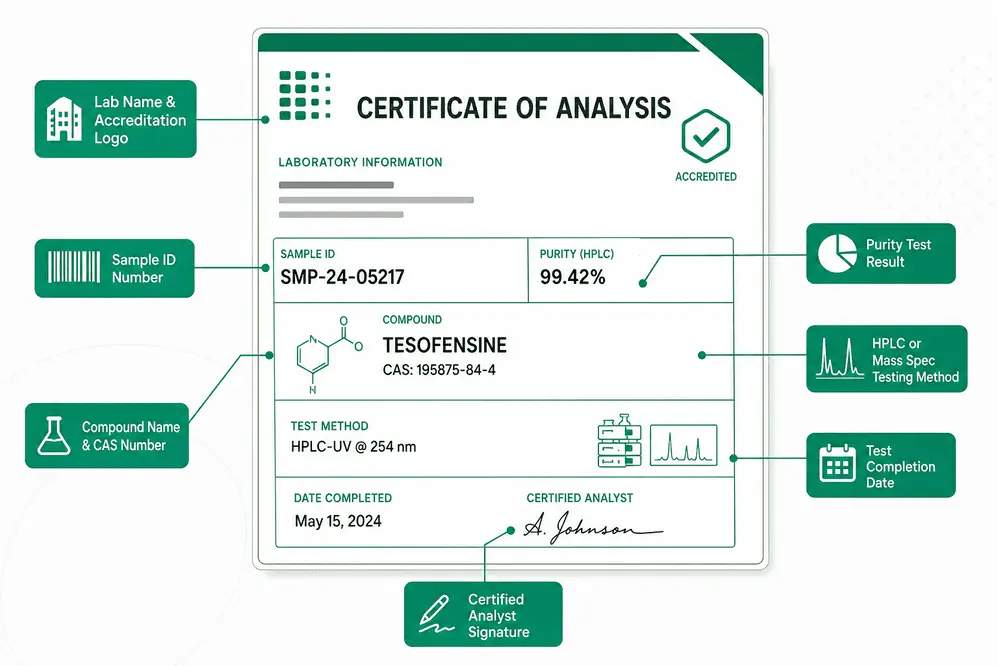
Red flags are a report with no batch number, one undated report reused across lots, “in-house tested” with no outside lab, and payment only by crypto, wire or gift card.
Where to look
Seller listing
SwissChems: Tesofensine 0.25 mg capsules, 60 per bottle
Ask for the report for your batch and run the checklist above before you pay.
Frequently asked questions
Is it legal to buy tesofensine online?
FDA hasn’t approved tesofensine. In a December 2025 warning letter, it said drugs compounded from tesofensine are ineligible for the section 503A exemptions.
Is tesofensine a peptide?
No. It’s a small-molecule triple reuptake inhibitor, NS-2330, with CAS number 195875-84-4. Sellers who call it a peptide are using the wrong label.
Does tesofensine work?
One 24-week phase II trial of 203 adults found that 0.5 mg lost 11.3 kg against 2.2 kg on diet and placebo, which is 9.2% of body weight more than placebo. The Lancet published an Expression of Concern about that paper in 2013, and the phase III results come from a company announcement.
What are the side effects of tesofensine?
In the main trial, the most common were dry mouth, nausea, constipation, hard stools, diarrhoea and insomnia. Heart rate rose 7.4 beats per minute at 0.5 mg.
Is tesofensine banned in sport?
WADA lists it under S6 stimulants, prohibited in competition.
Is tesofensine approved in Mexico?
COFEPRIS’s technical committee gave a favorable, non-binding opinion in February 2023. In November 2024, Saniona reported that Medix hadn’t received approval, and in February 2025 it said Medix was revising the application.
This page is information, not medical advice. Tesofensine isn’t approved by FDA for human use. Talk to a clinician before taking any weight-loss drug.
References
- PubChem. Tesofensine (CAS 195875-84-4).
- Astrup A, et al. Effect of tesofensine on bodyweight loss, body composition, and quality of life in obese patients. Lancet. 2008;372(9653):1906-1913. PMID 18950853.
- ClinicalTrials.gov: NCT00148486 and NCT00148512 (Parkinson’s disease), NCT00153010 (Alzheimer’s disease), NCT00394667 (obesity), NCT03488719 (tesofensine and metoprolol, 24-hour heart rate).
- Expression of concern: effect of tesofensine on bodyweight loss, body composition, and quality of life in obese patients. Lancet. 2013;381(9873):1167. PMID 23561987.
- Huynh K, et al. Randomized controlled trial of Tesomet for weight loss in hypothalamic obesity. Eur J Endocrinol. 2022;186(6):687-700. PMID 35294397.
- Medthority summary of Saniona’s December 2018 announcement of the phase III study of NS 2330.
- FDA. Warning letter to Darmerica, LLC, 8 December 2025.
- Saniona. Interim report Q1 2023.
- Saniona. Update on tesofensine application, 12 November 2024.
- Saniona. Medix to submit final version of tesofensine application following interaction with COFEPRIS, 10 February 2025.
- Krug O, Thomas A, Thevis M. Investigations into the metabolism and elimination of tesofensine in human urine. Drug Test Anal. 2026;18(9):1163-1173. PMID 42320973.
- USADA. What’s new on the 2025 WADA Prohibited List.
- FDA. Letter to Amazon.com, Inc., 2021.
- James WPT, et al. Effect of sibutramine on cardiovascular outcomes in overweight and obese subjects. N Engl J Med. 2010;363(10):905-917. PMID 20818901.
- University of Copenhagen press release on the tesofensine trial, reposted by ScienceDaily, 22 October 2008.
- Under-reporting of adverse effects of tesofensine. Lancet. 2013. PMID 23849924.