
AHK-Cu is a synthetic peptide known as Copper Tripeptide-3. Alanine-Histidine-Lysine bound to copper.
It is used topically for hair and skin, almost always as a serum. The short version of everything below: AHK-Cu has one small human hair study behind it, it is not a hair-loss drug, and it works better as a support alongside GHK-Cu than as a standalone fix.
Only one amino acid differentiates AHK-Cu from GHK-Cu. GHK starts with glycine; AHK with alanine. This is the whole structural difference. The reason for the confusion.
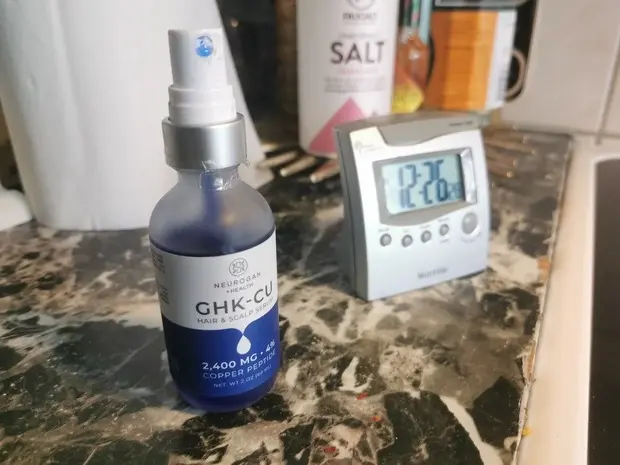
GHK-Cu is already in your blood. AHK-Cu doesn’t exist in your body. It’s lab-made.
Read the difference between ahk cu vs ghk cu here. It matters more than you might think.
For hair, you want a topical serum. Research vendors sell AHK-Cu as 50 mg powder vials, which are not made for the scalp. Two serums and one research vial are below.
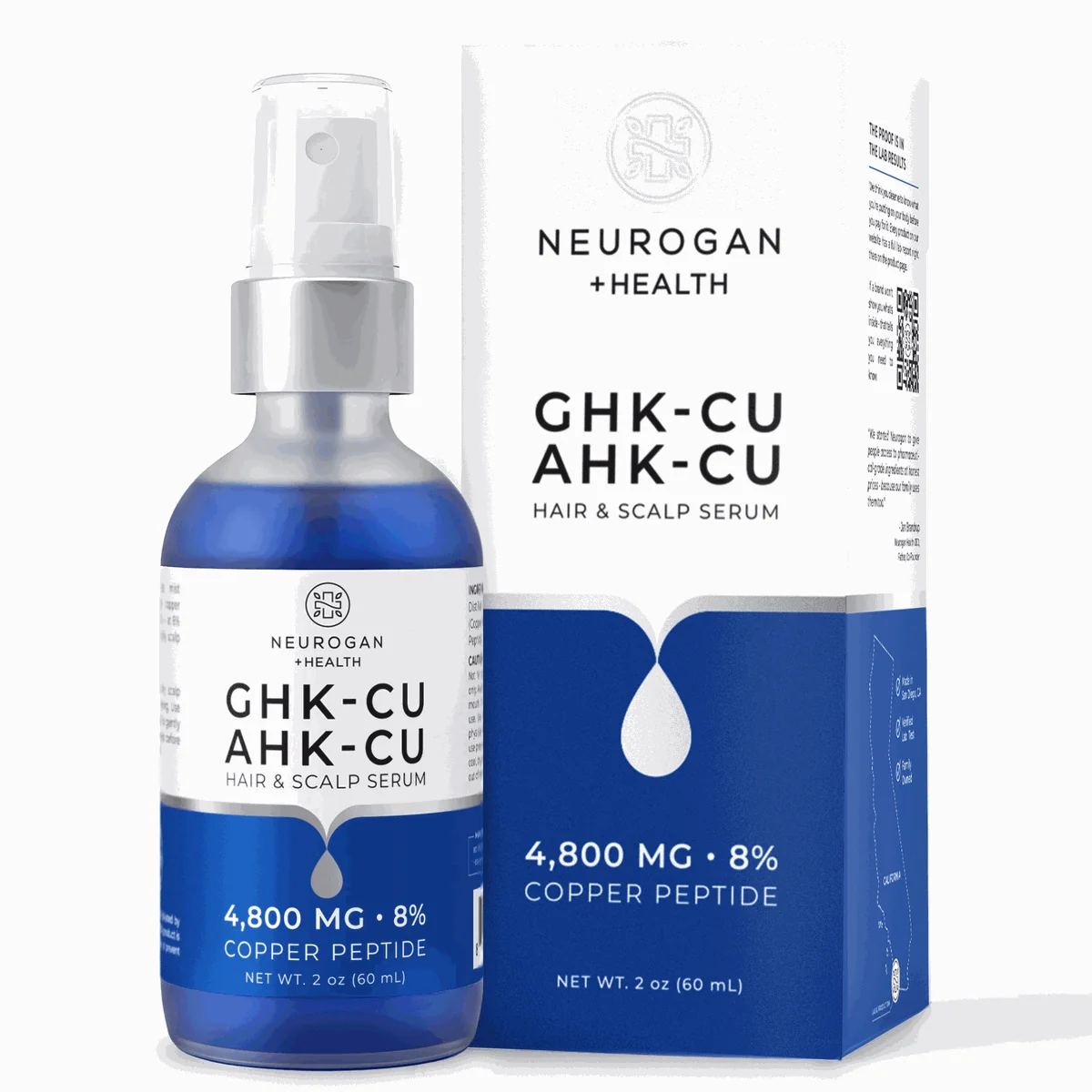
AHK-Cu + GHK-Cu
Hair Serum Pro
Combines two distinct copper peptides in one topical scalp formula. Designed for readers interested in both AHK-Cu and GHK-Cu.
For comparing a combined formula. The finished product has not been established as a clinically proven hair-regrowth treatment.
VIEW DUAL-PEPTIDE SERUM At Neurogan Health · Affiliate link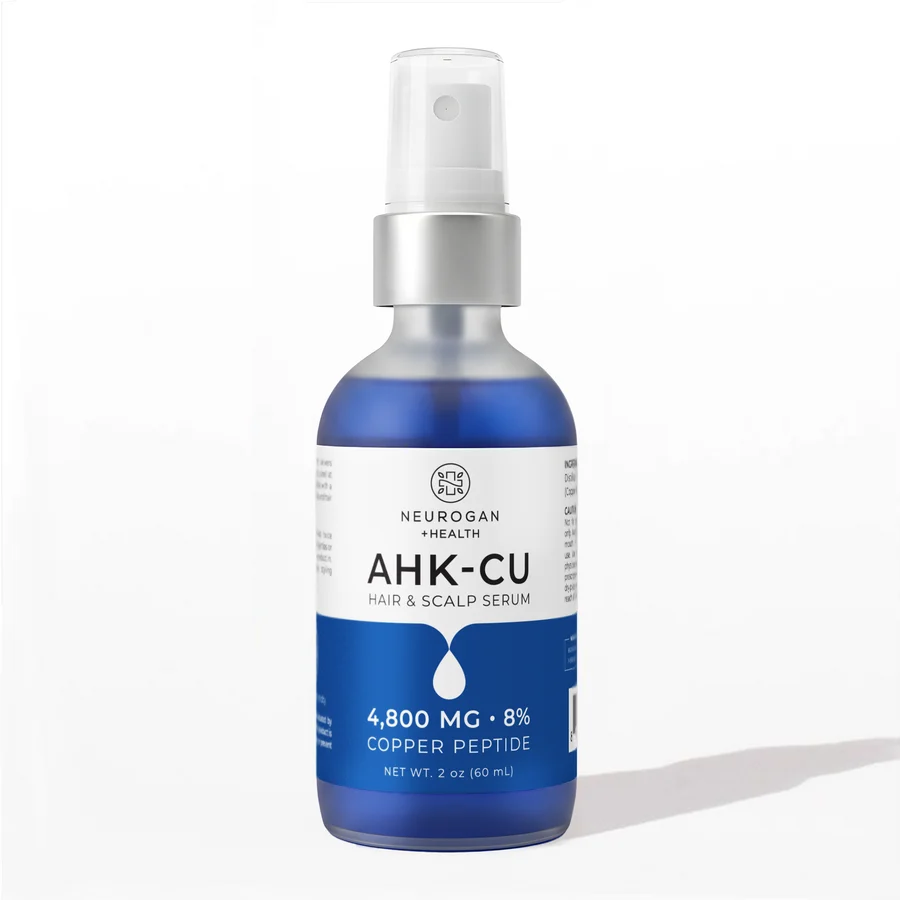
AHK-Cu
Hair Serum
A standalone AHK-Cu scalp formula without GHK-Cu. Separates AHK-Cu from the combined-peptide option.
For examining AHK-Cu separately. Laboratory follicle findings do not establish clinical hair regrowth from this finished serum.
VIEW AHK-CU SERUM At Neurogan Health · Affiliate link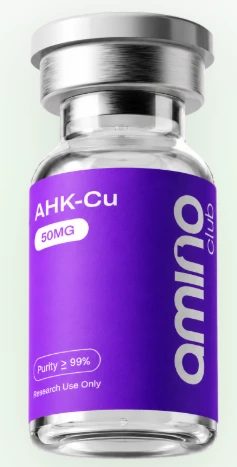
AminoClub · Copper peptide
AHK-Cu, 50 mg
Looking for standalone AHK-Cu? Compare AminoClub’s 50 mg research vial, check the published batch report, and see the latest price.
Research use only. Not a ready-to-use scalp serum. Purity shown is reported on AminoClub’s product page; check the COA for the batch you purchase.
The Only Hair Study
Here is what six months of using it actually produced, and how to buy it without getting sold water.
| Finding | Detail |
|---|---|
| Follicles elongated | At 10⁻¹² to 10⁻⁹ molar only |
| Dermal papilla cells multiplied | Statistically significant |
| Cell-death signals dropped | Not statistically significant |
| Higher doses inhibited growth | The window was narrow |
The last row debunks that stronger is better. AHK Cu works the opposite of what you want if you use more than the effective dose.
Four False Claims
| Claim | Reality |
|---|---|
| “Blocks DHT” | Traced to a 1995 study on copper ions in a test tube. No study shows topical AHK-Cu lowers scalp DHT. |
| “Increases density 30-40%” | No clinical trial exists. Numbers borrowed from mouse studies and combination products. |
| “Extensively researched” | That research is GHK-Cu’s. Check which peptide each cited study tested. |
| “Results in 6 days” | Hair cycles run months. No AHK-Cu study measured a human timeline. |
Copper peptides may work against DHT damage. It won’t block DHT production. This is why some people can’t drop finasteride.
What Is AHK-Cu?
AHK-Cu (Copper Tripeptide-3) is a copper-binding peptide composed of alanine, histidine and lysine.
Researchers have investigated its effects on human hair follicles and dermal papilla cells in laboratory experiments.
A 2007 study found increased follicle elongation at certain experimental concentrations. However, the follicles were cultured outside the body, and the study did not test a topical serum on people experiencing hair loss.
The bottom line: AHK-Cu has preliminary laboratory evidence, but its ability to regrow hair in people remains unproven.
Read the original study on PubMed.
The Concentration Gap
The scientist worked in picomolar to nanomolar levels. Commercial products are way above:
- 1% serum = 24 million times the tested range
- 8% serum = 200 million times
Brands use high percentages because peptides penetrate skin poorly. Good. But nobody has measured how much AHK-Cu reaches your follicle topically. Nobody knows for sure what the bottle really delivers.
The 8% marketing has no solid evidence behind it. The original product, Tricomin, used 1%
AHK-Cu vs GHK-Cu
| AHK-Cu | GHK-Cu | |
|---|---|---|
| Studied on hair follicles | Yes, directly | No |
| Total research volume | One study | Dozens, incl. human trials |
| Occurs naturally in body | No | Yes |
| Proven human hair regrowth | No | No |
“AHK for hair, GHK for skin” is shorthand, not science. AHK has the more relevant study. GHK has the deeper foundation. Serums combining both are hedging, not innovating.
More on the better-studied one: GHK-Cu buyer’s guide.
Does It Work?
Unknown, plausible, and not at marketed levels.
The mechanism is sound: support dermal papilla cells, raise VEGF and follicle blood supply, calm the signals pushing follicles into rest. Compounds that look this good in culture routinely do nothing on a human head.
Community reports match that gap. The recurring pattern across hair loss forums: better scalp feel, hair that looks thicker, little actual regrowth. Experienced users keep minoxidil and finasteride as the foundation.
Expect modest cosmetic improvement, not a restored hairline. Proven options ranked here: peptides for hair growth.
How to Use AHK-Cu
The short answer: topically, on a clean dry scalp, at 1%, once or twice a day, and then you wait months.
There is no oral form worth taking. Peptides this size don’t survive digestion. If you searched how to take AHK-Cu expecting a capsule, there isn’t one that makes sense.
The protocol:
- Use 1%. Matches Tricomin, the original product. No evidence higher works better, and the study says higher can work worse.
- Apply to clean, dry scalp, once or twice daily. Leave it on. This is a leave-in, not a rinse-out.
- Never with vitamin C or acids. Ascorbic acid, AHAs and BHAs oxidise the copper complex. Separate them by time of day. Acids in the morning, AHK-Cu at night, or the reverse.
- Watch the colour. Blue-violet means the complex is intact. Brown, green or clear means it’s dead. Store cool, dark, sealed.
- Judge at 3 to 6 months. Anything faster is a sales claim.
- Microneedling boosts delivery and irritation. Not on the same day as harsh actives.
Should you wash your hair after applying it? No. Apply after washing, not before. The point is to leave it in contact with the scalp. If you apply it before a shower, you’re rinsing your money down the drain.
Where in the routine? Scalp first, on damp-free skin, before any oils or heavy leave-ins that would block it.
Do Not Inject It
No published study has ever injected AHK-Cu into a human. No dose, no schedule, no safety data, no pharmacokinetics.
Research vials are not made to injectable standards. A 99% purity certificate identifies the powder. It says nothing about sterility or endotoxin, which is what puts people in hospitals.
Eyelashes, Beard and Body Hair
The Pyo study used scalp follicles. Every claim on this page is about scalp hair, because that’s the only hair AHK-Cu has been tested on.
Eyelashes: no. Not because it certainly doesn’t work, but because nothing has tested it there and the eye is the wrong place to run your own experiment. Copper peptide solutions near the eye can irritate, and the approved lash compound is bimatoprost, which has actual trials behind it. If lash regrowth is the goal, that’s the conversation to have with a doctor.
Beard and facial hair: unstudied. Beard follicles respond to androgens in the opposite direction to scalp follicles, which is why minoxidil behaves differently on a beard than on a crown. There is no reason to assume AHK-Cu’s scalp findings transfer, and no data either way.
Body hair: same answer, less interest.
If you apply it to your scalp, expect scalp effects. Anywhere else is guesswork.
Does AHK-Cu Change Hair Colour?
Copper is genuinely involved in hair pigmentation. Tyrosinase, the enzyme that makes melanin, is copper-dependent. So the question isn’t silly.
But no study has shown AHK-Cu restoring pigment in grey hair, and the leap from “copper matters for melanin” to “this copper peptide reverses greying” is the same leap that produced the DHT claim. Same pattern: real biology, no evidence the product does it.
If anything sells you AHK-Cu for grey hair, that’s a marketing claim, not a finding.
Safety
Topical copper peptides are generally well tolerated. No formal human safety study exists for AHK-Cu.
Reported issues are local: irritation, itching, redness, occasional copper or preservative sensitivity. Patch test first.
Avoid if you have Wilson’s disease or another copper-handling disorder. Pregnancy, breastfeeding and pediatric use are unstudied.
Buying Checklist
- Concentration printed on the label
- Copper Tripeptide-3 named and high on the ingredient list
- CAS 767286-83-9, molecular weight ~416 (sources listing GHK’s ~340 have confused the two peptides)
- Blue color, pH 5.5 to 7
- Opaque packaging
- Third-party COA with HPLC purity
Reject anything claiming to cure hair loss, listing injection protocols, or quoting clinical percentages that do not exist.
If a vendor clears all of the above, you are fine buying from them. The one I use and point people to is Elite Edge Biotech, which sells AHK-Cu as peptide and water with nothing else in the bottle. Affiliate link, and it costs you nothing extra.
FAQ
Does AHK-Cu regrow hair?
No human trial has tested it. One 2007 study showed follicle growth in culture. Users report improved appearance, not regrowth.
AHK-Cu or GHK-Cu?
AHK has the one direct hair follicle study. GHK has more research overall. Neither has proven human regrowth data.
Can I stack it with minoxidil and finasteride?
Yes, mechanisms do not conflict. Keep it away from vitamin C and acids, and add one variable at a time.
Can I inject it?
No. Zero human data, and research vials are not sterile-grade.
How do I use AHK-Cu powder?
Dissolve it to make a topical serum. 100 mg in 10 ml of liquid gives you a 1% solution, about a month of twice-daily scalp use. Distilled water with a little hyaluronic acid works well as a carrier. Keep it away from vitamin C and acids.
What’s the best carrier for AHK-Cu topical?
Distilled water with a humectant like hyaluronic acid. Avoid acidic bases and alcohol-heavy ones. Target a pH of 5.5 to 7, and check the solution stays blue-violet.
Should I wash my hair after applying AHK-Cu?
No. Apply it after washing, to a clean dry scalp, and leave it in. Washing it off defeats the purpose.
Can I mix AHK-Cu with hyaluronic acid?
For topical use, yes, and it’s a sensible pairing. For injection, no. Mixing a research powder at home has no sterility control regardless of what you mix it with.
Will AHK-Cu help my eyelashes grow back?
There’s no evidence for it and the eye area is a poor place to experiment. Bimatoprost is the compound with actual trials for lashes.
Conclusion
One petri dish study, sold as if there were fifty.
Use 1%, keep it off vitamin C and acids, give it six months, and treat it as a supporting player. Minoxidil and finasteride remain the compounds with human evidence.
Buy AHK-Cu as a maybe, not as a plan.