
Muira puama and catuaba sit side by side on the shelf, but a lab that tested 14 bottles sold as catuaba found only a minority held the bark on the label.
And the study some pages cite for muira puama? It’s about ginkgo.
So before you spend another dollar, here’s what’s actually proven, and what isn’t.
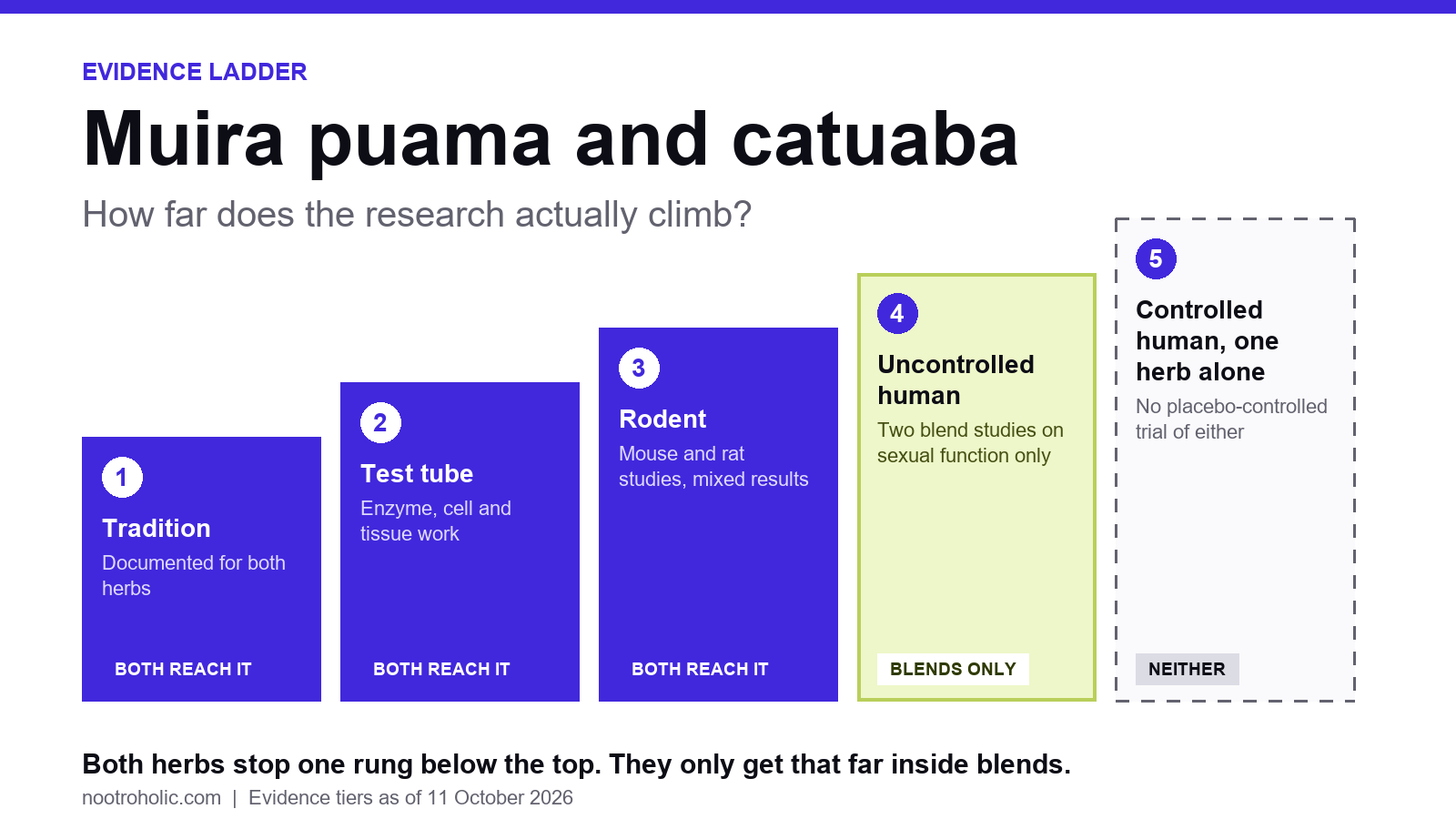
Muira puama is Ptychopetalum olacoides, one species. Catuaba is a trade name for at least four plants, most often Trichilia catigua. No controlled human trial has tested either one alone for libido. Every human study used a blend, and neither of the two libido studies had a placebo group.
Jump to: Quick answer · Muira puama · Catuaba · Human research · Evidence table · Safety · Which to choose · Buying checklist · FAQ
Quick answer: five differences that matter
How to read it. Strong: several primary papers or controlled human data. Limited: one lab, uncontrolled work, or blends only. None: we found nothing.
| Difference | Muira puama | Catuaba | Watch-out |
|---|---|---|---|
| 1The plantIdentity | StrongOne species, Ptychopetalum olacoides | NoneA trade name. Usually Trichilia catigua | Catuaba covers at least four plants. Muira puama can still be swapped for a Croton. |
| 2Human trials aloneOne herb, any outcome | NoneNothing found | NoneNothing found | Both show up only inside blends. |
| 3Human data in blendsMostly uncontrolled | LimitedTwo open-label libido studies | LimitedSafety, mouth pain, fatigue | No placebo group in the libido studies. Catuaba has none on libido. |
| 4What’s insideMain compounds | LimitedAporphine alkaloids | StrongPolyphenols (T. catigua) | The famous catuabine alkaloids come from a different tree. |
| 5Biggest riskAnimal and label data | LimitedAnxious mice, one test | LimitedLabel vs bark mismatch | Skip both if you’re pregnant or nursing. |
What is muira puama?
Muira puama is the root and bark of Ptychopetalum olacoides, a small Amazonian tree about 4 meters tall. You’ll also see marapuama, muirapuama and potency wood.
Amazon healers made root tea for weakness, rheumatism and stomach trouble. Brazil listed the plant in its pharmacopeia in 1956. The libido claim is younger. Drugs.com traces the promotion of muira puama as a male aphrodisiac to 1930s Europe, so the marketing is almost a century old.
The most detailed chemistry paper we found measured the bark. Magnoflorine and menisperine made up 75.96% of the compounds measured. Lupeol, the compound most web pages name, isn’t among the 14 compounds isolated. Two of the authors work for Herbalife and Naturex. Weigh that.
The name on a bottle isn’t enough, either. In Brazil’s northeast, a different tree, Croton echioides, is sold as marapuama. Our muira puama extract guide covers the label checks.
What is catuaba?
Catuaba isn’t a species. It’s a trade name that has landed on several trees, and a 2023 review says that has led to adulterations and controversial effects. The main candidates:
- Trichilia catigua, a stem bark rich in polyphenols. It’s the catuaba in the Brazilian tonic Catuama.
- Erythroxylum vacciniifolium, a bark with tropane alkaloids called catuabines.
- Anemopaegma arvense, a root also sold as catuaba.
Some labels name one of these. Some name “Erythroxylum catuaba.” Many just say catuaba. Catuabines come from Erythroxylum bark, not from the Trichilia bark most often sold.
The name that has no plant
“Erythroxylum catuaba” comes from one man. Arthur J. da Silva coined Erythroxylon catuaba in his 1904 thesis, by analogy to coca, and called his own Tupi etymology todo hypothetico. The International Plant Names Index lists the name as invalid.
The same thesis holds the legend. In Maranhão, people said catuaba trunks stood bare of bark as high as an old man could reach. It tells of a man over fifty who fathered a child every year, then moved his fence to keep his catuaba tree for himself.
Erythroxylum is the coca genus, so people ask about cocaine. We found no paper that reports cocaine in catuaba and none that tested for it. “No evidence of cocaine” is accurate. “Tested cocaine-free” isn’t.
The bigger problem is the bottle. In 2004, Kletter’s lab in Vienna tested 14 commercial catuaba products. Only a minority held the bark on the label, more than half were adulterated, and half held tropane alkaloids. It’s one small test from 2004, so don’t read it as proof that half of today’s shelves are fake. It does make the question fair. The same team also tested T. catigua extracts on rabbit erectile tissue in a dish. No effect.
What human research exists?
Muira puama
UTEP’s herbal fact sheet cites a rat study for libido and mouse work for memory. Drugs.com says clinical evidence is lacking for muira puama alone. Five human studies name it, and all five tested a blend:
- Waynberg & Brewer, 2000. Muira puama plus ginkgo, 202 women, one month, no control group. 65% scored higher on self-rated questionnaires. The authors said a double-blind study was planned. We found no follow-up.
- Nguyen, 2018. A four-part blend with a large dose of L-citrulline, 54 men with ED, no control group. Median erectile scores rose among the men who stayed, and about half reported better erections. But only 16 were still in at month three, and the main reason men left was breaking the rule to stop their ED drugs.
- Oliveira, 2005 and Spanemberg, 2012. Catuama in healthy volunteers for four weeks, and Catuama vs placebo in 72 people with burning mouth syndrome. Neither is about libido.
- Chiavaroli, 2026. A five-ingredient prostate supplement, 59 men, retrospective. Published in September 2026, it is about urinary symptoms, not libido.
Two citation traps. “Stough 2001” gets cited as a muira puama memory study, but it’s a 61-person trial of Ginkgo biloba alone. And the “262 men” figure, about 60% better libido, isn’t in PubMed. Pages disagree on the numbers, so treat it as unverified.
The lab work is real but small. Muira puama extract inhibited acetylcholinesterase in rodent brain tissue and looked antidepressant-like in mice. It’s mostly one Porto Alegre lab, and mice aren’t men.
Catuaba
No human trial of catuaba alone has been published for libido, or for any outcome we found.
ClinicalTrials.gov lists one. It tested a T. catigua extract added to escitalopram for mild depression, enrolled 111 people, and was terminated with no results posted. It’s filed under a product code, so a plant-name search misses it.
The rest is Catuama: the two studies above, plus a conference abstract on 90 women with radiotherapy fatigue that reports no difference between groups. In rodents, T. catigua extract cut immobility in the forced-swim test, an effect tied to dopamine. A later paper found no stress or memory benefit.
How we searched
We ran these searches on 11 October 2026. Re-run them and you should get the same counts, give or take new papers.
- PubMed, muira puama:
"muira puama"[tiab] OR muirapuama[tiab] OR marapuama[tiab] OR "Ptychopetalum olacoides"[tiab]returned 51 records. AddingAND Randomized Controlled Trial[pt]returned 0. - PubMed, catuaba:
catuaba[tiab] OR "Trichilia catigua"[tiab] OR Catuama[tiab]returned 81 records, some off topic. The same randomized-trial filter returned 1, the Catuama burning-mouth trial. - ClinicalTrials.gov, searching intervention names for catuaba, Catuama, Trichilia catigua, muira puama and Ptychopetalum olacoides: 2 trials. Both test a four-ingredient supplement in healthy volunteers and measure markers of vascular aging, not libido. The one catuaba trial sits under a product code (NCT02532660), so a name search misses it.
So as of 11 October 2026, neither database holds a controlled trial of either herb alone for libido. Unindexed Brazilian theses or hospital studies could still exist.
What a real trial would need
A real answer needs one herb per arm so you can see who did what, a placebo, a validated questionnaire such as the IIEF for erections or the FSFI for women, twelve weeks or more, and at least 100 people per arm so chance can’t carry the result.
Nobody has run that trial for either herb.
Muira puama vs catuaba: the evidence table
How to read it. Strong: several primary papers or controlled human data. Limited: one lab, uncontrolled work, or blends only. None: we found nothing.
| Evidence | Muira puama | Catuaba |
|---|---|---|
| 1Plant partWhere it comes from | LimitedRoot and stem bark. Sources disagree which. | LimitedStem bark or root, depending on the plant. |
| 2Traditional useDocumented, not proof | StrongNerve tonic, impotence. Brazil’s 1956 pharmacopeia. | StrongAphrodisiac and tonic. A 1904 thesis records it. |
| 3Human trialsOne herb alone | NoneNone alone. Blends: two open-label libido studies. | NoneNone alone. Blends: no libido studies. |
| 4Animal trialsMice and rats | LimitedMemory and enzyme work, mostly one lab. One anxiogenic result. | LimitedDopamine-linked antidepressant effect. One null paper. |
| 5Main compoundsVerified chemistry | LimitedAporphine alkaloids, 75.96% of measured compounds. | StrongT. catigua: cinchonains and procyanidins. |
| 6FormDoes any form win? | NoneCapsules, tinctures, tea. No study ranks them. | NoneBark capsules, tea, wine drinks. No study ranks them. |
| 7Safety dataHuman and animal | LimitedNo single-herb safety trial. Mild effects in blends. | LimitedImplantation losses in rats. MAO-A inhibition in a test tube. |
| 8Typical productIs the identity checked? | LimitedCapsule or tincture, often a blend. | NoneBark capsule, often no species named. |
Why muira puama and catuaba are sold together
Both barks carry an aphrodisiac reputation, and Brazil sold them together long before anyone tested them together. The best-known pairing is Catuama, a tonic that adds guaraná and ginger. Its 2005 package insert lists Trichilia catigua bark and Ptychopetalum olacoides root, and indicates the tonic for mental and physical fatigue, not libido. Guaraná matters here because it brings caffeine, and the label uses caffeine as its marker. The insert also says no cure or prevention data were found, advises against evening use and against use in pregnancy, and warns that other xanthine drugs add to its stimulant effect. We couldn’t confirm today’s formula uses the same species.
When researchers tested each Catuama herb on rabbit penile tissue, guaraná was the most active. It was the main driver of the relaxation, and nitric oxide wasn’t involved.
So a blend that works doesn’t tell you which herb did it. Most combo products don’t separate each herb’s effect.
Safety, interactions and who should skip them
Safety data is thin for both, and thin doesn’t mean safe. We left dosing numbers out on purpose. No trial of either herb alone gives one, and the figures online come from blends, patents or auto-generated pages.
- In pregnancy and breastfeeding, UTEP says safety isn’t established for muira puama, and Drugs.com says to avoid it. In rats, crude T. catigua extract increased pre- and post-implantation losses.
- Side effects are poorly documented. Drugs.com says adverse-reaction data are lacking, and mild effects in blends include bloating, dyspepsia, headache and nervousness.
- Muira puama extract reduced exploratory behavior in mice in a way the authors compared to an anxiety-producing drug. It’s animal data, so take it as a reason for caution.
- Interactions are theoretical, because no human study exists. T. catigua inhibited MAO-A in a test tube, muira puama inhibited acetylcholinesterase in rodent brain tissue, and guaraná blends add caffeine.
- The FDA keeps finding undeclared sildenafil or tadalafil in male-enhancement products. That’s a category risk, and it matters most if you take nitrates.
Who should skip them
- Anyone who is pregnant or nursing.
- Anyone on an antidepressant or a cholinesterase inhibitor, unless a pharmacist says it’s fine.
- Anyone prone to anxiety or panic, or sensitive to caffeine.
- Anyone who takes nitrates and is tempted by a “male enhancement” product with no test results.
Talk to a doctor if you take any prescription drug, or if erection or libido problems keep coming back. UTEP advises consulting a professional first for ED. Stop and call if your heart races, you feel panicky, or you can’t sleep on a blend.
Which should you choose?
Neither wins. It depends on your goal, and for most goals the evidence for both is Limited or None.
How to read it. Strong: several primary papers or controlled human data. Limited: one lab, uncontrolled work, or blends only. None: we found nothing.
| Goal | Muira puama | Catuaba | Before you buy |
|---|---|---|---|
| 1Libido and erectionsDesire, erections | LimitedTwo open-label blend studies | NoneNo human study | See a doctor first. Watch for hidden drugs. |
| 2MemoryCognition | NoneRodent tissue only | NoneRodents only, one null result | Neither has human data. |
| 3Stress and moodAnxiety, low mood | LimitedMouse signals, one anxiogenic | LimitedRodent dopamine effect | If anxiety is the issue, muira puama’s animal result points the wrong way. |
| 4FatigueEnergy | NoneNo data alone | LimitedCatuama registered for fatigue | The one controlled fatigue trial found no difference. Guaraná is a likely driver. |
If it’s libido, see a doctor before either herb. If it’s stress or memory, neither has human data. If it’s fatigue, Catuama is registered for it in Brazil, but the one controlled fatigue trial found no difference.
Shopping for the same goal? See our guides to tongkat ali and fadogia, cistanche and safed musli.
Buying checklist
- Botanical name. Ptychopetalum olacoides for muira puama. For catuaba, the Latin species, not just “catuaba.”
- Plant part and extract type. Root, bark or wood, and water, ethanol or plain powder. No study ranks them, and a ratio like 10:1 shows how much herb went in, not how strong it is.
- Catuaba species. Trichilia catigua has the most research. “Erythroxylum catuaba” isn’t a valid name.
- Third-party testing. A named lab and a batch certificate that confirms identity.
- Every ingredient with an amount. A proprietary blend can hide a token amount of the herb on the front, and guaraná adds caffeine.
- No miracle claims. Skip “clinically proven” and “tested cocaine-free.”
So where does that leave you?
Muira puama and catuaba both have a long history and no proof. If you buy either one, buy the one you can identify, and keep your doctor in the loop. If a seller can’t tell you which plant is in the bottle, you have your answer.
FAQ
Are muira puama and catuaba the same plant?
No. Muira puama is Ptychopetalum olacoides, one species. Catuaba is a trade name covering at least four plants, most often Trichilia catigua. They’re sold together but come from different families and have different chemistry.
Does muira puama work for libido or erectile dysfunction?
It’s unproven. No controlled trial has tested it alone. The human data come from blends, and the two libido studies had no placebo group. Drugs.com says clinical evidence is lacking for muira puama alone.
Does catuaba work, and which species should I look for?
No human trial of catuaba alone has shown a benefit for libido. Trichilia catigua has the most research behind it. “Erythroxylum catuaba” isn’t a valid botanical name, so a label using it tells you little.
Is it safe to take muira puama and catuaba together?
A four-herb tonic with both was tolerated for four weeks in healthy volunteers. Pregnancy and breastfeeding safety isn’t established, and interactions with antidepressants and stimulants are untested. Ask a clinician if you take any medicine.
Sources
Searches run 11 October 2026: PubMed, ClinicalTrials.gov, Consensus. Catuama claims come from its 2005 package insert. Last updated 11 October 2026.
- PubMed search, muira puama terms (51 records, 11 October 2026)
- PubMed search, catuaba terms (81 records, 11 October 2026)
- Drugs.com. Muira puama (Natural Products monograph, updated 19 Feb 2026).
- UTEP Herbal Safety. Muira puama fact sheet.
- Waynberg J, Brewer S. Effects of Herbal vX on libido and sexual activity in women. Adv Ther 2000. PMID 11186145.
- Nguyen S, Rajfer J, Shaheen M. Safety and efficacy of daily Revactin in men with erectile dysfunction. Transl Androl Urol 2018. PMID 29732286.
- Oliveira CH et al. Clinical toxicology study of Catuama in healthy volunteers. Phytother Res 2005. PMID 15798997.
- Spanemberg JC et al. Herbal compound (Catuama) for burning mouth syndrome. Oral Surg Oral Med Oral Pathol Oral Radiol 2012. PMID 22669143.
- Chiavaroli A et al. Food supplement with Epilobium, Ptychopetalum olacoides, Ginkgo, Equisetum and citrulline in the lower urinary tract. Phytother Res 2026. PMID 42680212.
- Stough C et al. Neuropsychological changes after 30-day Ginkgo biloba administration. Int J Neuropsychopharmacol 2001. PMID 11466162.
- Tian X et al. Chemical constituents of Ptychopetalum olacoides. Nat Prod Res 2017. PMID 28750557.
- Novello CR et al. Croton echioides, the Northeastern Marapuama. Rev Bras Farmacogn 2012.
- Teixeira TM et al. Native Brazilian plants for male sexual dysfunction. J Ethnopharmacol 2023. PMID 37437795.
- Kletter C et al. Morphological, chemical and functional analysis of catuaba preparations. Planta Med 2004. PMID 15490329.
- Silva AJ. Estudo botanico e chimico da catuaba. Thesis, Bahia, 1904. Reprinted in Rev Bras Farmacogn 14(1), 2004.
- International Plant Names Index. Erythroxylum catuaba A.J.Silva (record 336918-1).
- Zanolari B et al. Methylpyrrole tropane alkaloids from the bark of Erythroxylum vacciniifolium. J Nat Prod 2005. PMID 16124752.
- Bernardo J et al. Trichilia catigua bark aqueous extract in CNS targets. J Ethnopharmacol 2018. PMID 28970152.
- Campos MM et al. Antidepressant-like effects of Trichilia catigua extract. Psychopharmacology 2005. PMID 15991001.
- Martins NO et al. Antioxidant, anticholinesterase and antifatigue effects of Trichilia catigua. BMC Complement Altern Med 2018. PMID 29866157.
- Antunes E et al. Relaxation of rabbit corpus cavernosum by Catuama and its constituents. Phytother Res 2001. PMID 11507734.
- da Silva AL et al. Anxiogenic properties of Ptychopetalum olacoides. Phytother Res 2002. PMID 12164265.
- Piato AL et al. Antidepressant profile of Ptychopetalum olacoides (marapuama) in mice. Phytother Res 2009. PMID 19067380.
- Siqueira IR et al. Ptychopetalum olacoides possesses anticholinesterase activity. Pharmacol Biochem Behav 2003. PMID 12895682.
- Dos Santos AH et al. Trichilia catigua crude extract impairs fertility of adult female rats. J Ethnopharmacol 2015. PMID 25792016.
- ClinicalTrials.gov NCT02532660: LABCAT TCJUSS in depressive episode.
- Cruz FM et al. Phase II study of Catuama for fatigue in breast cancer radiotherapy. J Clin Oncol 2013 (meeting abstract).
- Catuama package insert, Laboratório Catarinense, rev. 06/2005 (Portuguese).
- US FDA. Male enhancement supplements recalled (undeclared sildenafil and tadalafil).