
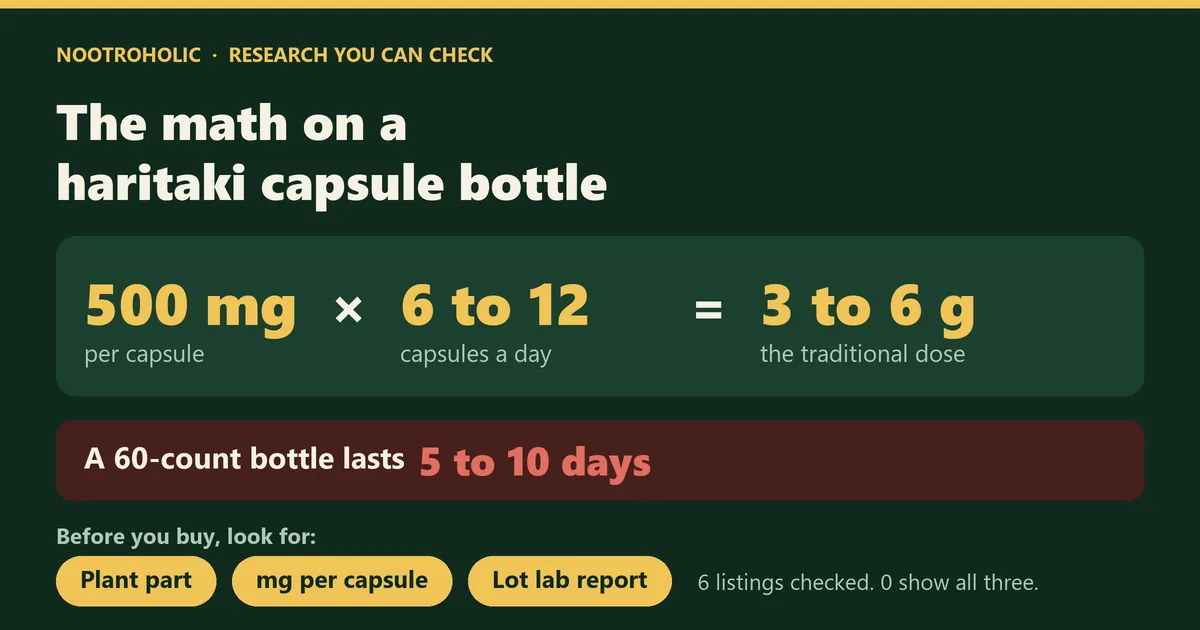
A typical haritaki capsule holds 500 mg of powder.
The traditional dose is 3 to 6 g.
That’s 6 to 12 capsules a day. A 60-count bottle lasts 5 to 10 days.
So the best haritaki capsule is the one that tells you what’s inside. The plant part, the mg per capsule and a lab report for your lot.
At the traditional dose you need 6 to 12 capsules a day. If you want trial-style dosing, you need an extract capsule at 250 to 500 mg, not a powder capsule. Buy the label that states the plant part, the mg per capsule and a lot-specific lab report. If none does, email the seller. If you’re pregnant, nursing or on glucose-lowering drugs, ask your doctor first.
Where to start: US capsules to check first
Dr. Wakde’s Haritaki Capsules
500 mg · 60 capsules · 4.0 stars (25 ratings)
- The listing says “nut powder.” Ask what plant part that is
- Its servings math doesn’t add up (2-capsule serving, 60 servings, 60 capsules)
- Ask for: the lot report
AyurBest Haritaki 500 mg Capsules
500 mg · 90 capsules · USDA Organic · Kosher (per listing title)
- At 3 to 6 g a day, a 90-count bottle lasts 7 to 15 days
- I only read the title. Ask for: the plant part and a lot report
Vadik Herbs Organic Haritaki Capsules
Certified Organic (per listing title)
- The title doesn’t give the mg or the count. Check both on the listing
- Ask for: the plant part and a lot report
Third Eye Awakening Organic Haritaki Capsules
650 mg · 100 capsules · Organic (per listing title)
- If the 650 mg is all haritaki, 3 to 6 g takes about 5 to 9 capsules a day
- Ask for: the plant part and a lot report
Stock changes, so check the listing. Based in the EU? Nimi and Cosmoveda are in the comparison below. Send the seller the email in this post before you order.
What’s actually inside a haritaki capsule?
Three different things get sold as “haritaki capsules.”
- Powder capsules. Ground fruit in a shell. The ones I checked hold 380 to 500 mg.
- Extract capsules. A concentrate. 500 mg of extract is not 500 mg of powder.
- Blends. Triphala and similar formulas. These aren’t haritaki alone.
The shell matters less. The three that state it use HPMC (hydroxypropyl methylcellulose), which is plant-based. Tablets are different, because they need a binder like gum acacia, so a 500 mg tablet holds less than 500 mg of haritaki.
“Nut powder” is not “fruit wall powder”
A top capsule listing on Amazon US says its capsules contain “pure nut of Haritaki.”
The pharmacopoeia defines the medicinal drug as the pericarp, the fruit wall. The seed is a different part. A “nut” could mean the whole fruit with the stone in it, and I can’t tell from the listing.
The part changes the chemistry. In a 2024 analysis, the outer skin of the fruit carried about 8 times more of 12 measured tannins and phenolics than the inner layer and seed together. That’s one sample, not a clinical result.
Ask what part is in the capsule. We go deeper on this in the haritaki powder guide.
The capsule math nobody prints on the bottle
Here’s what 500 mg capsules mean for the traditional dose.
| Daily dose | Capsules at 500 mg | A 60-count bottle lasts |
|---|---|---|
| 1 g | 2 | 30 days |
| 3 g (low end, traditional) | 6 | 10 days |
| 6 g (top end, traditional) | 12 | 5 days |
Now compare that with what the labels say. Dr. Wakde’s suggests 1 to 2 capsules, once or twice a day. That’s 500 mg to 2 g, well under the traditional dose.
And the trials? Most used extracts, not powder. The type 2 diabetes trial gave 250 or 500 mg of aqueous extract twice daily. The skin and gut trials gave 250 mg of standardized extract twice daily. The pain study gave one 1,000 mg dose. One exception: a four-week trial in patients with schizophrenia used six 500 mg capsules of black myrobalan (3 g) a day.
So a powder capsule and a trial extract aren’t comparable. A 500 mg powder capsule is not a 500 mg extract capsule. For the trial results, see the haritaki guide.
Best haritaki capsules: what 6 listings actually show
I read each listing on 10 October 2026. This is what’s printed on the page, and nothing more.
| Product | Form | Per capsule or tablet | Testing shown on the page |
|---|---|---|---|
| Nimi Haritaki Extract Capsules (60, EU) | Extract | 500 mg extract, 75 mg tannins | “BDIH controlled heavy metal testing” seal |
| Cosmoveda Organic Haritaki Capsules (200, EU) | 79% fruit powder | about 380 mg powder, about 149 mg polyphenols | None |
| Dr. Wakde’s Haritaki Capsules (60, US) | “Nut powder” | 500 mg | None |
| Saptamveda Natural Haritaki Capsules (60, US) | Powder | “500mg capsules” | None |
| Banyan Botanicals Haritaki Tablets (90, US) | Tablet | 500 mg, with gum acacia | None on the page |
| Brieofood Organic Haritaki (90 tablets, US) | Tablet | 750 mg, with gum acacia | Organic cert, GMP-facility claim |
The Cosmoveda and Nimi per-capsule figures come from the labels, with one calculation of mine. Cosmoveda prints its numbers per 8 capsules, so I divided by 8.
AyurBest, Vadik Herbs and Third Eye Awakening are in the picks above. I only read their listing titles, so they’re not in this table.
Nimi Haritaki Extract Capsules: best documented, but it’s an extract
Nimi is the only capsule I found with a testing seal on the page. It says “BDIH controlled heavy metal testing.”
A seal isn’t a lot report. It doesn’t tell you the lead number in your bottle.
It’s also an extract. The label says 83% haritaki fruit extract, and 1 g of extract per 2 capsules carries 150 mg of tannins. The maximum is 1 capsule twice daily. I didn’t see the extraction solvent or the extract ratio on the page, and the page doesn’t say where the fruit grows.
At 1 g of extract a day, you’re in the same range as the 250 to 500 mg twice-daily trials. It’s not the same extract though, so don’t treat the trial results as yours.
Cosmoveda Organic Haritaki Capsules: the one with real numbers
Cosmoveda prints something the others I checked don’t. Per 8 capsules you get 3.04 g of fruit powder and 1,193.2 mg of polyphenols.
The label says to take 4 capsules twice a day. That’s 8 capsules and 3.04 g, the low end of the traditional 3 to 6 g.
It’s certified organic, from Indian and Sri Lankan Fairtrade projects, and the page says the powder comes from the dried fruit. That’s still not “pericarp” or “whole fruit with seed.”
What’s missing is a lab test. I saw no testing claim on the page. And it doesn’t say which method produced the polyphenol number, so you can’t compare it with the chebulinic acid figures in the research.
Dr. Wakde’s Haritaki Capsules: the US pick, two things to ask
It was the first listing in my Amazon US search for “haritaki capsules.” 60 capsules, 4.0 stars from 25 ratings.
Two things to ask before you buy.
First, the “nut.” The listing says “pure nut of Haritaki” and “100% Pure Haritaki nut powder.” Ask the seller what part that is.
Second, the supplement facts don’t add up. They list a serving size of 2 capsules and 60 servings per container, and the bottle holds 60 capsules. That’s 30 servings. It’s probably a typo, but it’s the kind of typo you ask about.
It also claims zero additives and zero fillers. I saw no lot testing mentioned.
Saptamveda Natural Haritaki Capsules: not enough on the page
60 capsules. The description says “500mg capsules” and “100% authentic.”
I found no plant part, no capsule material, no certification and no testing claim. There are no reviews either. The title says “60 tabs” and the description says capsules.
You can still buy it. But this is the listing where an email to the seller does the most good.
Tablets, not capsules: Banyan and Brieofood
Both turned up in a “haritaki capsules” search, so you may see them.
Banyan’s tablet is 500 mg of haritaki fruit and gum acacia, 90 tablets. It was sold out when I checked, and the page doesn’t give a testing claim. Banyan does publish a company testing policy on its site, which we covered in the haritaki powder guide.
Brieofood is 750 mg per tablet, organic haritaki with gum acacia and purified water, 90 tablets per pack. It claims organic certification by One Cert International and a GMP-compliant, FDA-registered facility. It has 465 ratings at 4.4 stars. The listing also sells a pack of 2. A serving is 2 tablets (1,500 mg), and reviewers say the uncoated tablets are hard to swallow.
Both contain a binder. So the haritaki per tablet is less than the tablet weight.
What to check before you buy haritaki capsules
Here are the 6 checks, in the order I’d run them.
- Form. Powder, extract or blend. If it says “extract,” ask for the ratio and what was measured.
- mg per capsule. And per serving. Do the servings math, like I did with Dr. Wakde’s.
- Plant part. Pericarp, whole fruit or “nut.” If the seller can’t say, assume whole fruit.
- Other ingredients. The shell, plus any binder, filler or flow agent.
- A lot report. Lead, cadmium, arsenic, mercury, microbes and the plant identity, for your lot. A seal is a start. A report is the answer. The full checklist is in the haritaki powder guide.
- A marker panel. Chebulagic, chebulinic, gallic and ellagic acid. This matters because authentic batches vary. In a study of 35 authenticated batches, chebulinic acid ran from 3.48 to 182.65 mg/g. That’s 52 times. Two bottles with “500 mg” on the front can hold very different chemistry.
Lead math still applies. At 12 capsules you’re swallowing 6 g, so a powder at the EU supplement limit of 3.0 mg/kg delivers 18 micrograms of lead a day. Ask for the number.
Words that prove nothing: “100% pure,” “authentic,” “premium,” “lab tested” with no lot, “Himalayan.”
Haritaki capsules benefits: what’s actually shown
The traditional use is digestion and regularity. That’s plausible for a tannin-rich fruit with a long history as a gentle laxative.
The human evidence is thin though, and it’s about extracts. I found no solid placebo-controlled trial of haritaki capsules or powder for constipation.
Small trials of extracts and a mouth rinse show changes in vascular, skin, gut and dental measures. Those are lab measures in small groups. None is a proven treatment.
If you want the study-by-study breakdown, it’s in the haritaki guide.
Haritaki capsules side effects and who should skip them
The main effect is laxative, and the main side effect is loose stools. Cramps and urgency come with it. If diarrhea continues you can get dehydrated.
Ask a doctor or pharmacist first if you are pregnant or breastfeeding, giving it to a child, or have kidney or liver disease. The same goes for active gut illness and glucose-lowering drugs. The drug interaction risk is theoretical because nobody has measured it.
Start with the lowest label dose. Watch your stool for a few days before you raise it.
If you believe haritaki harmed you, report it on our adverse events page.
Capsules or powder?
Capsules win on taste, carrying and dose control. A powder tastes bitter and astringent, and capsules skip that.
Powder wins on the dose. At 6 g a day, 12 capsules is a lot to swallow.
If you want the traditional dose, powder is the practical choice. If you want a fixed small dose with no taste, a capsule works. If you want to mimic a trial, you need the trial’s extract.
Whichever you pick, the same rule applies. Ask for the lot report.
Email the seller
Send this before you order.
Is your haritaki capsule powder or extract? What plant part is it (pericarp, whole fruit or seed), and how many mg per capsule? Please send the lab report for the lot I’m buying, with lead, cadmium, arsenic, mercury and microbes, plus the methods, units and detection limits. If it’s an extract, what’s the ratio and what was measured? Please also send chebulagic, chebulinic, gallic and ellagic acid results for your last 3 lots.
A seller who answers has told you something. So has one who doesn’t.
Haritaki capsules FAQ
What are haritaki capsules?
Haritaki capsules are ground fruit or fruit extract of Terminalia chebula in a capsule shell. The powder capsules I checked hold 380 to 500 mg. Extract capsules are a concentrate, so 500 mg of extract isn’t 500 mg of powder.
How many haritaki capsules should you take?
No dose is validated for everyone. The traditional dose is 3 to 6 g of powder, which is 6 to 12 capsules at 500 mg. The labels I saw suggest 1 to 2 capsules once or twice a day. Start at the low end and watch your stool.
What is the best haritaki capsule?
None shows the plant part, the mg per capsule and a lot-specific lab report together, so none can be proven best. Nimi shows a heavy-metal testing seal, and Cosmoveda prints per-capsule numbers. Ask any seller for the lot report.
Are haritaki capsules better than powder?
They’re easier to take. At the traditional dose you’d swallow 6 to 12 capsules a day. Powder suits the traditional dose. A capsule suits a small fixed dose.
What are the side effects of haritaki capsules?
Loose stools, cramps and urgency are the main ones, and dehydration if diarrhea continues. Pregnancy, breastfeeding, children, kidney or liver disease and glucose-lowering drugs call for a doctor’s advice first.
Can you take haritaki capsules every day?
No trial supports long-term daily use. The longest I found was 24 weeks on an extract. If you take it daily, keep the dose low and check with a clinician.
Do haritaki capsules help with constipation?
It’s plausible, because haritaki has a long traditional use as a gentle laxative. But I found no solid placebo-controlled trial of capsules or powder for it, so it isn’t proven.
Last Words
Haritaki capsules are convenient, and 500 mg is not much haritaki. The label tells you less than you’d think.
Pick the one that states the part and the mg, then ask for the lot report. If the seller can’t send it, you have your answer.
Email the seller first. A clear answer with a lot report is your green light. A dodge is your answer too.
What we don’t know
- Whether any capsule on the market matches its label for plant part or mg
- Whether pericarp-only capsules work better than whole-fruit ones
- A proven best dose, or a safe long-term daily dose
- Which brand is cleanest, because no one has tested matched, blind-bought lots
Sources
- Royal Botanic Gardens, Kew. Plants of the World Online: Terminalia chebula Retz.
- Government of India. The Ayurvedic Pharmacopoeia of India, Part I, Vol. I, Haritaki monograph
- Xu J et al. Study on quality characteristic of Chebulae Fructus and its adulterants and degradation pathway of hydrolyzable tannins. Molecules, 2024
- Terminalia chebula aqueous extract in type 2 diabetes, randomized trial. Phytotherapy Research, 2020
- Chakkalakal D et al. Standardized Terminalia chebula extract and skin appearance. J Clin Med, 2023
- Min M et al. Terminalia chebula extract and gut microbiome. J Funct Foods, 2024
- Single-dose Terminalia chebula extract in experimental mechanical pain. 2016
- European Commission. Regulation (EU) 2023/915 on maximum levels for contaminants in food
- Nimi. Haritaki Extract Capsules, 60 pieces, accessed 10 October 2026
- Cosmoveda. Organic Haritaki Capsules, 200 capsules, accessed 10 October 2026
- Dr. Wakde’s. Haritaki Capsules, 60 veggie capsules, accessed 10 October 2026
- Saptamveda. Natural Haritaki Capsules, accessed 10 October 2026
- Banyan Botanicals. Haritaki Tablets, accessed 10 October 2026
- Brieofood. Organic Haritaki 1500mg tablets, accessed 10 October 2026