
The best haritaki powder is the one whose seller shows you a lab report for your exact lot.
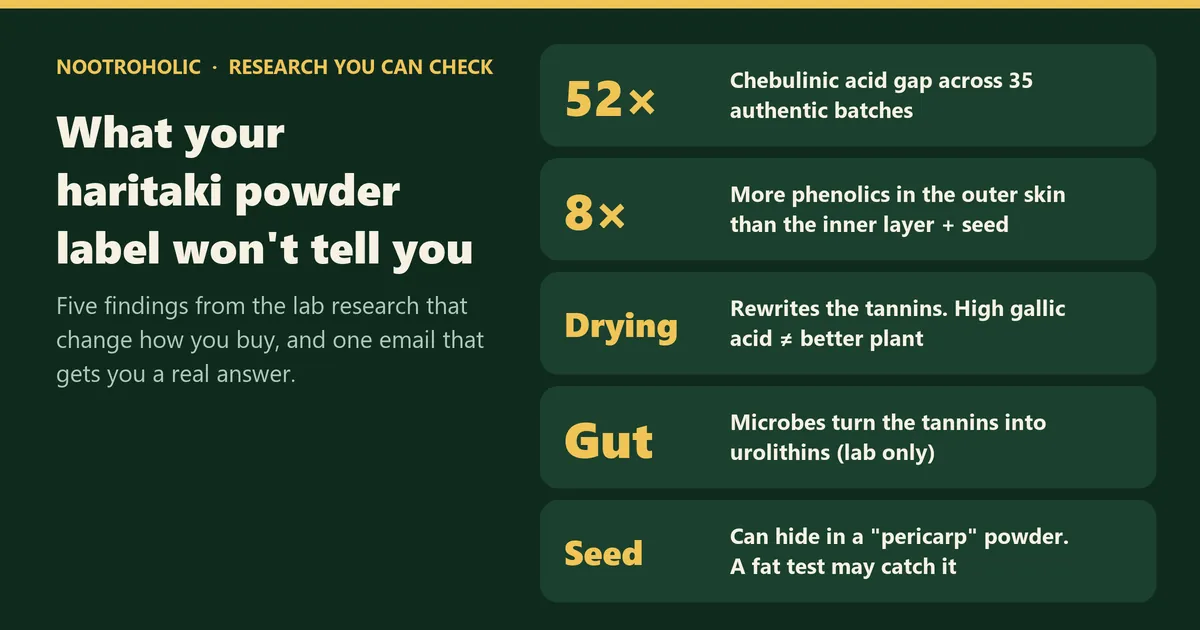
In one study of 35 authenticated batches of haritaki fruit, chebulinic acid ran from 3.48 to 182.65 mg/g. That’s a 52-fold gap inside one species.
So “100% pure” can at best name the plant. It can’t tell you what’s in your bag.
Safety has the same catch. A powder sitting at the EU lead limit for supplements (3.0 mg/kg) delivers 18 micrograms of lead at the 6 g top of the traditional dose. It’s legal. You still don’t want it.
So buy for proof, start low, and use the checks below.
Quick answer: Haritaki powder is ground Terminalia chebula fruit. The traditional dose is 3 to 6 g. Most human trials used extracts at 250 to 500 mg, not the powder. Authentic batches can differ more than 50-fold in key tannins. Expect a laxative effect, and loose stools if you overdo it. Buy only with a lot-specific lab report for lead, cadmium, arsenic, mercury, microbes and plant identity. If you’re pregnant, nursing, or on glucose-lowering drugs, ask your doctor first.
Where to start: three powders to check first
Banyan Botanicals Organic Haritaki Powder, 1 lb
- Certified organic and Fair for Life, per Banyan’s site
- Publishes a testing policy: HPTLC and microscopy for ID, third-party tests for metals and microbes
- Still ask for: the lot report and a pericarp statement. A seller reply says it’s seedless
Kailash Herbals Organic Haritaki Powder, 1 lb (16 oz)
- Listed as organic, 1 lb (16 oz)
- I haven’t seen a lot report or a plant-part statement
- Ask for: the lot report, pericarp or whole fruit, and the metals panel
Just Jaivik Organic Haritaki Powder, 227 g (0.5 lb)
- Listed as USDA Certified Organic, 227 g
- I haven’t seen a lot report or a plant-part statement
- Ask for: the lot report, pericarp or whole fruit, and the metals panel
Stock changes, so check the listing. Before you order, send the seller the email in the buying section below.
What is haritaki powder?
Haritaki powder is dried Terminalia chebula Retz. fruit, milled fine. The tree grows across India, Nepal, Bangladesh, Sri Lanka, Thailand, Laos, Myanmar, Cambodia and Vietnam, according to Kew’s plant database.
You’ll see many names for it: harad, harda, hirda, kadukkai, karakkaya, chebulic myrobalan. They all point at the same species. But a name on a label proves nothing about the batch.
Haritaki is also one of the fruits in Triphala. If you want the comparison, we cover it in the haritaki guide.
Haritaki fruit powder: pericarp, whole fruit, or seedless?
Sellers blur this.
The fruit has a wall (the pericarp) and a seed inside. The Ayurvedic Pharmacopoeia of India defines the medicinal drug as the pericarp of mature fruit. It describes a fibrous wall about 3 to 4 mm thick, not stuck to the seed.
So three things get sold under one name:
- Mature-fruit pericarp, seed excluded. Matches the pharmacopoeia.
- Whole fruit, seed ground in. A different preparation. Honest if labeled “whole fruit.”
- “Pulp,” “rind,” “shell,” “seedless.” Vague. Ask what tissue was actually milled.
The fruit wall isn’t uniform either. A 2024 analysis split mature fruit into layers and added up 12 measured tannin and phenolic compounds in each.
| Fruit layer | Sum of 12 measured compounds |
|---|---|
| Outer skin (exocarp) | 148.86 mg/g |
| Middle tissue (mesocarp) | 96.14 mg/g |
| Inner layer plus seed (measured together) | 18.64 mg/g |
The outer skin carried about 8 times more than the inner layer and seed. That’s chemistry in one sample, with no clinical result attached. It still shows that what gets milled into your powder changes what’s in it.
Does pericarp-only work better? I found no matched clinical comparison of pericarp against whole fruit. The pharmacopoeia tells you what the traditional drug is. It doesn’t tell you what works best.
Read the label. If a seller uses “whole fruit” and “seedless pericarp” for the same product, that’s your first red flag.
Two authentic batches can differ 52-fold
The same 2024 study measured 35 authenticated batches of haritaki fruit from India, Myanmar and several Chinese provinces. The spread was wide.
| Marker | Lowest batch | Highest batch | Gap |
|---|---|---|---|
| Chebulinic acid | 3.48 mg/g | 182.65 mg/g | 52.5× |
| Chebulagic acid | 6.82 mg/g | 156.84 mg/g | 23.0× |
| Punicalagin | 6.90 mg/g | 81.35 mg/g | 11.8× |
The authors point to origin and processing but didn’t test which one caused it. A bigger number doesn’t make a batch 52 times better, and no study links these numbers to results in people.
What it does tell you: one lab report describes one lot. A seller who claims consistency should show the same marker panel on three lots in a row.
Haritaki powder benefits: what the research actually tested
The traditional case for haritaki powder is old and the lab case is large. The human case is small, and it’s built on other forms of haritaki.
| Study | What was tested | Who | What it found | Does it apply to the powder? |
|---|---|---|---|---|
| Gupta et al. (dental) | T. chebula mouth rinse vs chlorhexidine vs saline | 78 people, 26 per group | Plaque and gum scores improved in both active groups, with no clear difference between them | No. It’s a rinse, not something you swallow. |
| Type 2 diabetes trial (2020) | Aqueous extract, 250 or 500 mg twice daily, 12 weeks | 60 people, placebo-controlled | A vascular marker (reflection index) fell 2.55% and 5.21% in the two doses. Placebo rose 1.40%. | No. Extract, and a biomarker, not heart events. |
| Skin study (2023) | Standardized extract, 250 mg twice daily, 8 weeks | 38 completers (21 extract, 17 placebo) | Changes in sebum, redness and wrinkle measures | No. One branded extract, small, with an industry link. |
| Gut microbiome trial (2024) | Standardized extract, 250 mg twice daily, 8 weeks | 43 women with higher BMI and borderline glucose | Shifts in gut bacteria and short-chain fatty acids | No. A microbiome change isn’t a patient benefit. |
| Pain tolerance study (2016) | One 1,000 mg oral dose | 12 healthy volunteers, crossover | Short-term difference in a lab pain test | No. One dose in healthy people. |
| Banazadeh et al. (schizophrenia, 2022) | Black myrobalan capsules, six 500 mg a day (3 g), four weeks, against placebo | Patients with chronic schizophrenia | Better scores on a cognitive screening test and on negative symptoms | Partly. It is the closest match to the traditional low dose, but it says little for healthy adults. |
Read the right-hand column twice. It says “No” five times and “Partly” once.
You can’t point at these trials and say your powder does the same. An extract concentrates certain compounds. Your powder is the whole ground tissue.
Haritaki powder for digestion and constipation
This is the benefit most people buy it for, and it’s the best fit for the traditional use. Haritaki is tannin-rich and has a long history as a gentle laxative.
But the human evidence is thin. I found no solid placebo-controlled trial of ordinary haritaki powder for constipation. What exists is tradition, formulas and animal or lab work.
So treat it as plausible. It isn’t proven. If your constipation is new, severe, or comes with blood or weight loss, see a doctor first.
Antioxidants and gut microbes: big in the lab, unproven in you
Haritaki is rich in hydrolysable tannins like chebulagic acid and chebulinic acid. Lab tests show strong antioxidant activity.
A test tube isn’t a body. Antioxidant assays don’t show that the powder treats any inflammatory disease. They show a reason to study it.
Digestion adds a twist. In a 2015 lab study, human gut microbes turned chebulagic and chebulinic acids into urolithins (A, B, C, D and M5). The test used simulated digestion, a multi-herb formula, and the pure acids.
A 2026 lab study did something similar with Triphala, which is a blend, not haritaki alone. Gut fermentation broke down roughly half the native phenolics, and urolithins showed up briefly, peaking around 24 hours.
Both are test-tube studies. No study shows that haritaki powder raises urolithins in people, or that it helps. It does suggest the chemistry that reaches your body may differ from what’s in the jar.
Haritaki powder spiritual benefits
Ayurveda calls haritaki a rasayana, a rejuvenative, and gives it spiritual standing in some traditions. That’s culture and belief. Value it as that.
No clinical study measures spiritual effects. The viral “decalcifies the pineal gland” claim has no direct testing either. We checked it in Haritaki and the Pineal Gland.
How to take haritaki powder
No single dose is validated for everyone. Three numbers circulate, so know which is which.
- The traditional dose is 3 to 6 g of powder. This comes from the Ayurvedic Pharmacopoeia of India. It’s a historical dose. No trial has proven it safe or effective.
- Seller label doses. The labels I checked range from about ¼ teaspoon to 1 teaspoon, once or twice a day, in warm water. That’s well under the traditional top end.
- Trial doses were 250 to 500 mg of extract. These are extracts, so don’t convert them into grams of powder. 250 mg of extract is not 250 mg of powder.
How to use the powder:
- Weigh it once. A kitchen scale tells you what a teaspoon of your powder weighs. Density varies by brand and grind.
- Start at the bottom of the label range. Use a quarter teaspoon, not a heaping one.
- Mix it with warm water. It tastes bitter and astringent. Some people stir in honey.
- Watch your stool for a few days. If it goes loose, cut the dose. If it stays normal, you decide whether to go up.
- Pick a consistent time. Morning and evening both show up in advice online. No trial compared timing, so choose what you’ll actually stick to.
How long until it works? No trial timed the powder. The extract trials above ran 8 to 12 weeks before measuring anything.
Can you take it daily? That’s the question the evidence can’t answer. The longest trial I found ran 24 weeks on an extract. Long-term safety isn’t established.
Haritaki powder side effects and who should skip it
Haritaki is astringent and tannin-rich. At higher doses it can act as a laxative. That’s the main effect you’ll feel, and the main side effect too.
Common ones:
- Loose stools
- Abdominal discomfort or cramps
- Urgency
- Dehydration, if the diarrhea continues
Ask a doctor or pharmacist first if you:
- are pregnant or breastfeeding (there’s not enough safety data)
- are giving it to a child
- have kidney or liver disease
- have active gut illness, or fragile hydration or electrolyte balance
- take glucose-lowering drugs or several medications
The drug interaction risk is theoretical, since nobody has measured it. Glucose and gut-transit effects are the ones to take seriously.
Get medical help for severe belly pain that doesn’t settle, bloody stools, repeated vomiting, dehydration, or signs of allergy. Don’t push the dose up to fix it.
The small trials above reported few problems. But a trial of 12, 38 or 60 people can’t see rare or delayed harms.
If you believe haritaki harmed you, report it on our adverse events page.
How to buy haritaki powder: the lab checks that matter
Contamination is a supply-chain problem that any herb can have, and studies have gone both ways. A 2011 screen of market herbs including T. chebula didn’t detect the metals and pesticides it looked for. Another study of Ayurvedic products containing haritaki found various metals at low levels.
So test the lot you’re buying, or ask the seller for proof.
What “organic haritaki powder” does and doesn’t prove
Organic certification covers how the crop was grown and handled. That’s worth having, because it means rules on synthetic pesticides.
But it doesn’t test for heavy metals. Soil can hold lead or cadmium from industry or history, and organic rules don’t change that. It also doesn’t prove species, plant part, or microbe counts.
So treat organic as one good signal. It isn’t a test result. The same goes for “GMP” (how a factory runs) and “third-party tested” (who ran a test, on which sample, unknown).
The COA checklist
A real COA is for your lot, with numbers. Use this table.
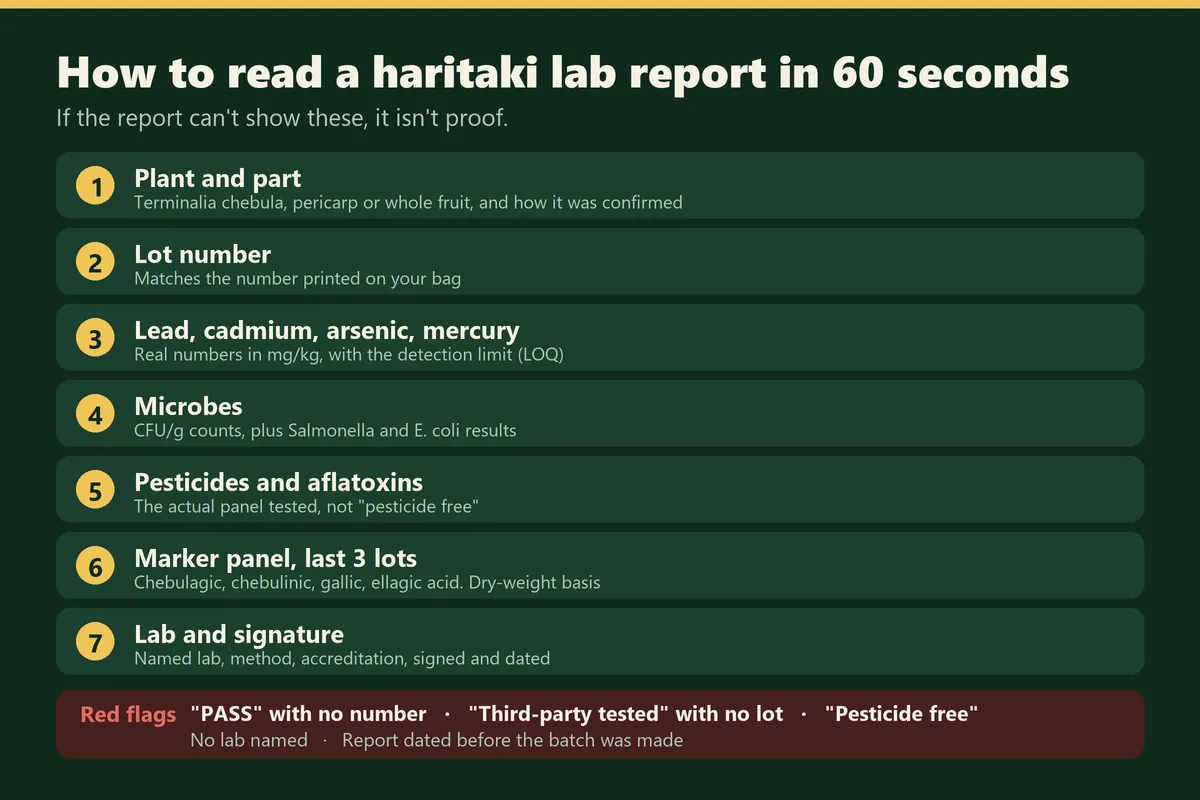
| What to check | What a good report shows |
|---|---|
| Plant and part | Terminalia chebula Retz., and whether it’s pericarp or whole fruit, with how identity was confirmed (microscopy or an HPTLC fingerprint) |
| Marker panel | Chebulagic, chebulinic, gallic and ellagic acid, with the method and dry-weight basis. Ask for the last three lots. |
| Lot number | The same lot number as your bag, with sampling and test dates |
| Lead, cadmium, arsenic, mercury | Measured values with units (mg/kg), a limit, and the detection limit (LOQ). “Not detected” must come with an LOQ. |
| Microbes | Counts (CFU/g) for total aerobic count, yeast and mold, plus Salmonella and E. coli tests |
| Pesticides | The actual panel tested. “Pesticide free” isn’t a result. |
| Aflatoxins | Values for B1, B2, G1 and G2, or a reason they were skipped |
| Lab | A named laboratory, a method, and an accreditation you can look up |
| Signature | A signed, dated report |
For the same skill on other products, see how to verify a peptide COA and verify authentic shilajit.
Run the lead math yourself. Take the limit in mg/kg, multiply by your dose in kg, and convert to micrograms. 3.0 mg/kg × 0.006 kg = 0.018 mg, which is 18 µg. Your seller’s real number should sit far under the limit.
If a seller claims pericarp, the pharmacopoeia sets these limits: foreign matter at 1% or less, total ash and acid-insoluble ash at 5% or less each, alcohol-soluble extractive at 40% or more, and water-soluble extractive at 60% or more. Those are identity and purity checks. They don’t test safety, so a powder can pass them and still fail on metals.
Why one lab number can mislead
Drying changes haritaki’s chemistry. In the 2024 study, sunlight drying shifted the tannin profile. Punicalagin and chebulagic acid fell, chebulinic acid rose, and smaller compounds like gallic and ellagic acid built up. The authors suggest big tannins break into smaller ones as the fruit dries, though those pathways are inferred.
So a high gallic acid number can mean a good plant, or a plant that has broken down more. One number can’t tell you which. Ask for the panel: chebulagic, chebulinic, gallic and ellagic acid, with the method and whether the result is per dry weight.
No drying method has been proven best, and sun-dried isn’t a defect.
Can a lab catch seed hiding in a pericarp powder?
Species testing can’t answer that. A powder can be 100% Terminalia chebula and still include the seed.
A 2026 study reports a fat-based fingerprint. It compared fruit-rind powder with nut (kernel) material and with mixtures of the two. The kernel carried more total fat and triglycerides, the rind carried more of the key phenolics, and the triglyceride signal rose as more kernel went in. Fat is the signal this method looks for, which is one reason an odd fat figure on a label (see the seller table below) deserves a question.
Two limits. It’s one study, and some of its authors work at Himalaya Wellness Company, so wait for independent replication. And seed in a powder labeled “whole fruit” isn’t adulteration. It only matters when the label says pericarp only.
Label claims that prove nothing
- “100% pure.” Pure of what? Show the species and part.
- “Himalayan” or “wildcrafted.” A location, not a quality test. No evidence ranks one region above another.
- “Highest chebulinic acid.” Higher tannin isn’t proven better for results or tolerance. And a percent without a method and a sample basis means nothing.
- “Shade dried.” A process description, not a grade.
- “Microfine” or “100 mesh.” Fineness isn’t purity. It doesn’t prove absorption either.
- “Third-party tested.” Which lot? Which lab? Which results?
Email the seller
A supplier who answers in detail has told you something. One who dodges has too.
Is your haritaki powder Terminalia chebula mature-fruit pericarp only, or does it include seed? Please send the original COA for the lot I’m buying: identity, lead, cadmium, arsenic, mercury, microbes and the pesticide panel, with methods, units, LOQs, testing lab and accreditation scope. Please include chebulagic, chebulinic, gallic and ellagic acid results for your last three lots, and say how you check for seed in a pericarp-only product. What are your harvest region, drying method and shelf-life basis?
Best haritaki powder: what sellers actually publish
I can’t name a winner. No public page I found shows a verified, lot-matched COA for any haritaki powder, so none can be proven best. What I can show is how much each seller discloses. Listings are a snapshot from 10 October 2026. Kailash Herbals and Just Jaivik joined the list after the research, so for them I only checked the Amazon listing title.
| Seller | What’s public | What’s missing |
|---|---|---|
| Banyan Botanicals Haritaki Powder (US) | Certified organic and Fair for Life. A published testing policy: HPTLC and microscopy for ID, third-party testing for metals and microbes. Both sizes showed as sold out on Banyan’s own site on 10 October. | The actual lot’s chromatogram and metals values. The page says “fruit,” not “pericarp,” though a seller reply says it’s processed without the seeds. |
| Kailash Herbals Organic Haritaki Powder, 1 lb (US) | Listed as organic, 1 lb (16 oz). | Everything else. I only checked the listing title. Ask for the lot report, plant part and testing details. |
| Just Jaivik Organic Haritaki Powder, 227 g (US) | Listed as USDA Certified Organic, 227 g (0.5 lb). | Everything else. I only checked the listing title. Ask for the lot report, plant part and testing details. |
| BioMenü Organic Haritaki Powder, 125 g (EU) | 100% organic, single ingredient, Indian origin, non-irradiated. | A lot COA and a named lab. Its nutrition table lists about 48 g fat per 100 g, which is odd for a fruit powder. It may be an error, but the seller should explain it. |
| Sewanti Organic Haritaki Powder (Canada) | Organic T. chebula powder. | Pack size, lot results, pericarp statement and provenance. |
| Organic India | A sourcing story for haritaki. | A standalone haritaki powder. I found their Triphala, which is a blend, so it isn’t comparable. |
Banyan Botanicals haritaki powder is where I’d send my first email. Its public testing policy is more specific than “lab tested.” But a policy is not a lot report, so ask for the report.
The best powder is still the one whose seller hands you a clean, lot-matched report for your bag.
Haritaki powder vs extract, capsules and Triphala
| Form | What it is | What to ask |
|---|---|---|
| Powder (pericarp) | Ground fruit wall, nothing removed | Is it the declared tissue, and tested for this lot? |
| Whole fruit powder | Fruit wall plus seed | Is it labeled honestly as whole fruit? |
| Extract | Concentrated water or alcohol extract | What solvent, ratio, and marker? Is it the same product the trial used? |
| Capsules | Powder or extract in a shell | What’s in them, and how much per capsule? |
| Triphala | Haritaki blended with two other fruits | Can you credit any result to haritaki alone? |
A “10:1 extract” isn’t ten times stronger. It means about ten units of plant went into one unit of extract. And “40% tannins” depends on the test method behind it.
For the trial results above, you’d need the extract the study used. For traditional use, plain powder is the match.
Haritaki powder FAQ
What is haritaki powder?
Haritaki powder is the dried fruit of Terminalia chebula ground to a powder, used in Ayurveda and found in Triphala. Pharmacopoeial haritaki is the pericarp (fruit wall) of the mature fruit, but some sellers grind the whole fruit with its seed. Check the label.
Why do haritaki powders differ so much?
Authentic batches can differ a lot. One study of 35 authenticated batches found chebulinic acid ranging from 3.48 to 182.65 mg/g. Origin and processing are suspected, but the study didn’t prove which. The part of the fruit that gets milled matters too. That’s why you need a lot report, not just a species claim.
What are the benefits of haritaki powder?
Traditional use centers on digestion and regularity. Small human trials of extracts and a mouth rinse show changes in vascular, skin, gut and dental measures. The closest test of a traditional-style dose was a four-week trial of 3 g a day in patients with schizophrenia. No solid trial has tested ordinary powder for digestion, so treat the benefits as traditional and plausible. None are proven.
How do you take haritaki powder?
The traditional dose is 3 to 6 g of powder. Seller labels commonly suggest about ¼ to 1 teaspoon in warm water, once or twice a day. Start at the low end and watch your stool. No dose is proven safe for everyone.
What are the side effects of haritaki powder?
The main effects are loose stools, cramps, urgency and, if diarrhea persists, dehydration. Pregnancy, breastfeeding, children, kidney or liver disease, and glucose-lowering drugs call for a doctor’s advice first. Long-term safety isn’t established.
Can you take haritaki powder every day?
No trial supports a long-term daily dose of the powder. The longest I found was 24 weeks on an extract. If you take it daily, keep the dose low, watch for loose stools, and check with a clinician.
Is organic haritaki powder better?
Organic certification covers how the fruit was grown, which is worth having. It doesn’t test for heavy metals, microbes or species identity. You still need a lot-specific COA, whether the powder is organic or not.
What is the best haritaki powder?
No seller has publicly proven a lot-matched, fully tested haritaki powder, so no brand can be crowned best. Choose the one that gives you a lot COA with measured lead, cadmium, arsenic, mercury and microbe results, and states whether it’s pericarp or whole fruit.
Does haritaki powder have spiritual benefits?
In Ayurvedic tradition, haritaki is a rasayana with spiritual associations. No clinical study measures spiritual effects. The claim that it decalcifies the pineal gland has no direct testing, as covered in our pineal gland article.
Last Words
Haritaki powder has a long history and a thin human evidence base, and the trials belong to other forms of haritaki. The part you can control is the bag.
Buy a powder whose seller shows lot-specific numbers for metals, microbes and plant identity. Start low, and stop if your stool goes loose. If you’re pregnant, nursing, or on glucose-lowering drugs, ask your doctor first.
Send the seller the email first. A clear answer with a lot report is your green light. A dodge is your answer too.
What we don’t know
- Whether pericarp-only powder works better than whole fruit
- A proven best dose, or a safe long-term daily dose
- Whether any region, drying method or mesh size makes a better powder
- Which commercial brand is cleanest, because no one has tested matched, blind-bought lots
- Why authentic batches differ so much: origin, processing, or both
- Whether the 2026 fat-based seed-detection method holds up outside the lab that built it
Sources
- Royal Botanic Gardens, Kew. Plants of the World Online: Terminalia chebula Retz.
- Government of India. The Ayurvedic Pharmacopoeia of India, Part I, Vol. I, Haritaki monograph
- Gupta D et al. Terminalia chebula mouth rinse, chlorhexidine and control, 78 participants
- Terminalia chebula aqueous extract in type 2 diabetes, randomized trial. Phytotherapy Research, 2020
- Chakkalakal D et al. Standardized Terminalia chebula extract and skin appearance. J Clin Med, 2023
- Min M et al. Terminalia chebula extract and gut microbiome. J Funct Foods, 2024
- Single-dose Terminalia chebula extract in experimental mechanical pain. 2016
- Dhanani T et al. Validated HPLC method for phenolic constituents in Terminalia species. J Chromatogr Sci
- Heavy-metal and pesticide screening of herbal materials including T. chebula. 2011
- European Commission. Regulation (EU) 2023/915 on maximum levels for contaminants in food
- WHO. Guidelines for assessing quality of herbal medicines with reference to contaminants and residues. 2007
- FDA. Small Entity Compliance Guide: CGMP for dietary supplements (21 CFR Part 111)
- Banyan Botanicals. Haritaki Powder and quality control and testing
- Xu J et al. Study on quality characteristic of Chebulae Fructus and its adulterants and degradation pathway of hydrolyzable tannins. Molecules, 2024
- Olennikov DN et al. In vitro bioaccessibility, human gut microbiota metabolites and hepatoprotective potential of chebulic ellagitannins: a case of Padma Hepaten formulation. Nutrients, 2015
- Jangra B et al. Gut microbial biotransformation of triphala polyphenols into urolithins. Food Bioscience, 2026
- Shankarappa L et al. Integrated phytochemical and chromatographic analysis for detection of adulteration in Terminalia chebula fruit rind powder. Pharmacognosy Research, 2026