
One BPC-157 capsule sold online lists 3 mg of SNAC, the absorption enhancer behind the Wegovy pill. Oral semaglutide trials used about 300 mg per tablet, a hundred times more. And even that pill puts only 1 to 2% of its drug in your blood.
So, can you take peptides orally? Mostly no. A few engineered drugs get through, and for research peptides like BPC-157, FDA’s 2026 review found no published oral absorption data in humans.
If you’re asking because you’d rather skip the needle, here’s what holds up. Each peptide below gets an evidence tier, from approved drug to rodent-only to nothing, so you can tell a real option from a label. Here for the weight-loss pill? Jump to the Wegovy section.
Can You Take Peptides Orally? The Short Answer
Can peptides be taken orally? Rarely, because your gut digests them like food. Swallowed peptides and proteins typically reach your blood at less than 1 to 2% of the dose. The exceptions come in three kinds:
- Engineered drugs: semaglutide tablets (Rybelsus, the Wegovy pill)
- Gut-local peptides: linaclotide, which never needs to be absorbed
- Rodent-only research peptides: BPC-157 and KPV
Tiers run from T5 (approved oral drug) through T4 (small human oral data), T3 (human data by another route), T2 (rodent oral data) and T1 (test tube only) down to T0 (nothing).
Why Can’t Peptides Be Taken Orally?
Because a peptide is a short protein, and your digestive tract is built to chop proteins up. Pepsin starts in the stomach. Pancreatic digestive enzymes take over in the small intestine, and enzymes on the gut lining finish the job.
Stomach acid gets the blame, but enzymes do most of the damage. In a UCL study of 17 peptide drugs, acid alone did little, insulin was gone in about two minutes, and only three peptides were still around after 30 minutes in intestinal fluid. Those three were ciclosporin, desmopressin and octreotide.
Surviving isn’t enough, because the peptide also has to cross the gut wall. The gaps between cells are 3 to 10 angstroms wide and generally block molecules over 500 daltons (2021 review). BPC-157 weighs about 1,419 daltons.
Enteric coating, a shell that survives stomach acid, doesn’t fix this. It skips the stomach and drops the peptide into the intestine, which was the harsher environment in the lab. Coated tablets with absorption enhancers still give low and variable absorption.
One loophole is tiny peptides. A transporter called PepT1 carries two- and three-amino-acid peptides into gut cells, which helps KPV but not a 15-amino-acid peptide like BPC-157.
The Exceptions: Oral Peptides That Work
Do oral peptides work? The ones that do have a trick, and each trick shows what a plain research capsule is missing.
- An absorption enhancer. Oral semaglutide includes SNAC, which buffers stomach acid right next to the tablet so the drug can cross stomach cells. Only 0.4 to 1% is absorbed, or 1 to 2% in the newer tablets.
- A ring structure. Ciclosporin is a cyclic peptide that enzymes struggle to cut. Reviews put its absorption at 30 to 40%.
- A very potent drug. Desmopressin tablets absorb about 0.16%, and that’s enough because the drug is potent.
- Acting inside the gut. Linaclotide is negligibly absorbed and doesn’t need to be. It’s the one mechanism that could plausibly fit gut-focused claims for BPC-157 or KPV.
Oral Peptides for Weight Loss: Rybelsus and the Wegovy Pill
Looking for the weight-loss pill? That’s oral semaglutide, and the Wegovy pill was approved on December 22, 2025. Novo listed the 1.5 mg starting dose at $149 a month at launch, and that price covers only that dose. The pill takes 25 mg a day to match a 2.4 mg weekly shot, about 70 times more drug per week.
In the OASIS 4 trial, the Wegovy pill cut body weight 13.6% versus 2.2% on placebo over 64 weeks. Novo’s 16.6% headline counts only people who stayed on treatment. Stomach side effects hit 74.0% of people on the pill versus 42.2% on placebo.
Here is how to take peptides orally when the drug is built for it. It means an empty stomach, up to four ounces of water, then a 30-minute wait before food, drinks or other pills. The label notes absorption was higher with a longer fast after the dose.
Foundayo (orforglipron) is also a weight-loss pill, built on a small molecule instead of a peptide. For injectables, see our fat loss peptides guide.
Oral Peptides vs Injection: How Much Gets In
Oral peptide bioavailability is the share of a dose that reaches your bloodstream. The lower the number, the more drug you have to swallow to get the same blood level. These figures come from FDA labels.
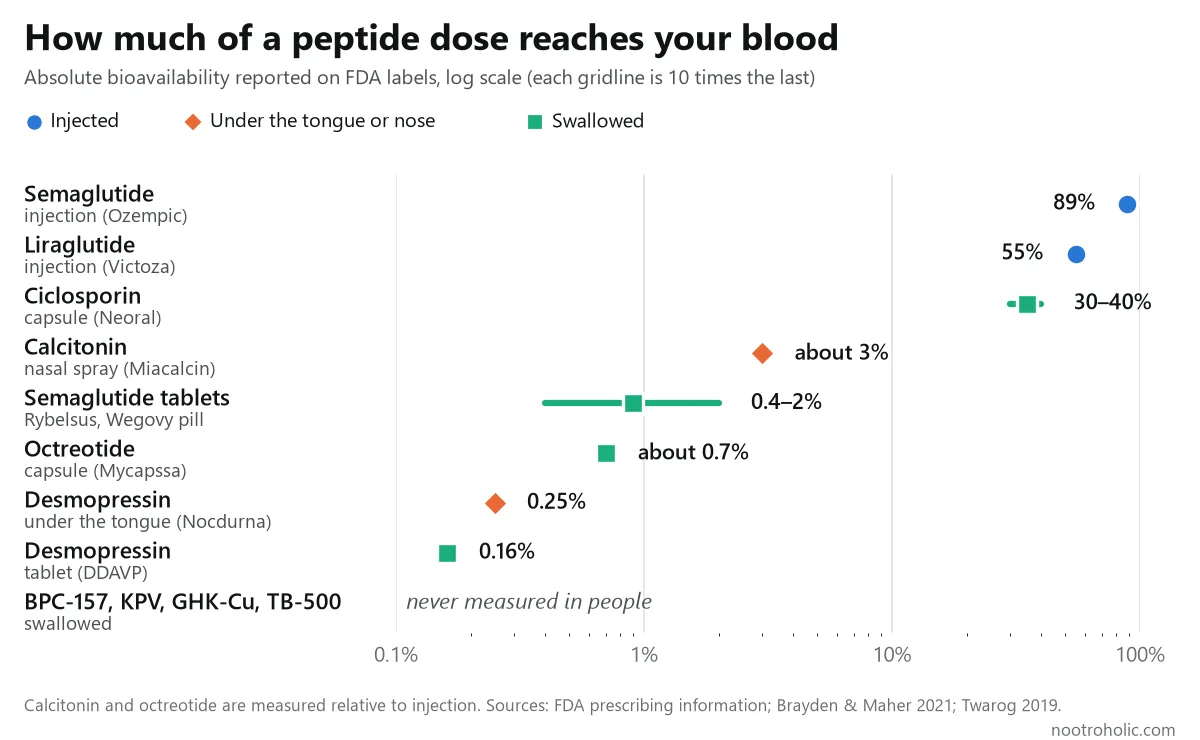
Injection isn’t 100% either. Semaglutide injection is 89% bioavailable and liraglutide is about 55%, though some guides claim 95 to 100%.
Are Oral Peptides as Good as Injections?
No. Even when oral peptides are effective, a swallowed tablet delivers about 1% where an injection delivers 50 to 90%. Makers cover the gap with doses 70 to 200 times higher. That only works when the drug is potent and well understood.
Sublingual vs Oral Peptides
Under the tongue skips stomach enzymes and the liver. But saliva washes the dose away and the lining is tight and fatty. Sublingual desmopressin is 0.25% bioavailable, versus 0.16% swallowed. Nasal calcitonin reaches about 3% of the injected amount.
We found no human data on troches or dissolving tablets of research peptides.
Oral Peptides Compound by Compound
| Compound | Oral tier | Best oral evidence | Verdict |
|---|---|---|---|
| Oral semaglutide | T5 | Large human trials | Works, with SNAC and strict rules |
| Glutathione | T4 | Two human trials, one positive, one null | Moves a lab value, no clinical outcome |
| KPV | T2 | Mouse colitis | Local gut effect, no human data |
| BPC-157 | T2 | Rat drinking water | No human absorption data |
| Epitalon | T2 | One rat study | No human oral data |
| GHK-Cu | T1 | Lab release test | Oral use untested |
| Pinealon, CJC-1295, ipamorelin, TB-500 | T0 | None | Injection or nothing |
Oral BPC-157
The oral case rests on rat studies from one Zagreb lab, with the peptide in drinking water for tendon and fistula injuries. About 76% of PubMed’s BPC-157 papers (175 of 231 in October 2026) list the lab’s Predrag Sikiric as an author.
The “survives stomach acid” line traces to a one-page 1995 test-tube item cited in FDA’s review. A 2026 review calls gastric stability necessary but not sufficient. The only formal study of how it moves through the body tested injections and found a half-life under 30 minutes.
The human record is thin. A 2025 systematic review found 35 animal studies and one clinical study. The one registered oral human trial, 42 volunteers in 2015, never reported.
The question readers ask most is cancer. In cell and rat studies, BPC-157 activates VEGFR2 and drives new blood-vessel growth, and a 2026 review lists pathological angiogenesis and carcinogenesis among the risks of unregulated peptides. We found no report of tumor growth in people, but with so little human data, that silence proves little.
“Arginate” capsules are sold as the stable oral form. PubMed has zero records for BPC-157 arginate, and FDA’s review covers only the free base and acetate. Some capsules add 3 mg of SNAC, about a hundredth of the roughly 300 mg used with oral semaglutide, with no human data behind it.
Verdict: plausible for a local gut effect, unproven for anything else. See our BPC-157 guide.
Oral KPV
KPV is the best oral story here. It’s a three-amino-acid peptide that rides PepT1, and in mice, 100 µM in drinking water cut a colon inflammation marker by about half. Follow-up work packaged it in colon-targeted nanoparticles, because the goal is a local effect.
None of the oral KPV studies measured it in blood. FDA found no human data by any route. See our KPV guide.
Oral GHK-Cu
No study has measured oral GHK-Cu absorption in any mammal. The best-known review lists oral liposomes as a future direction, and its authors work for a copper-peptide skincare company. The human data come from creams, and skin trials don’t transfer to a capsule.
See AHK-Cu vs GHK-Cu.
Oral Epitalon and Oral Pinealon
An independent 2025 review says epitalon has primarily been studied by injection. Its one oral rat study measured glucose transport in the intestine, which shows a gut effect and says nothing about blood levels. FDA found no clinical data to support its safety in humans and flagged a theoretical cancer concern from telomerase activation.
Pinealon has no oral study in any species. Its one human study had 32 people, no control group, and reported suppressed blood-cell production alongside the benefits. For the longer story, read our Khavinson peptides guide.
Oral CJC-1295, Ipamorelin and TB-500
CJC-1295 has one good human study, by injection. Ipamorelin’s best-known trial was intravenous and did not beat placebo. To get an oral drug in this class, Novo Nordisk redesigned ipamorelin into a different molecule, which reached 30% oral bioavailability in dogs.
TB-500 is a seven-amino-acid fragment of thymosin beta-4. FDA found no report of it being given to patients for any condition. See our CJC-1295 and ipamorelin guide.
MK-677 gets a side note because it works orally but isn’t a peptide. It’s a small molecule that raised growth hormone and lean mass in a two-year trial, and raised fasting glucose too.
What People Who Tried Oral Peptides Report
We read 67,705 public comments from Reddit and YouTube, plus 77 forum pages in nine languages. Of 907 BPC-157 users who described a clear result, 59% said it helped. Detailed reports on other forums leaned the other way. Three helped, six saw no effect and three were mixed.
When people compared routes, 75% said injection works better. About one in six reported a side effect, most often low mood, anxiety, stomach upset or fatigue.
It’s anecdote. People who feel better post more, products are often mislabeled, and nobody is blinded.
Are Oral Peptides Safe? Side Effects, Quality and Legal Status
Oral peptides side effects are best documented for approved drugs. Rybelsus carries a boxed warning for thyroid C-cell tumors, and nausea hit 20% of people on 14 mg versus 6% on placebo.
For research peptides, FDA says it lacks sufficient information to know whether the drug would cause harm in humans. The bigger risk is the product. Test purchases of online semaglutide found endotoxin in all three vials, and a falsified “semaglutide” vial contained insulin and caused a hypoglycemic coma. A commercial tester, Finnrick, reports 92 of 200 BPC-157 samples failed its criteria. That testing isn’t peer reviewed.
In the US, no research peptide is approved. FDA moved BPC-157 and 15 others off its safety-risk list in April 2026, but that didn’t make it legal for pharmacies to compound (mix) them. In July an advisory panel voted 8 to 6 to recommend adding BPC-157, against FDA staff advice. The vote isn’t binding, and no rule has been issued as of October 2026.
“Research use only” doesn’t protect sellers, and one vendor got 70 months in prison on July 30, 2026, after admitting it forged lab certificates. BPC-157 is also banned in sport. In Australia it’s prescription-only.
Best Oral Peptides: Ranked by Evidence
If “best” means most evidence for oral use, the order runs oral semaglutide, glutathione, then KPV and BPC-157 (animals only), then everything else. Only the first is a prescription peptide drug. The rest are research chemicals or supplements.
Before you buy anything, read our list of the best peptide vendors and the peptide scams to avoid.
Frequently Asked Questions
Do oral peptides really work?
Approved ones do, for their labeled uses. For research peptides like BPC-157 and KPV, the oral evidence comes from rodents, and no human absorption data exist.
Are oral peptides worth it?
For prescription drugs like semaglutide tablets, that’s a talk with your prescriber. For research peptides, nothing shows the oral form gets absorbed, so you’d be paying for an untested effect.
Are oral peptides legal?
Approved oral peptides are legal with a prescription. In the US, research peptides aren’t approved and can’t currently be compounded from bulk. “Research use only” labels don’t change that. Rules differ by country.
How long do oral peptides take to work?
Oral semaglutide has a half-life of about a week and reaches steady state after 4 to 5 weeks of daily dosing. For research peptides, no human data answer this. See how long peptides take to work.
Do oral peptides need to be refrigerated?
It depends. Rybelsus tablets stay at room temperature in the original bottle, away from moisture, while Mycapssa is refrigerated until first use. Research capsules have no authoritative storage data. See how to store peptides.
Where to buy oral peptides?
Prescription oral peptides come from licensed pharmacies. Regulators in the US, Canada, the UK and Australia warn that online “research” sources can sell contaminated or mislabeled products. Start with our vendor audits.
Peptides discussed here, other than approved drugs, are research compounds that the FDA has not approved for human use. This article is educational only, not medical advice. Statements describe published research, not treatment or dosing recommendations. Consult a qualified clinician. Links may include affiliate links.