
White safed musli powder earns a price premium, and the peeling and washing that makes it white removed up to 20.95% of its saponins in a three-year Indian university study.
Quick answer
Safed musli powder, also sold as white musli powder, is ground from the root of Chlorophytum borivilianum, an Ayurvedic tonic herb. Two small trials in healthy volunteers found better semen parameters (1 g/day of extract, 12 weeks) and longer walking and cycling distance (3 g/day of powder, 60 days). I found no human trial on erections, and the testosterone result is unclear. Traditional dose: 3 to 6 g/day.
What Is Safed Musli (White Musli)?
Safed musli is Hindi for white musli. The plant is Chlorophytum borivilianum, a small perennial herb in the Asparagaceae family.
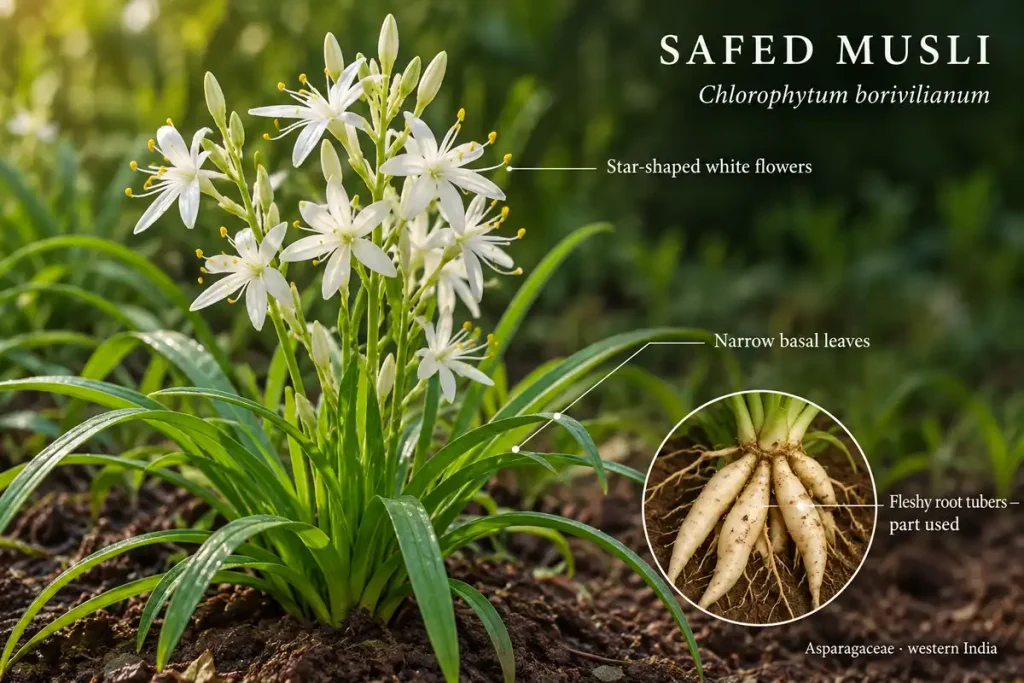
You buy the root. The tubers are fleshy and finger-shaped, 10 to 25 cm long, brown outside and white once peeled.
Other names are Shweta musli, white musale and India spider plant. Kew lists it as an accepted species native to western India. The IUCN Red List rates it Critically Endangered in the wild, because heavy root harvesting thinned the populations.
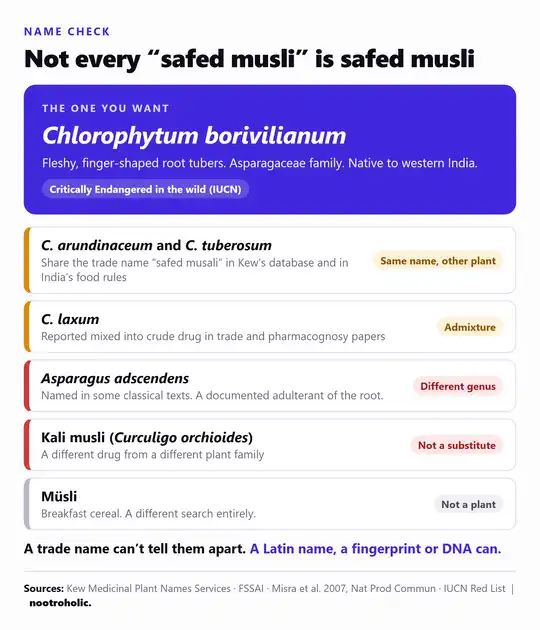
Now the trap. “Safed musli” is a trade name. It doesn’t guarantee the species.
Kew’s medicinal-name database maps “safed musali” to at least 3 Chlorophytum species, and India’s food regulator puts all 3 under one “Musali” entry. Some classical texts point to Asparagus adscendens.
Kali musli (Curculigo orchioides) is a different drug.
Is White Musli Powder Better? What Peeling and Washing Do to Safed Musli
Fresh roots have brown skin. Processors peel them, wash them and dry them pale, because white root sells higher.
The ICAR grower guide advises partial-shade drying so roots keep their white colour and fetch a premium. It also lists peeling as one of the 2 biggest production costs.
So the premium pays for labour and looks. It doesn’t pay for potency.
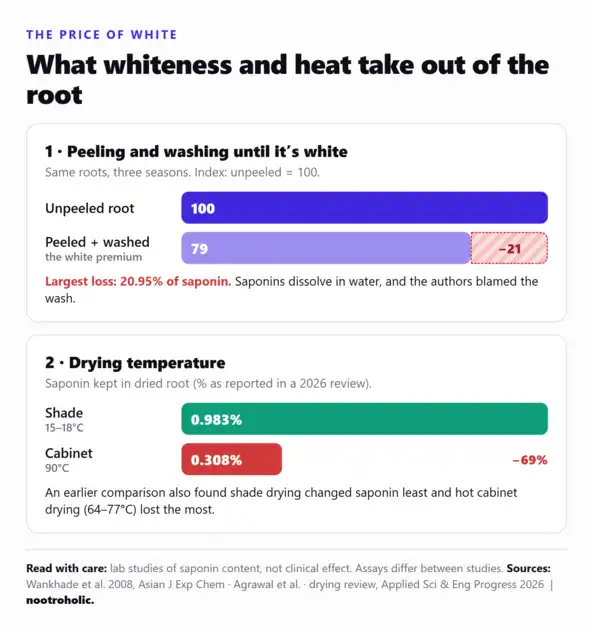
Akola team (Wankhade et al., 2008) measured what whiteness costs. They compared peeled-and-washed roots with unpeeled roots over 3 seasons.
Peeled roots had statistically lower saponin, and the largest loss was 20.95%. The authors blame water, because saponins dissolve in it.
In a plant-parts comparison, the peel’s methanol extract gave the highest crude saponin yield of any part tested. That measures extraction yield, so treat it as a lead.
Heat does similar damage. An earlier comparison (Agrawal et al.) found shade drying changed saponin the least and hot cabinet drying at 64 to 77°C lost the most.
Storage matters too. In the Akola study, saponin fell steadily in polythene bags and was statistically lower after 12 months. Some vendor listings claim 24 months.
Colour tells you how the root was processed. It can’t tell you the species, the saponin level or what was added. Nobody has ever measured a saponin with their eyes.
Safed Musli Benefits: What Human Studies Show
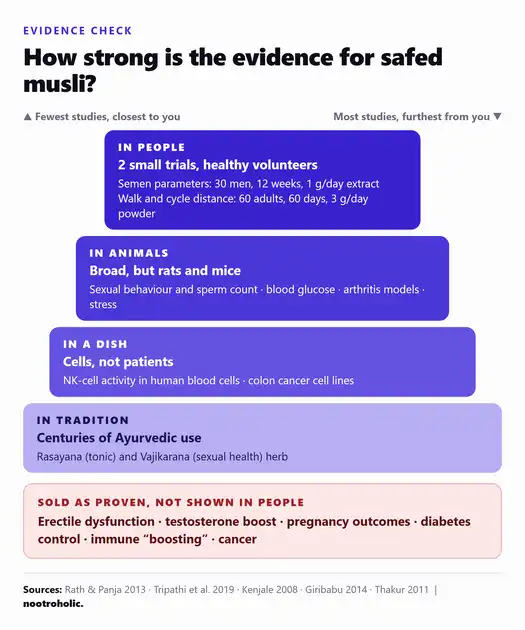
The evidence runs upside down. Tradition is deep, animal work is broad and human data is thin. That’s the reverse of how the herb is sold.
Safed Musli Benefits for Men: Sperm Quality, Testosterone and Erections
The main human trial is Rath and Panja (Ayu, 2013). 30 healthy men aged 20 to 40 took 500 mg of water extract or a barley placebo twice a day for 12 weeks, 15 per group.
The treated group improved on semen volume, sperm count, motility and normal morphology, and no adverse reactions were reported.
Testosterone is where the paper disagrees with itself. The results section reports a statistically significant rise. The discussion says the extract didn’t move testosterone much and blames normal baseline levels.
The authors suggest testing men with low testosterone.
“Steroidal saponin” sounds like a hormone. It isn’t. The name describes a molecular skeleton, and the human data I found show no clear testosterone gain.
Rat studies at 125 to 250 mg/kg of water extract (Kenjale et al., 2008) show more mounting and higher sperm counts. That isn’t an erectile dysfunction trial. I found no human trial of erectile function, so “herbal Viagra” is just a label.
Safed Musli for Stamina and Exercise
Tripathi et al. (Indian Journal of Pharmacology, 2019) randomized 60 healthy adults to 3 g/day of standardized root powder or maize-starch placebo for 2 months.
At day 60 the powder group walked 468 m in 6 minutes against 420 m for placebo. In a 6-minute cycling test they covered 2.92 km against 2.4 km.
The walking gap showed up by day 30 (456 vs 423 m). Diastolic blood pressure in the fixed-workload test was lower too (75.8 vs 82.4), but handgrip didn’t beat placebo.
It’s a pilot, so treat it as a lead. The blood pressure change is also why you should ask a doctor first if you take blood-pressure medicine.
Safed Musli Benefits for Women
Tradition uses it for lactation and general vitality. There’s no safety data for pregnancy or breastfeeding, so skip it in both.
Blood Sugar, Immunity, Cancer and the Rest
These are rat and cell results. Water extract at 250 to 500 mg/kg improved glucose and HbA1c in diabetic rats (Giribabu et al., 2014).
A hot-water fraction raised natural killer cell activity in cultured human immune cells. Isolated saponins were toxic to colon cancer cells in a dish. None of that is treatment evidence.
I also found no human data for height, hair growth, weight loss or skin whitening. People search for all 4.
Hidden Gem: Safed Musli Is Not Just a Saponin Herb
Sellers quote saponin percentage. The root is more than that.
In a hot-water extract, about 60% was polysaccharide, including roughly 31% inulin-type fructans and 25% acetylated mannans (Thakur et al., 2011). Those figures apply to the extract only.
The team split the extract into 3 fractions and tested each on natural killer (NK) cells from human blood, in a dish. At 5 µg/mL the polysaccharide fraction roughly doubled NK activity (+98%). The crude extract raised it 72.9%. The saponin and phenolic fraction did nothing at 5 or 25 µg/mL.
That’s a cell-culture result, and it doesn’t prove immune benefit. But it carries a buying lesson. A 40% saponin concentrate can discard the part that did the work in that assay.
A separate lab saw the same pattern (Scientific World Journal, 2013). A crude tuber extract beat an isolated saponin fraction on free-radical scavenging and on toxicity to all 3 cancer cell lines tested. The saponin fraction won only on iron chelation.
Hidden Gem: Saponin Content Is Set Before the Factory
Extract ratios get the attention. The bigger swings happen in the field.
Saponin in dried roots runs from about 2% to 17% across genotypes and processing. In a germplasm study summarized in a 2024 review, accession RC-14 reached up to 9.3% and RC-28 only 1.8%, at the same site. That’s a 5-fold gap from genetics alone.
Soil fungi matter too. Dave, Das and Tarafdar (ScienceAsia, 2011) inoculated plants with mycorrhizal fungi. With Glomus mosseae, saponin per plant rose from 0.56 g to 2.8 g, a 5-fold gain.
Glomus intraradices reached 2.7 g. Roots grew larger too, and accumulation peaked at 270 days.
Harvest age is unsettled. That experiment peaked at 270 days. The ICAR guide says roots are ready about 4 months after planting, once the leaves yellow and fall.
Concentration, yield per hectare and cultivar can each have a different best day. “Harvested at X months” means little until someone shows the assay.
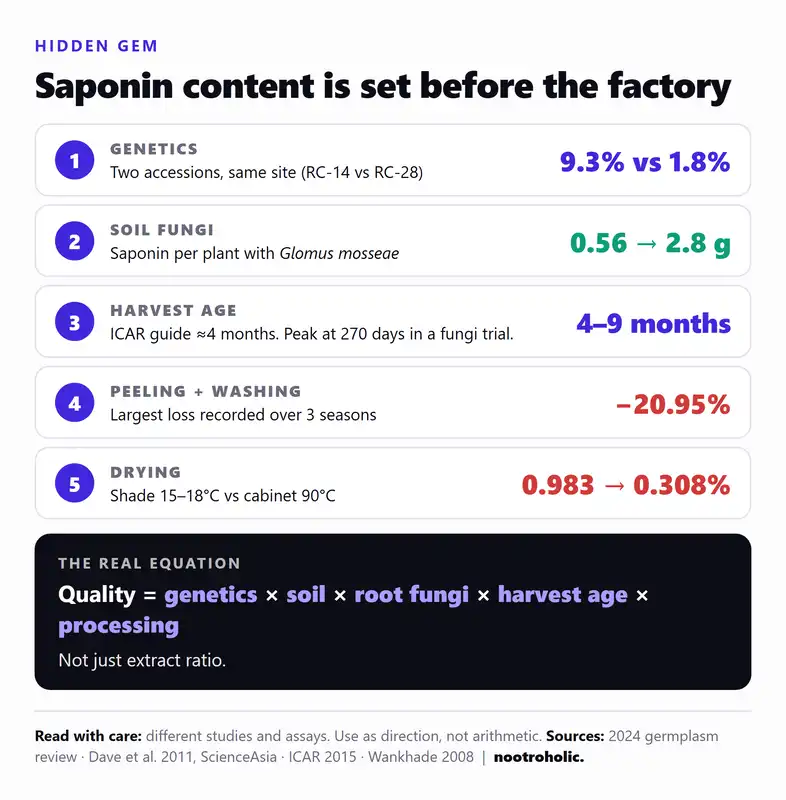
So saponin content = genetics × soil × root fungi × harvest age × processing. Extract ratio isn’t in it.
“Indian origin” and “Rajasthan” tell you almost none of it. Few listings say more.
How to Take Safed Musli Powder: Dose, Timing and Milk
| Source | Form | Dose | Duration | What happened |
|---|---|---|---|---|
| Rath & Panja, 2013 | Water extract | 1 g/day (500 mg twice) | 12 weeks | Semen parameters improved. No adverse reactions. |
| Tripathi et al., 2019 | Standardized root powder | 3 g/day | 60 days | Walk and cycle distance improved. No adverse events. |
| Traditional use, India’s FSSAI compendium | Root powder | 3 to 6 g/day | Not specified | A regulatory and traditional level. Clinical proof is missing. |
Don’t convert extract doses by ratio. A 10:1 water extract, a 10:1 ethanol extract and a saponin-enriched 10:1 extract can differ in chemistry. “1/10th the powder dose” is a guess.
Most sellers suggest starting at 1 to 2 g. That’s convention, and no trial tested it. Start low and raise it slowly, because fructans can cause gas at higher doses.
Ayurvedic practice mixes the powder into warm milk with honey or ghee. There’s a reasonable mechanism.
Saponins are poorly absorbed intact. Gut bacteria convert them to sapogenins, and sapogenins dissolve in fat but barely in water.
Powder, capsule or extract? Powder keeps the whole-root matrix but needs a bigger dose and brings the sticky mucilage.
Capsules fix the texture. Extracts shrink the dose but change the chemistry.
How long does it take? The walking gap in the 60-person trial appeared by day 30, and the semen trial ran 12 weeks. Anything promising results in days has no trial behind it.
You’ll also see “8 to 12 weeks on, then off” advice. The trials ran about 8 and 12 weeks. Nobody tested breaks.
Safed Musli Side Effects, Interactions and Who Should Avoid It
Neither human trial reported adverse reactions. Across both, 45 people took the herb for up to 12 weeks. That’s too small and too short to call it safe long term.
Reviews list stomach upset, bloating and loose stools at higher doses. Allergic reactions are possible.
In mice, single doses up to 2,000 mg/kg of water extract caused no obvious acute toxicity. No long-term human data exist.
Nobody has studied interactions, so these are theoretical. Ask a doctor first if you take:
- Diabetes medicine. Rat glucose results suggest an added effect.
- Blood-pressure medicine. Blood pressure changed in the exercise trial.
- Immunosuppressants. Immune-cell stimulation showed up in a dish.
Same for autoimmune or hormone-sensitive conditions. Skip it in pregnancy, breastfeeding and childhood. There’s no safety data.
One more risk sits outside the herb. Sexual-performance supplements have been found with undeclared prescription drugs. Be extra suspicious of unlabeled blends sold for performance.
Real vs Fake Safed Musli Powder: A Buyer’s Checklist
Fake usually means the wrong plant under the right name. Demand explains why.
The ICAR guide puts world demand above 50,000 tonnes a year against production under 5,000. When demand runs more than 10 times supply, substitutes tend to appear.
Misra et al. (2007) built DNA fingerprints (AFLP) to separate the “Safed Musli complex” from adulterants, because crude drug is sold mixed with other Chlorophytum species and Asparagus adscendens.
A plain total-saponin test can’t catch that, because related species carry saponins too. Your eyes can’t either.
Ask for these 9 things:
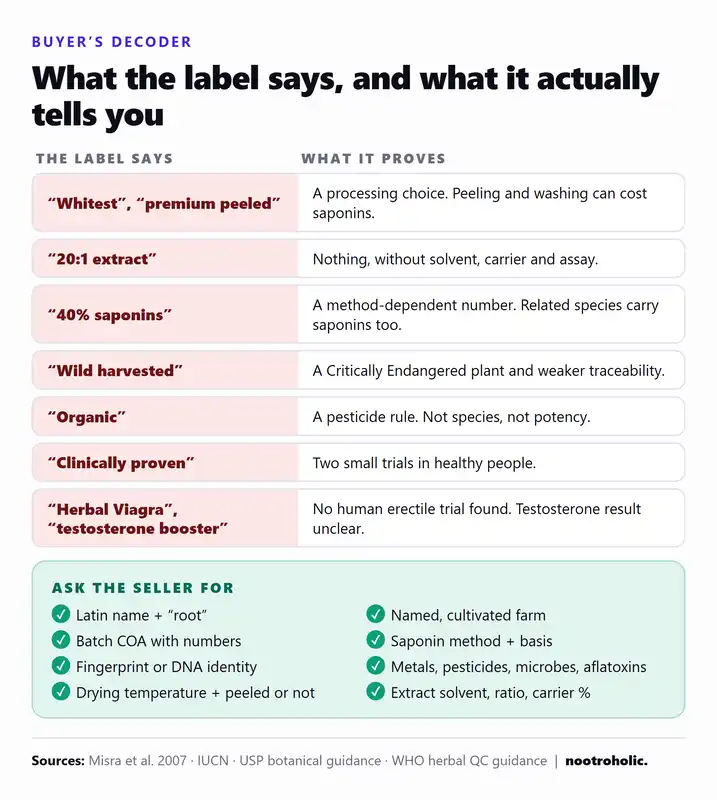
- A Latin name and the plant part, such as Chlorophytum borivilianum, root. “Safed musli” alone isn’t enough.
- A named, cultivated source and a harvest age. Wild-harvested is a red flag for a Critically Endangered plant.
- A batch COA with numbers, not “pass”, from a named lab.
- The saponin method and basis (HPLC or gravimetric, dry weight). A bare “40%” means little.
- An identity test, meaning an HPTLC or HPLC fingerprint, or DNA on the raw root.
- Contaminant results for lead, cadmium, arsenic, mercury, pesticides, microbes and aflatoxins. Aspergillus flavus has been isolated from safed musli tubers.
- Processing details: unpeeled or lightly peeled, dried at low temperature, with an honest answer on sulfites used for colour.
- For extracts: the native extract ratio, the solvent and the carrier percentage.
- A realistic expiry date and opaque, sealed packaging.
A bag priced far below market should make you suspect a substitute. And a famous brand name isn’t a batch test. If you only check 2 things, check the Latin name and the batch COA.
Safed Musli vs Ashwagandha, Shatavari and Kaunch Beej
| Herb | Plant and part | Signature compounds | What to know |
|---|---|---|---|
| Safed musli | Chlorophytum borivilianum, root | Steroidal saponins, fructans, mannans | Two small human trials (semen parameters, exercise). |
| Ashwagandha | Withania somnifera, root | Withanolides | Many more human trials, mostly on stress and sleep. |
| Shatavari | Asparagus racemosus, root | Steroidal saponins | Traditional women’s tonic. Limited human data. |
| Kaunch beej | Mucuna pruriens, seed | Natural L-DOPA (about 4 to 6%) | Human trials are mostly in Parkinson’s disease. L-DOPA means drug-interaction caution. |
Combo powders that stack ashwagandha, shatavari, safed musli, kaunch beej and shilajit borrow evidence from each ingredient. I found no trial of the blends.
Doses per herb are often hidden, and every herb adds its own interactions. Pick the herb whose evidence matches your goal and take one at a time. For shilajit, see the best ways to use shilajit.
Musli Pak is a different product. It’s a ghee-and-sugar Ayurvedic sweet with around 20 ingredients. Safed musli is 1 of them (Hussain et al., 2024).
- Wankhade et al., 2008. Asian J Exp Chem
- Rath & Panja, 2013. Ayu
- Tripathi et al., 2019. Indian J Pharmacol
- Thakur et al., 2011. Evid Based Complement Alternat Med
- Dave, Das & Tarafdar, 2011. ScienceAsia
- More et al., 2024. Int J Pharm Sci Rev Res (germplasm review)
- Drying review, 2026. Applied Sci Eng Progress
- Agrawal et al. Drying characteristics of safed musli
- Jat et al., 2015. Good Agricultural Practices for Safed musli, ICAR-DMAPR
- Saponins in different plant parts of C. borivilianum, 2015
- Crude vs saponin extract, 2013. Sci World J
- Misra et al., 2007. Nat Prod Commun
- Kenjale et al., 2008. Phytother Res
- Giribabu et al., 2014
- Kew Plants of the World Online
- IUCN Red List
- Hussain et al., 2024. Springer