No. Thymogen is not thymosin alpha 1. Thymogen is a two-amino-acid peptide. Thymosin alpha 1 has 28. They came out of the same calf thymus research, and that is the whole connection.
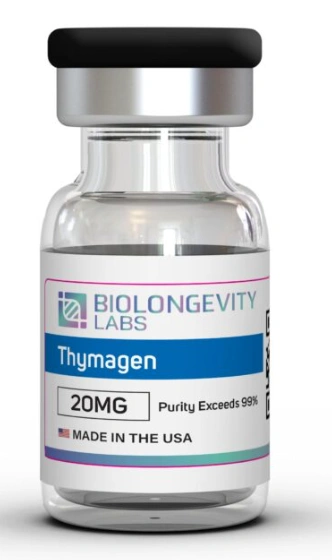 Research use only
Verified compound profile
Thymogen (L-α-Glu-L-Trp)
Synthetic dipeptide · Oglufanide / IM-862 · CAS 38101-59-6
- Sequence
- L-Glu-L-Trp (EW)
- Formula
- C16H19N3O5
- Molecular weight
- 333.34 g/mol
- PubChem CID
- 100094
- Form
- Lyophilised powder
- Storage
- −20°C, protect from light
- COA names L-α-glutamyl-L-tryptophan in full — not just “Glu-Trp”
- Chiral identity confirmed — the D-form weighs the same and acts in reverse
- Batch chromatogram supplied, not only a purity percentage
- Peptide content assay, so you know net peptide vs fill weight
- Lot number on the report matches the vial
Full explanation of each check is in the article above.
Affiliate link. If you buy through it, Nootroholic earns a commission at no extra cost to you. This does not change what the research says.
Sold for laboratory research only. Not for human consumption, and not a medicine. Thymogen is not approved by the FDA or EMA for any use.
If you came here to find out whether the dosage numbers, benefits and side effects you read about thymosin alpha 1 apply to Thymogen, the answer is no. Different molecule, different research, different rules.
And here is the part almost no vendor page mentions: Thymogen already failed a 202-patient, placebo-controlled human trial. It ran under a different name.
Jump to what you need
- What is Thymogen?
- Why do people think it’s thymosin alpha 1?
- Why doesn’t “99% pure” prove much?
- Has Thymogen been tested in people?
- What does the Russian and animal research show?
- How do you check a certificate of analysis?
- Is Thymogen legal?
- Sources
What is Thymogen?
Thymogen is a synthetic dipeptide: glutamic acid joined to tryptophan, both in the L form.
Researchers pulled it out of Thymalin, a calf thymus peptide mixture, using reverse-phase HPLC. Then they made it synthetically and named it Thymogen.
You will see it sold under six or seven names. They are all the same molecule.
| Sequence | L-Glu-L-Trp (EW) |
| Size | 2 amino acids |
| Formula | C16H19N3O5 |
| Molecular weight | 333.34 g/mol |
| CAS | 38101-59-6 |
| PubChem CID | 100094 |
| Also sold as | Oglufanide, Timogen, Thymagen, IM-862, EW dipeptide |
Two amino acids is small. Small enough to matter: your body carries dipeptidases, enzymes whose job is to chop dipeptides into free amino acids. Any claim about what Thymogen does after it enters the bloodstream has to survive that.
Why do people think Thymogen is thymosin alpha 1?
Because a 1990s US patent said Thymogen was the active ingredient in a thymus extract called thymosin. That line got copied for thirty years.
It isn’t true in the way people now read it. Both compounds were found in bovine thymus fractions. That’s the relationship. Neither is a version of the other.
Four different things get blended together on product pages. Here is what each one actually is.
| If you see this name | It means this |
|---|---|
| Thymogen | One synthetic dipeptide, L-α-Glu-L-Trp. 2 amino acids. |
| Thymalin | A calf thymus peptide mixture. Not a single molecule. |
| Thymosin alpha 1 | A separate 28-amino-acid peptide. Sold internationally as thymalfasin (Zadaxin). |
| Thymodepressin | The D-form dipeptide. Studied as an immune suppressor. |
Can you use thymosin alpha 1 dosage numbers for Thymogen?
No. You would be applying numbers from a 3,100-dalton peptide to a 333-dalton one.
Every search for a thymosin alpha 1 dosage chart, protocol, or “what to take when sick” is a search about the other molecule. It has its own pharmacokinetics, its own trial record, its own regulatory file.
The transfer fails in both directions. Thymosin alpha 1 is approved in more than 35 countries for chronic hepatitis B. Thymogen is not that drug, and does not inherit that record.
Why doesn’t a “99% pure” certificate prove much?
Because Thymogen’s mirror image weighs exactly the same — and does the opposite thing.
Flip the shape of both amino acids and you get Thymodepressin. Same formula. Same mass. Opposite direction.
Thymogen
C16H19N3O5
333.34 g/mol
L-α-Glu-L-Trp
Immune stimulant
Thymodepressin
C16H19N3O5
333.34 g/mol
D-γ-Glu-D-Trp
Immune suppressant
Grey lines are identical in both. Red lines are the difference — and a mass spectrum cannot see either of them.
This was not a small shift in potency. Researchers describe the pair as the first example of two mirror-image drugs regulating the same system in opposite directions. Reversing both centres didn’t just remove the stimulating effect; the D forms became inhibitors under the same conditions where the L forms stimulated.
The two marketed drugs aren’t even clean mirrors. Thymodepressin also attaches at a different point on the glutamic acid — the γ bond instead of the α.
So what does a purity percentage tell you? How much of one peak is in the vial. Not which molecule that peak is. A batch can be 99.4% pure and 99.4% wrong.
Has Thymogen been tested in people?
Yes. More rigorously than almost any peptide in this category. The results were not good.
The trials ran under the name IM862 (oglufanide disodium), which is why they don’t show up if you only search “Thymogen.”
| Study | What happened |
|---|---|
| Phase I/II, AIDS-related Kaposi’s sarcoma | 36% response rate. Minimal toxicity. Promising. |
| Randomised nasal study, 44 patients | Difference between arms was not statistically significant. |
| Phase III, 202 patients, placebo-controlled | 23% response on drug vs 21% on placebo. No significant difference. Shorter time to response, but also shorter time to progression — the authors concluded it may accelerate progression. |
| Phase II, metastatic renal cell carcinoma | Confirmed the lack of significant toxicity. |
| Phase II, hepatitis C | Entered on the strength of its antiangiogenic and immune-modulating profile. |
Read that honestly and it cuts both ways.
Thymogen has been through randomised, double-blind, placebo-controlled testing. Most research peptides have nothing close. That is a genuine point in its favour.
The efficacy signal did not survive. The tolerability signal did — low toxicity is the most repeatable finding across every one of these studies.
“Well tolerated” and “works” are two different claims. Only one of them held up.
What does the Russian and animal research show?
Thymogen was registered as a drug in Russia in 1990 and appears in the Russian Pharmacopoeia. Reported mechanisms include changes to lymphocyte differentiation and to the T-helper / T-suppressor ratio.
That is a real regulatory history. It is not a modern efficacy file. 1990 approval standards are not the standards that produced the 2005 phase III — which is exactly why the phase III carries more weight, not less.
The animal work is separate again. A 2000 rat study reported activated T-cell differentiation and neutrophil activity, then tracked survival and spontaneous tumours in female rats over 12 months. Secondary summaries describe 76 rats dosed at 5 micrograms, five times a week, with lower tumour incidence than controls.
Rats. Micrograms. One year. That’s a hypothesis about ageing, not a human outcome.
The “more than 25 million patients treated” figure you’ll see quoted has no published patient registry behind it that I could find. Treat it as marketing arithmetic until someone shows the denominator.
How do you check a certificate of analysis?
For this molecule, a purity number answers the wrong question. Here is what to look for instead, and why each item earns its place.
| Look for | Why it matters |
|---|---|
| The name spelled out: L-α-glutamyl-L-tryptophan | “Glu-Trp” alone is ambiguous by exactly the margin that matters. |
| Chiral analysis, or a reference standard | This is the only check that separates Thymogen from Thymodepressin. Most COAs skip it. |
| The bond position (α, not γ) | Same reason. Same mass, different molecule. |
| A chromatogram, not a percentage | You want the trace, the method and the peak integration — the number on its own is unverifiable. |
| A peptide content assay | Net peptide is routinely 10–25% below the gross fill weight. Purity does not show this. |
| Water, counterion and residual solvent data | This is where the missing mass usually hides. |
| A lot number that matches the vial | Plus a named lab you can actually contact. Otherwise the document is decoration. |
| Sterility and endotoxin, if relevant | Purity testing covers neither. |
The question to ask a supplier: can you show that this lot contains L-α-Glu-L-Trp — not just something weighing 333 daltons?
If the answer is a purity percentage, the identity is unverified.
Is Thymogen legal?
Thymogen is not an approved drug in the United States or the EU. What’s sold online is labelled research-use-only, which is a legal category, not a quality claim. It tells you nothing about what’s in the vial.
Thymosin alpha 1 sits in a different but equally awkward spot: never FDA-approved in the US, and placed in Category 2 of the interim 503A bulk substances list in September 2023.
Neither compound has an over-the-counter route. If you’re researching immune peptides for a real medical situation, that conversation belongs with a clinician who can see your labs. Nothing here is medical advice, and nothing here is a protocol.
What it adds up to
- Thymogen is a 2-amino-acid peptide. Thymosin alpha 1 is a 28-amino-acid peptide. They are not interchangeable, and neither are their dosages.
- Its mirror image weighs the same and suppresses instead of stimulates. Purity testing cannot tell them apart.
- It has real human trial data, under the name IM862 — and the trial failed its endpoint.
- Low toxicity is the finding that has held up across every study.
- Ask for chiral identity, not purity.
Sources
- PubChem CID 100094 — Thymogen / oglufanide.
- Deigin V.I. et al. International Journal of Molecular Sciences (2024) — reciprocal activities of Thymogen and Thymodepressin.
- Deigin V.I. et al. Molecules 26(21):6550 (2021) — Thymodepressin review; Thymogen registration history.
- Semina O. et al. — reciprocal effect of optical isomerism of EW-dipeptides on immune response.
- Tulpule A. et al. Journal of Clinical Oncology 18(4):716 (2000) — randomised study of IM862 nasal solution in AIDS-related Kaposi’s sarcoma.
- AIDS Malignancy Consortium / IM862 Study Team. Journal of Clinical Oncology (2005) — phase III trial of IM862.
- Phase II trial of IM862 in metastatic renal cell carcinoma, British Journal of Cancer.
- Anisimov V.N., Khavinson V.Kh., Morozov V.G. Biogerontology 1:55–59 (2000) — L-Glu-L-Trp, ageing and spontaneous carcinogenesis in rats.
- US FDA — compounding statements on thymosin; 503A interim bulk substances list, Category 2 (September 2023).
- US Patent 6,060,452 — analogs of L-Glu-L-Trp (source of the “active principle in thymosin” framing).