
Most people buy useless pancragen in free acid form. Complete different set of molecule used in research.
Useful pancragen is identified by this string: Lys-Glu-Asp-Trp-NH₂.
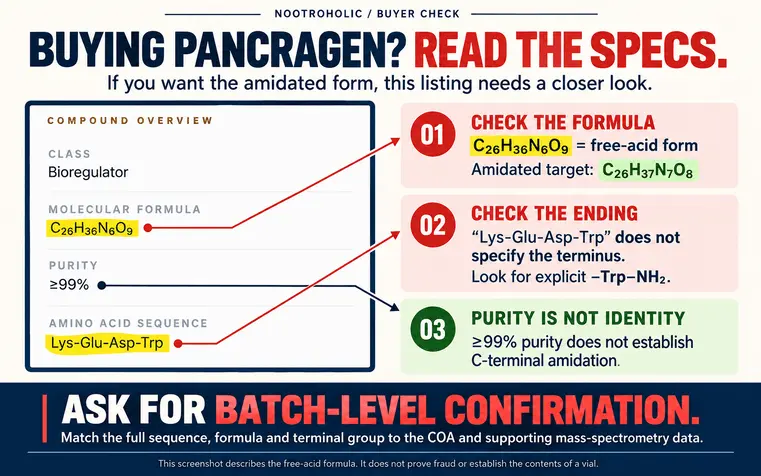
It’s super rare to find a legit one. The fakes are everywhere.
What Pancragen is
Synthetic tetrapeptide with four amino acids: lysine-glutamate-aspartate-tryptophan.
Important note: A vendor might use Lys-Glu-Asp-Trp only in the details. It’s still garbage, but they can now label it as “Pancragen”.
Know what to look for:
Pancragen is one of many great Vladimir Khavinson’s peptides created in Russia. They also made Epitalon, Thymalin, and a few interesting bioregulator peptides.
| Product | What it is | Form |
| Pancragen (synthetic) | Pure KEDW tetrapeptide | Lyophilized powder, 20 mg vials |
| Pancragen® capsule | “Linked amino acid complex,” heterogeneous | Oral capsules, Russian manufacturer |
| Suprefort (A-1) | Bovine pancreas extract, mixed peptides <10 kDa | Oral capsules |
How does Pancragen work?
Khavinson’s hypothesis is that these peptides slip into the nucleus to bind DNA.
Mainstream biology says it’s more likely they bind to cell membranes and trigger signaling cascades from outside.
How might Pancragen work?
A tiny peptide. Changes in pancreatic cell markers. But how does one lead to the other? Explore the proposed routes, the laboratory findings and what the newer research adds.
Does the peptide enter the nucleus,
or pass a message to it?
Both ideas can explain changes in gene activity. The difference is what carries the message. Neither route is established for Pancragen by the two abstracts linked here.
Direct nuclear interaction
The proposed peptide enters the cell and nucleus, then interacts with DNA or its associated proteins to influence which genes are used.
Analogy: delivering a message directly to the cell’s instruction library.
A signal relayed inward
A surface interaction could trigger a chain of signals inside the cell. The cell’s own proteins then influence gene activity; direct peptide–DNA contact is not required.
Analogy: ringing the doorbell so someone inside carries the message.
Conceptual routes, not competing results from a head-to-head experiment. Dashed paths are hypotheses; the surface symbol is not an identified Pancragen receptor.
Illustration of the experimental setting, not a delivery pathway.
Cells in a dish.
Signals under observation.
Researchers exposed pancreatic cell cultures to Pancragen and examined changes in proteins linked to cell specialization, proliferation and survival.
The companion study explicitly identifies H-Lys-Glu-Asp-Trp-NH₂ and reports findings in aged human pancreatic cell cultures.
Study notes & source
The 2012 paper investigated molecular markers in aging pancreatic cells. These experiments do not show how an oral or injected product reaches the pancreas.
Read the PubMed abstract · PMID 23734516No effect sizes or direct DNA-binding pathway are illustrated.
More of the proteins
that guide cell identity.
The study reported higher expression of transcription factors: proteins that help regulate which genetic instructions a cell uses.
These factors help pancreatic cells develop and maintain specialized roles. Acinar cells produce digestive enzymes; islet cells include hormone-producing cells.
Study notes & source
The 2013 abstract reports increased differentiation-factor expression in both “young” and “aged” cultures. Marker changes alone do not demonstrate new, functioning beta cells in a person.
Read the PubMed abstract · PMID 23486591Arrows show direction, not the size of the effect.
A shift in growth
and survival markers.
The companion study reported increases in Ki-67, PCNA and Mcl1, alongside lower p53 expression in aged cultures.
These changes suggest altered regulation of proliferation and programmed cell death. They do not establish safe regeneration or improved insulin production in patients.
Study notes & source
The 2012 abstract also reports increases in MMP2, MMP9, serotonin and CD79α. This panel highlights selected markers for clarity; it is not a complete account of the experiment.
Read the PubMed abstract · PMID 23734516All The Evidence
| Study | Model | n | Key result |
| Kvetnoi 2007 | Diabetic rats | NR | Changes to pancreatic morphology, insulin, PCNA, p53 |
| Khavinson 2007 | STZ-diabetic rats | NR | Oral: marked glucose drop. IM: normalized capillary endothelial adhesion |
| Khavinson 2010 | Rats | NR | Reduced caspase-3, effects on insulin-secreting cells |
| Korkushko 2011 | Humans, elderly | 33 T2D + 30 healthy | Lower fasting glucose, lower OGTT glucose, lower insulin, lower HOMA-IR |
| Khavinson 2013 | Human pancreatic cell culture | — | Upregulated Pdx1, Ptf1a, Pax6, Pax4, Foxa2, Nkx2.2 |
| Goncharova 2014 | Old rhesus monkeys | small | 50 µg/day IM ×10d normalized insulin and C-peptide; effect partly held 3 weeks after stopping |
| Goncharova 2015 | Old rhesus monkeys | 9 | vs glimepiride: glimepiride stronger but with delayed hypoglycemia; Pancragen milder, normalizing |
Monkey studies are the most interesting. Aged macaques with impaired glucose tolerance improved in C-peptide and insulin with ten days of injections. Persisted for 3 weeks after the last dose.
The human study of 33 elderly participants with type 2 diabetes showed real improvements in glucose, insulin, and HOMA-IR.
They also found that nocturnal melatonin was 70% lower for diabetics compared to healthy participants. This is the reason for the melatonin claim around Pancragen you see repeated online by sellers. Just know that the study measured the deficit, and it never showed Pancragen corrects it.
Dosing: the gap nobody mentions
The dose in the research and the recommended dose found online in peptides forums live in different realities.
50 micrograms per animal per day for ten days was the monkey dose.
Khavinson patent states 0.01–100 µg/kg.
Oral Pancragen is 1-2 capsules once or twice daily before meals. Cycled for 30 days every 4-6 months.
People online even say 1- 2 mg daily for reconstituted vials. This is 20-200x more than professional researchers used.
Because vials come in 20mg, the vial itself has become the dosing recommendation.
This is why I never use Reddit or online forums for serious health advice. Most of the time, people have no clue what they write.
Pancragen side effects, safety data, and legal status
Pancragen: the safety gaps.
Understanding what remains unknown is part of understanding the peptide. Limited reporting of side effects cannot establish long-term safety.
What has not been established?
The studies discussed in this article do not establish a comprehensive human safety profile. Small studies and short follow-up can miss uncommon, delayed or cumulative harms.
Read this carefully: “No adverse events reported” describes the reporting. It does not show that a substance has no side effects.
Already taking diabetes medication?
If Pancragen lowers glucose in humans, additional glucose lowering with other medicines is a plausible concern. Its interaction effects have not been adequately characterized.
These medicines have different mechanisms and different risks of low blood sugar. A shared treatment goal does not establish an identical mechanism or a predictable additive effect.
Discuss any contemplated use with the clinician managing your diabetes. Do not change prescribed medication to accommodate an experimental peptide.
Research labeling is not approval.
A “research use only” label does not establish safety for human use or authorize a product as a medicine. Pancragen should not be presented as an FDA-approved treatment.
ClinicalTrials.gov registration, supplement registration and FDA drug approval are different things. Likewise, a nomination or advisory review for pharmacy compounding is not a completed authorization.
Official resources & scope
Section 503A sets specific conditions for use of bulk drug substances in compounding. Consult the current FDA rules for the substance and product concerned; another peptide’s review does not determine Pancragen’s status.
FDA · 503A bulk substancesSearch ClinicalTrials.govA substance need not be named to be prohibited.
WADA’s S0 category covers pharmacological substances without governmental approval for human therapeutic use, when not addressed elsewhere on the List. Substances meeting those criteria are prohibited at all times.
Pancragen’s absence by name is not clearance to use it. Ask your anti-doping organization for a determination before use. Do not assume a therapeutic use exemption will be available.
Check the rules
The relevant anti-doping organization must assess substance status and any TUE application. Supplement marketing alone does not establish approval for human therapeutic use.
WADA · S0 and the Prohibited ListWADA · TUE processWhat people actually say about it
Almost nothing is said. Check Reddit, and you get tons of vendor recommendations that point you to the garbage Pancragen I told you about earlier.
The common points in the Longevity forum, where people are more knowledgeable about this, often say:
- Issues related to price and procurement. The official dealers are expensive; the less expensive dealers are accused of selling counterfeits.
- Unresolved skepticism regarding the exclusively Russian sources. One poster stated clearly that nobody outside Russia tried to reproduce any of that.
- Confusion between synthetic Cytogens and animal-derived Cytomaxes along with fears about prions in the latter.
- Testimonials that are positive, vague, and have little to do with pancreas—sleep, joints, mood. And then nothing. No one is posting lab results after that.
Nobody posts before-and-after HbA1c.
Where it sits against real options
Unlike Pancragen, Metformin has decades of randomized trials and cardiovascular data behind it, with a known safety profile.
Semaglutide and trizepatide have tens of thousands of trials in human patients.
Pancragen has 1 uncontrolled study in 63 people and 9 monkeys.
That’s not even a close question, and if it’s being pitched as an alternative to diabetes therapy, you can be sure there’s a sales pitch involved. The reality is that Pancragen is just an intriguing, non-validated preclinical finding with an attractive mode of action.
Conclusion
Pancragen has a much more mechanistically sound foundation compared to most other bioregulators. The transcription factor research is quite specific and the persistence of the primate effect after dosing is rather unique.
Moreover, it has no independent replication, no PK data, no toxicology, only one uncontrolled human trial, and a product sold with a completely different chemistry to the one used in the study, at 20–200x higher doses than anything ever tested.
If you have diabetes or prediabetes, take this as a scientific oddity and find yourself proper evidence-based treatment. If you wish to experiment regardless, remember that you buy an untested molecule from an unregulated supply chain, demand batch COA and never combine it with glucose-lowering drugs without careful supervision.
FAQ
Does Pancragen lower blood sugar?
In aged rhesus monkeys it improved glucose clearance and normalized insulin and C-peptide responses. In one uncontrolled study of 33 elderly type 2 diabetics, fasting glucose, insulin and HOMA-IR all fell. That’s the entire human evidence base — uncontrolled, unblinded, and never replicated outside the original research group.
What are the claimed Pancragen benefits?
Vendors list blood sugar control, beta cell support, digestive enzyme production, melatonin normalization and anti-aging effects. Only the glucose and insulin findings have any human data behind them, and that comes from a single uncontrolled study. The rest is extrapolated from cell culture, animal models, or a separate pancreas extract product.
Is Pancragen the same as Suprefort?
No. Suprefort is a bovine pancreas extract containing mixed peptides under 10 kDa. Pancragen is a single synthetic tetrapeptide. Most clinical claims circulating about “Pancragen” actually come from a small, non-peer-reviewed Suprefort report.
Can you take Pancragen orally?
Capsules exist and one rat study found oral dosing lowered blood glucose. But no pharmacokinetic study of any Khavinson peptide has ever been published, so nobody has confirmed intact KEDW reaches the bloodstream after oral dosing in humans.