Finding a Vesugen peptide that’s actually KED is hard. A sad amount of people are getting scammed, and they still buy the same scam.
Vesugen made aging neurons grow 42% longer dendrites. More branches. Longer reach and richer structure.
For those who know this peptide and want to get the real thing, check out our source below.
20mg vial, triple independent lab verification, CLIA-certified testing, published COAs, and research-use-only protocols.
Check Current Availability →This is the best guide on what Vesugen is. The proof and research. Plus, where to source it because there are more fakes than legit out there.
What Is Vesugen Peptide?
Three amino acids bound together. Lysine. Glutamic and aspartic acid. KED for short.
Vesugen peptide belongs to Khavinson bioregulators. A family of short peptides developed in Russia by Professor Vladimir Khavinson.
Vesugen’s sequence traces back to the vascular wall. That’s why it’s called a vascular bioregulator. The others in the family work on different parts. Epitalon on the pineal gland. Pinealon on the brain. Cardiogen on the heart muscle.
These peptides are small enough to slip inside a cell.
How Vesugen Works
Most peptides wait for a receptor outside a cell to respond. Short bioregulators like Vesugen are different. Small enough to enter the cell and influence gene expression from inside.
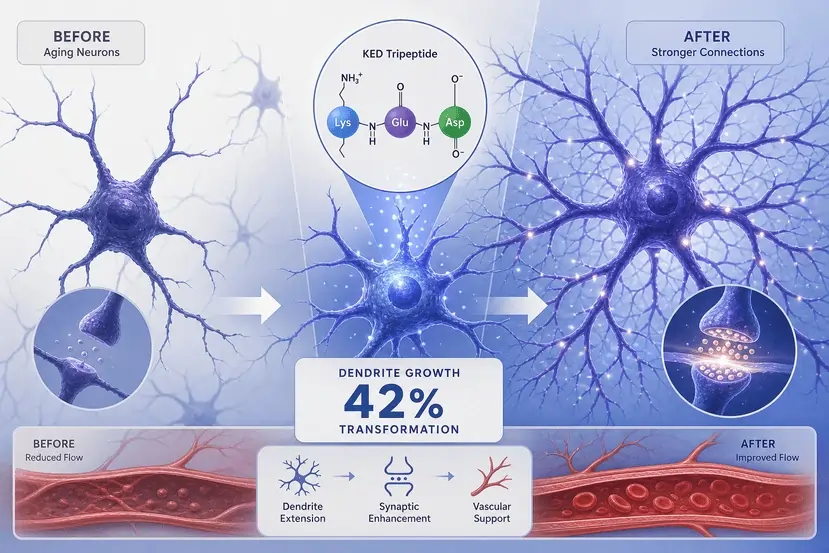
Vesugens’ targets sit in vascular tissue. Russian studies report that KED affects the expression of genes tied to blood-vessel health. Including Ki-67 (a marker of cell proliferation), sirtuin-1, endothelin-1, and connexin. KED supports aging endothelial cells to function as younger cells.
A detail almost nobody reports:
The induced-neuron study from 2024 suggests that KED doesn’t bind DNA the same way the other cousins do. EDR and AEDG bind directly to promoter regions of DNA. KED appears to act “by interacting with histone proteins and/or the nucleosome.” IN other words, KED may work one level up, on the spools that DNA wraps around instead of the DNA strand itself. A real distinction that matters if you compare them.
What the Research Truly Shows
If you want proof instead of what the seller hype to make you open your wallet, welcome to this section.
Every claim here comes from a specific study.
The 2024 Induced-Neuron Study
Kraskovskaya et al., published in the International Journal of Molecular Sciences in October 2024
Researchers took skin fibroblasts from three elderly women, aged 61, 66, and 68, and directly reprogrammed them into cortical neurons. Then treated the neurons with KED at 10 micrograms per milliliter for ten days and measured what changed.
Two results show statistical significance:
- Primary dendritic processes rose from 4.59 to 6.06, a 32% increase (p = 0.0093).
- Total dendrite length rose from about 270 to 384 micrometers, a 42% increase (p = 0.0148).
Dendrites are the branches neurons use to receive signals. More branches and more length translate to a richer, more connected neuron. The opposite of what aging usually does.
Now the honesty. Several other measures did not reach significance with KED. Branching points rose 34% but missed the significance bar. Terminal processes rose 37%, also not significant. The oxidative DNA damage marker fell 15%, not significant. Mitochondrial signal barely moved. Lysosomal activity did not change. The senescence marker p16 did not change. Lamin B1 dropped 7%, not significant.
So the accurate takeaway is narrow and real: in aging human-derived neurons, KED stimulated dendrite growth. It didn’t fix mitochondria, clear senescent cells, or repair DNA damage in that experiment. The authors concluded the peptide is worth further study “as an agent stimulating dendritogenesis.” A claim the data supports.
The 2021 Alzheimer’s Mouse Model
Khavinson et al., published in Pharmaceuticals in 2021, gave KED to 5xFAD mice, a standard Alzheimer’s model. At 400 micrograms per kilogram per day by injection from age two to four months. KED helped preserve dendritic spine density in the hippocampus. The effect was stronger in male mice than female mice. A correction to two figures was published in 2025, but it did not change the conclusions.
The 2017 Neuronal Spine Study
Kraskovskaya et al., 2017, in Bulletin of Experimental Biology and Medicine, tested KED on mouse hippocampal neurons under amyloid stress. KED at 200 nanograms per milliliter increased the number of mushroom-type dendritic spines by 20%. For context, a sibling peptide, EDR, raised them 71% in the same study. KED helped. It was not the strongest of the family for that endpoint.
The Vascular Studies
The vascular claims come mostly from Russian-language work. Kozlov et al., 2016, examined KED in the context of atherosclerosis and restenosis. Earlier Khavinson work reported KED stimulated Ki-67 in aged vascular endothelial cell cultures. These are cell and animal studies published largely in Advances in Gerontology, with limited Western indexing and no large randomized trials.
How to Read the Russian Clinical Reports
You will find vendor pages citing figures like “53 to 61% improvement in blood flow.” That number traces to a 2014 observational study of 41 elderly men with vascular-related erectile dysfunction. It was small, observational, Russian-language, and never replicated in Western peer review. It is not nothing. It is also not the kind of evidence that justifies a confident health claim. Treat every Russian clinical figure on Vesugen the same way: interesting, early, unconfirmed.
Vesugen vs Other Khavinson Bioregulators
People mix these up constantly. Here is the clean separation.
| Peptide | Sequence | Tissue target | Best known for |
|---|---|---|---|
| Vesugen | KED | Blood vessels | Vascular support, dendrite growth |
| Epitalon | AEDG | Pineal gland | Telomerase, melatonin, longevity |
| Pinealon | EDR | Brain | Neuroprotection, cognition |
| Cardiogen | AED | Heart muscle | Cardiac tissue support |
Vesugen vs Epitalon
Epitalon is a longevity peptide. Works on the pineal gland and the aging clock for the entire body. Vesugen is the vascular specialist. They don’t overlap. Longevity protocols sometimes reference both.
Vesugen vs Pinealon
The closest comparison. Both show dendrite effects in the 2024 study. Pinealon (EDR) was the stronger dendrite and spine stimulant in head-to-head data. Vesugen (KED) was framed as the vascular member that also supports neurons. If the brain is your focus, this Pinealon guide tells you all about it.
Forms of Vesugen in the Research Market
Vesugen comes in three forms.
Lyophilized vials are the freeze-dried powder. The standard format for Western research.
Russian capsules are called AC-2 complex. Marketed as a dietary supplement. The original consumer form and not a US product.
Sublingual drops have been popping up on European bioregulator sellers.
The verification standard does not change regardless of form. Third-party test to confirm the actual three-amino-acid sequence because KED and EDR sit one letter apart. And a careless vendor can mislabel them.
Safety Signal in the Literature
Vesugen shows a clean profile with no reported serious adverse events among the studies. The Khavinson peptides are described as low-toxicity in Russian literature.
Two honest caveats. First, one Russian study flagged prooxidant and hematopoietic effects under certain conditions, a reminder that “clean” is not the same as “fully characterized.” Second, there are no large Western randomized human trials, so the safety picture rests on cell studies, animal work, and Russian clinical reports. That is a thinner evidence base than an approved drug. Treat it that way.
Where Research-Use Vesugen Is Sold
Vesugen is sold as a research chemical. Not a supplement or medicine. Various peptide vendors have it in stock. To find it is not hard. To get actual pure KED tested by someone other than the seller is the tricky road.
What to Demand From a Vendor
- A batch-specific Certificate of Analysis from an independent third-party lab, not an in-house check.
- HPLC for purity and mass spectrometry to confirm the compound is the Lys-Glu-Asp tripeptide, not a mislabeled cousin.
- A lot number on the COA that matches the vial.
- The correct CAS number, 204271-66-9, on the listing.
Our verified vendor list scores every source against it.
A Verified Source for Vesugen
Vendors with true Vesugen, like BioLongevity Labs, provide a 20 mg vial with triple independent lab verification. Even CLIA-certified testing and a research-use-only policy. That layered outside testing is exactly what protects you in a category where a single mislabeled vial wastes the entire experiment.
If you want to be 100% sure you get the real thing, this is it.
20mg vial, triple independent lab verification, CLIA-certified testing, published COAs, and research-use-only protocols.
Check Current Availability →Red Flags
Run away if a vendor list the wrong CAS number. And if they can’t straight up tell you if the vial consists of KED or EDR. In bioregulators, the EDR-versus-KED label mix-up is the specific mistake to watch for.
Frequently Asked Questions
What is Vesugen peptide used for in research?
It is studied as a vascular bioregulator and, more recently, as a stimulator of dendrite growth in aging neurons. Research contexts include vascular endothelial function and neuroprotection in cell and animal models.
What is the amino acid sequence of Vesugen?
Lysine-glutamic acid-aspartic acid, abbreviated KED or Lys-Glu-Asp.
Is Vesugen the same as KED?
Yes. Vesugen is the brand name for the KED tripeptide.
Who developed Vesugen?
Professor Vladimir Khavinson and colleagues at the St. Petersburg Institute of Bioregulation and Gerontology in Russia.
What did the 2024 study on Vesugen find?
In neurons derived from elderly donors, KED increased primary dendritic processes by 32% and total dendrite length by 42%, both statistically significant. It did not significantly change mitochondrial, lysosomal, senescence, or DNA-damage markers in that study.
How does Vesugen differ from Epitalon and Pinealon?
Vesugen (KED) targets vascular tissue, Epitalon (AEDG) targets the pineal gland and aging clock, and Pinealon (EDR) targets the brain. Pinealon was the stronger neuronal stimulant in head-to-head data.
Is Vesugen FDA-approved?
No. It is sold as a research compound, not approved for human or veterinary use.
What is the difference between KED and EDR peptides?
KED is Vesugen (vascular); EDR is Pinealon (brain). They differ by one amino acid and are easily confused on labels, so confirm the sequence on the COA.
Where can researchers buy Vesugen?
From research-peptide vendors that publish independent third-party COAs confirming the KED sequence. Always verify the current COA before ordering.
What We Still Don’t Know
The honest limits. Nearly all Vesugen research traces to one institutional lineage in St. Petersburg, which means independent Western replication is the next evidence threshold the field needs to clear. The 2024 dendrite findings are promising but come from a single in vitro study. The vascular claims rest largely on Russian-language cell and animal work without large human trials. Vesugen is an interesting research compound with a specific, documented effect on dendrite growth, not a proven therapy for anything.
The Bottom Line
Vesugen is the KED tripeptide. A vascular bioregulator that simulates dendrite growth in aging human-derived neurons by 32 to 42%. Beyond that, the evidence is early and mostly Russian. Not yet replicated in Western labs.
If you are sourcing it for research, the compound is only as good as the proof behind it.
Confirm the sequence is actually KED. An independent COA is key. Buy from a verified source. The science is truly interesting. The marketing is not always honest. Let the data, not the marketing, decide where your money should go.
Vesugen (KED) has not been evaluated by the FDA and is not intended to diagnose, treat, cure, or prevent any disease. This article describes peer-reviewed laboratory and animal research for educational purposes only and is not medical advice or instructions for personal use. Links marked sponsored are affiliate links.