
Research use only. Nothing on this page is medical advice.
AHK-Cu is a copper peptide sold for hair. It has one hair study, and that study never touched a head: scientists kept hair follicles from human scalps alive in lab dishes and added AHK-Cu (1).
Three facts decide whether it’s worth your money:
- No human trial has tested AHK-Cu on hair loss in our searches.
- One 60 mL serum holds as much AHK-Cu as 4.6 Olympic pools of the strongest lab dose, going by its label (1, 2).
- Most “copper peptide research” is about GHK-Cu, a different peptide (3).
Jump to the study, the dose gap, claims checked, safety or serums and vials.
What is AHK-Cu?
AHK-Cu is the tripeptide L-alanyl-L-histidyl-L-lysine bound to copper (1). Its CAS number is 767286-83-9, and the copper complex weighs about 415 g/mol (4). The peptide alone is 354.41 g/mol (5).
It differs from GHK-Cu by one residue: alanine where GHK has glycine. GHK is the better-studied peptide, a natural serum compound that averages 200 ng/mL at age 20 and 80 ng/mL by age 60 (6).
What did the one hair study find?
In 2007, a lab kept human hair follicles alive in dishes of nutrient liquid, added AHK-Cu and measured how far the follicles grew. It also tested cultured dermal papilla cells, the cells that steer the follicle (1).
How to read the table. Dish: seen in cultured follicles or cells. Not significant: the change could be chance.
| Finding | Result | Watch-out |
|---|---|---|
| 1Follicle growth | DishFollicles elongated at 10⁻¹² to 10⁻⁹ molar (1) | Follicles sat outside the body |
| 2Dermal papilla cells | DishThe cells multiplied in culture (1) | Cells in a dish, not a scalp |
| 3Cell death | Not significantFewer dermal papilla cells died at 10⁻⁹ molar (1) | The drop wasn’t statistically significant |
| 4Survival signals | DishThe Bcl-2/Bax ratio rose, and cleaved caspase-3 and PARP fell (1) | Lab markers, not hair counts |
That is the whole hair record for AHK-Cu. It used no people and no finished serum.
How far is the dish from the bottle?
The study’s top dose was 1 nanomolar, about 0.4 micrograms per liter. Serums contain far more.
| What | Concentration | In plain terms |
|---|---|---|
| 1Top lab dose | 1 nanomolar, about 0.4 micrograms per liter (1) | About 1 g spread through an Olympic pool |
| 2Neurogan AHK-Cu serum | 8%: 4,800 mg in 60 mL, per the label (2) | 193 million times the lab dose |
| 3Neurogan AHK-Cu + GHK-Cu serum | 4% each: 2,400 mg of AHK-Cu in 60 mL, per the label (7) | 96 million times the lab dose |
The math: 8% is 80 g per liter. Divide by 415 g/mol and you get 0.19 mol per liter, against 0.000000001 in the lab (4). One bottle’s 4.8 g is the amount the lab dose would contain in about 4.6 Olympic pools.
This doesn’t prove a serum fails. Skin limits how much gets through, and reviews say topical copper peptides struggle to cross the skin barrier (3, 8). But nobody has measured how much AHK-Cu reaches a follicle, so the lab result can’t tell you what a bottle does.
Four AHK-Cu claims, checked
| Claim | What the sources show |
|---|---|
| 1It blocks DHT | We found no study showing AHK-Cu lowers scalp DHT in our PubMed and Europe PMC searches |
| 2It increases density 30 to 40% | No clinical trial of AHK-Cu turned up, so no density figure for it can be real |
| 3It is extensively researched | One hair study exists (1). Most copper peptide research is GHK-Cu, one amino acid away (3) |
| 4Results come in days | The study measured cultured follicles. No AHK-Cu study tracked a human timeline |
AHK-Cu vs GHK-Cu
| Question | AHK-Cu | GHK-Cu |
|---|---|---|
| 1Hair follicle evidence | One ex vivo study of human follicles (1) | Reviews describe larger follicles, and a mouse delivery study exists. Human hair trials are still needed (3, 8, 9) |
| 2Skin evidence | None found | One 40-person randomized trial: wrinkle volume fell 55.8% against a control serum (10) |
| 3Review verdict | Nothing beyond the one study | Trials are small and mostly facial creams (3). One review found 20 studies, 18 preclinical and 2 randomized trials (11) |
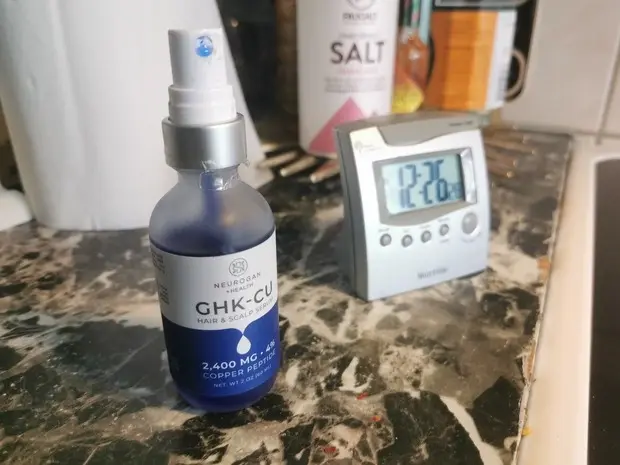
For the full comparison, read AHK-Cu vs GHK-Cu and our GHK-Cu buyer’s guide.
Does AHK-Cu regrow hair?
Unproven. The study proposed that AHK-Cu works by stimulating dermal papilla cell growth and blocking their cell death (1). That is a proposed mechanism, and no trial has counted hairs on anyone using it.
Minoxidil and finasteride have human trial data. See our peptides for hair growth guide for how the options rank.
AHK-Cu safety and side effects
- No formal human safety study of AHK-Cu turned up in our searches.
- Ask a clinician first if you have a copper-handling disorder such as Wilson’s disease. Pregnancy and breastfeeding are unstudied.
- No published study has injected AHK-Cu into people, and research vials aren’t made to injectable standards. Don’t inject it.
AHK-Cu dosage
No dose is established. The one study used 10⁻¹² to 10⁻⁹ molar in lab dishes, which isn’t a dose for people. We don’t give mixing or dilution instructions for research vials.
Where to buy AHK-Cu: serums and vials
AHK-Cu reaches you as a ready-made scalp serum or a research vial. A vial isn’t a serum.
| Product | Price and size | Lab data | Watch-out |
|---|---|---|---|
| 1Neurogan AHK-Cu serum | $229, 60 mL | 4,961 mg measured in one lot (Qalitex, May 2026) and 5,990 mg in another (Nutri Analytical, Jan 2026), against a 4,800 mg label (2) | The two labs differ by about 21%. Lab data covers contents, not hair results |
| 2Neurogan AHK-Cu + GHK-Cu serum | $185, 60 mL | 2,450 mg AHK-Cu and 2,414 mg GHK-Cu measured (Qalitex, May 2026), against 2,400 mg each (7) | An earlier lot read 2,818 and 3,060 mg at another lab |
| 3Amino Club AHK-Cu vial | 50 mg, $34.99 | ILS Laboratories: 99.78% purity and 52.6 mg measured for 50 mg (lot AHK0001). 99.90% and 106.39 mg for 100 mg (lot AHK0002) (12) | A research vial, not a scalp serum. Identity is an HPLC match |
| 4Elite Edge AHK-Cu vial | 100 mg, $42.50 | Certificate available on request. The COA library had no AHK-Cu certificate (13, 14) | Nothing to check before you order |
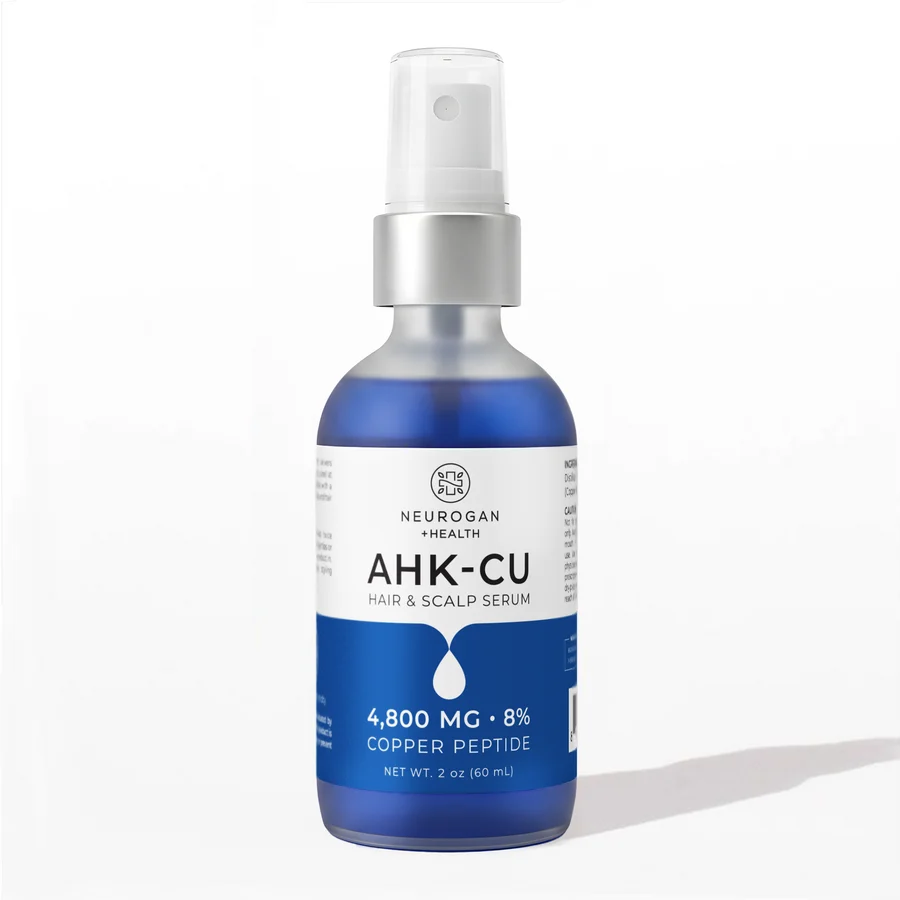
Neurogan AHK-Cu serum
4,800 mg AHK-Cu per label · 60 mL · $229
- Third-party lab reports from Qalitex and Nutri Analytical on the product page
- Heavy metals and a microbial panel tested
- 90-day money-back guarantee and free shipping
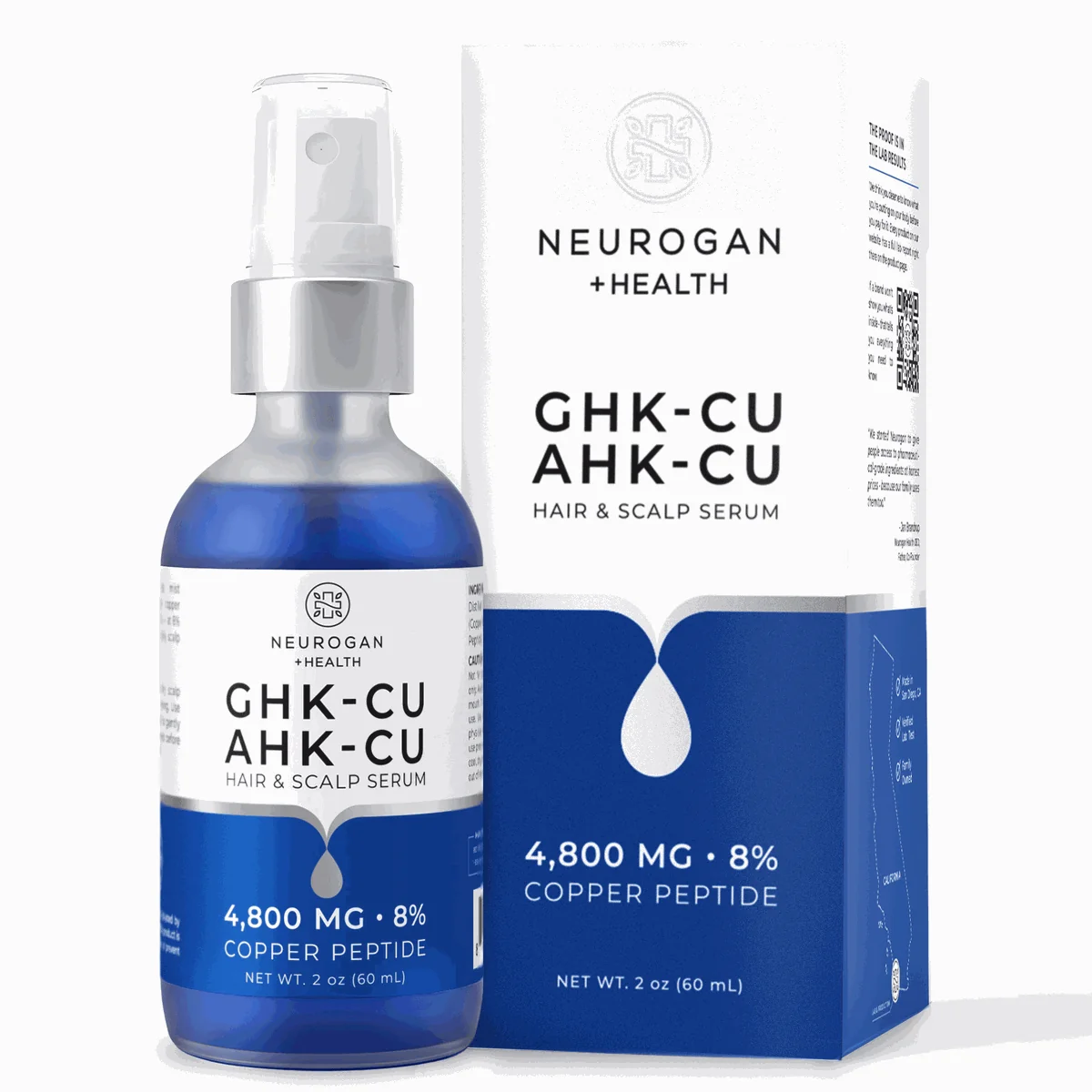
Neurogan AHK-Cu + GHK-Cu serum
2,400 mg of each peptide per label · 60 mL · $185
- Qalitex report measured both peptides near label
- Metals below 0.01 ppm and pathogens absent in the tested lot
- 90-day money-back guarantee and free shipping
Amino Club AHK-Cu
AHK-Cu 50 mg · $34.99 list · research use only
- Public lot reports from ILS Laboratories (ISO/IEC 17025) for 50 mg and 100 mg lots
- Heavy metals not detected and sterility PCR showed no growth
- Free standard shipping over $100, same-day dispatch before 3 PM ET
Elite Edge AHK-Cu
AHK-Cu 100 mg · $42.50 · research use only
- Certificate available on request
- Free US shipping over $200
Match the lot number on any vial to its report before you trust it. Our guide to verifying a peptide COA explains each line, and the full list of peptides shows where AHK-Cu sits among the others.
AHK-Cu FAQ
Does AHK-Cu regrow hair?
Unproven. The only hair study used human follicles in a dish and showed growth there. No human trial has tested AHK-Cu on hair loss.
What is the difference between AHK-Cu and GHK-Cu?
They differ by one amino acid: alanine in AHK, glycine in GHK. AHK-Cu has one hair follicle study. GHK-Cu has more research overall, mostly in skin, and small human trials.
What is the AHK-Cu dosage?
No dose is established. The one study used 10⁻¹² to 10⁻⁹ molar in lab dishes. We don’t give mixing or dilution instructions for research vials.
Can you use AHK-Cu with minoxidil or finasteride?
No trial has tested AHK-Cu with either. Ask a dermatologist before combining products.
Can you inject AHK-Cu?
No. No published study has injected AHK-Cu into people, and research vials aren’t made to injectable standards.
What are the side effects of AHK-Cu?
No formal human safety study turned up in our searches. Anyone with a copper-handling disorder such as Wilson’s disease should ask a clinician first.
Does AHK-Cu work for eyelashes, beard or grey hair?
Nothing has tested it there. The one study used scalp follicles.
Does AHK-Cu block DHT?
We found no study showing that AHK-Cu lowers scalp DHT.
Where can you buy AHK-Cu?
As a ready-made scalp serum from Neurogan, or as a research vial from Amino Club or Elite Edge. Serums list contents on lab reports, and vials need a lot-matched certificate.
Sources
Show references (14)Hide references
- Pyo HK, et al. The effect of tripeptide-copper complex on human hair growth in vitro. Arch Pharm Res 2007. Source
- Neurogan Health. AHK-Cu Copper Peptide Hair Serum 4800mg product page and lab reports. Source
- Najafi N, et al. A systematic review of the mechanisms and therapeutic applications of GHK-Cu in topical microneedle delivery. Arch Intern Med Res 2026. Source
- PubChem. Compound CID 178189140 (AHK-Cu, CAS 767286-83-9). Source
- PubChem. Compound CID 7408502 (L-alanyl-L-histidyl-L-lysine). Source
- Dou Y, et al. The potential of GHK as an anti-aging peptide. Aging Pathobiol Ther 2020. Source
- Neurogan Health. AHK-Cu + GHK-Cu Hair Serum Pro product page and lab reports. Source
- Liu T, et al. Thermodynamically stable ionic liquid microemulsions pioneer pathways for topical delivery and peptide application. Bioact Mater 2024. Source
- Pickart L. The human tri-peptide GHK and tissue remodeling. J Biomater Sci Polym Ed 2008. Source
- Badenhorst T, et al. Effects of GHK-Cu on MMP and TIMP expression, collagen and elastin production, and facial wrinkle parameters. J Aging Sci 2016. Source
- Mokhtar J, et al. The regenerative potential of GHK-Cu in aesthetic medicine. Aesthet Surg J 2026. Source
- Amino Club. AHK-Cu product page with released lot reports (ILS Laboratories, lots AHK0001 and AHK0002). Source
- Elite Edge Biotech. AHK-CU 100mg product page. Source
- Elite Edge Biotech. COA library, searched for AHK. Source