
You eat 1,400 calories. You walk 10,000 steps. The scale doesn’t move, and you start to feel like your own body is lying to you.
It kind of is. There’s an enzyme called NNMT, and when it runs hot, it tells your fat cells to stay fat while quietly draining the cellular fuel you’d need to burn anything. The harder you diet, the harder that enzyme presses the brake.
That’s the thing 5-Amino-1MQ goes after. Not your appetite. Not your willpower. The brake itself.
So here’s the honest version: what it is, what the mouse data actually shows, whether any human trials exist yet (they don’t, and that matters), how to spot a third-party tested batch from a fake, and the stuff the slick sellers leave out.
5-Amino-1MQ: Capsules vs Vials
Both are US-sourced with a published COA. Pick capsules for simplicity, vials for flexible reconstitution.
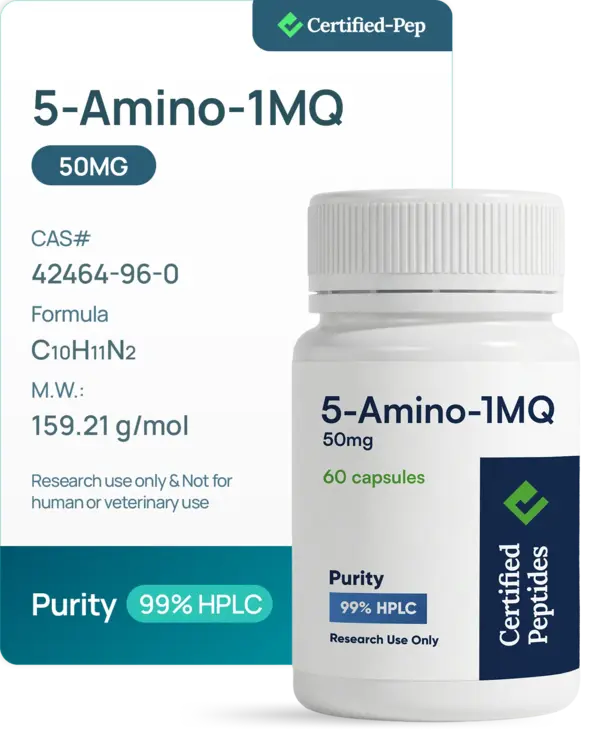
- ✓ Pre-dosed 50 mg capsules — needle-free
- ✓ Batch tested at a US lab for identity, content & purity
- ✓ Screened for endotoxins, heavy metals & sterility
- ✓ Capsule COA published in their COA library
- ✓ Every batch third-party tested for identity & purity
- ✓ COA published & batch-matched
- ✓ Vacuum-sealed, pH-verified vials
- ✓ Ships from Sparks, NV · fast & tracked
For laboratory research use only. Not for human or animal consumption. Not intended to diagnose, treat, cure, or prevent any disease. Links are affiliate links — we may earn a commission at no extra cost to you. Prices shown were accurate at publication; always confirm the live price, salt form, and COA batch number before purchasing.
What is 5-Amino-1MQ?
5-Amino-1MQ (full name 5-amino-1-methylquinolinium, CAS 42753-43-7) is a small molecule that blocks an enzyme called NNMT, short for nicotinamide N-methyltransferase.
Picture NNMT as a drain in your metabolism. When it gets overactive, which tends to happen with obesity and aging, it wastes resources. It burns through the raw material your cells use to make NAD+, the fuel for your mitochondria and your longevity genes, and it nudges your fat cells to grow and stay put.
5-Amino-1MQ jams that drain shut.
Block NNMT and two things happen at once in the research. NAD+ climbs, feeding the mitochondria and the sirtuins tied to anti-aging. And fat metabolism shifts toward burning instead of storing. One brake released, two wins. That dual action is why it keeps surfacing in the same conversations as NMN, and why the search volume jumped.
Is 5-Amino-1MQ a peptide?
You’ll see it sold as the “5 amino 1mq peptide” everywhere. That label is wrong.
It isn’t a peptide chain. It’s a synthetic derivative of quinoline, a small molecule. People file it under “peptides” because the same biohackers and researchers use it, and vendors stock it right next to the fat loss peptides on the same page. The name stuck. A chemist would wince.
Does it matter for buying? Not really. Does it matter for understanding what you’re putting in your body? Yes. You’re dealing with a small-molecule enzyme inhibitor, not a peptide hormone. Different rules, different risks.
5-Amino-1MQ for fat loss: what the research actually shows
Here’s where I keep myself honest with you. Almost every exciting number you’ve seen comes from mice. Anyone who skips that part is selling, not informing.
That said, the preclinical data is real and it has names attached.
The pivotal fat-loss study. In 2018, Neelakantan, Vance, Wetzel and colleagues published in Biochemical Pharmacology the first proof that a small-molecule NNMT inhibitor could reverse diet-induced obesity. They gave 5-Amino-1MQ to obese C57BL/6 mice at 20 mg/kg, three times a day, for 11 days. Treated mice lost roughly 5% of body weight in those 11 days while controls kept gaining, with smaller fat cells and lower plasma cholesterol, and no drop in how much they ate. The fat loss came from changed metabolism, not a smaller appetite.
Note the honest detail the marketing pages bury: nine mice per group, 11 days. Small and short. Striking signal, thin evidence. Both true.
The muscle angle. In 2024, Watowich and colleagues at the University of Texas Medical Branch published in Scientific Reports that 5-Amino-1MQ improved grip strength in aged mice more than rigorous exercise alone, and let exercised mice run longer with less tapering off. That’s the finding the bodybuilding forums latched onto. Still mice. Still no human equivalent.
NAD+ and longevity. By plugging the NNMT drain, the compound stops what researchers call the “leak” in your NAD+ pool. Work going back to Ulanovskaya and colleagues in Nature Chemical Biology (2013) framed NNMT as a metabolic methylation sink, which is exactly why it sits in the same sentence as NMN and other NAD+ boosters.
One thing the literature is clear on: 5-Amino-1MQ is highly selective. It hits NNMT without messing with the related methyltransferases or the NAD+ salvage enzymes. That precision is most of why it’s interesting.
5 amino 1mq human trials: the answer nobody states plainly
People search this and get weasel words. Here’s the flat version.
As of 2026, not a single human clinical trial of 5-Amino-1MQ has been completed. Not “ongoing.” Zero.
The pharmaceutical-grade NNMT inhibitors are still sitting in academic and early-stage industry pipelines. Every fat-loss percentage, every grip-strength chart, every “reverses obesity” headline traces back to rodents. The 2018 paper said it outright: no human data were generated.
So what does that mean for you, practically?
It means you’re an early adopter of a research compound, not a patient on an approved drug. The dose that worked in a mouse was 20 mg/kg three times daily, scaled to a 25-gram animal under lab conditions. Nobody has established a safe or effective human dose, because nobody has run the trial. Treat anyone quoting you a confident human protocol as a salesman.
That’s the gap. Own it, and you’ve told the reader something the other ten tabs they have open won’t.
Where to buy 5-Amino-1MQ third party tested (without getting burned)
Now the part everyone actually searches. The phrase that matters is third party tested, and it’s the single line that separates real product from rice flour in a capsule.
Let me be blunt. If you search “5 amino 1mq Amazon,” you’re playing Russian roulette. Amazon bans unapproved metabolic compounds, so what shows up is usually disguised, underdosed, or fake. Same with the random cheap listings when you type “5 amino 1mq for sale” and sort by price.
When you buy 5-Amino-1MQ, the vendor is everything. Here’s the checklist I won’t budge on:
Third-party Certificate of Analysis. Not the vendor’s in-house lab. An independent one, with HPLC purity and a mass spec confirming the molecule is actually 5-amino-1-methylquinolinium. 98%+ is the standard. “Third party tested” on a badge means nothing if you can’t open the PDF and read the batch number yourself. Source quality decides a lot here, so check the best peptide vendors before you order anything.
The salt form is stated. Chloride or iodide (more on the color panic below). If they can’t tell you which salt you’re getting, they don’t know their own product.
Real purity you can read, not a glowing “lab tested!” sticker with nothing behind it.
Dry storage and shipping. This compound hates moisture.
Match the batch number on the bottle to the batch number on the COA. If they don’t match, or the COA is “available on request” and never arrives, walk. Never let a discount code override the lab data.
Amino 1 review: what holds up across user reports
Dig through the 5 amino 1 mq Reddit threads and the pattern is consistent. Two camps.
The people reporting a real energy shift and gradual fat loss almost always bought from a vendor with a published third-party COA, used it consistently for weeks, and paired it with actual diet and training. The “it did nothing” camp is usually running underdosed or fake product, which loops straight back to the vendor problem.
That’s the most useful thing any amino 1 review can tell you: the variable that predicts whether people see anything isn’t the molecule, it’s whether the molecule was real. Reddit is good for vibe-checking a vendor and spotting scams. It’s no substitute for the COA or a doctor.
Capsules or injection? Clearing up the confusion
This trips up almost everyone.
5-Amino-1MQ shows up in two formats. Oral capsules, usually a 50 mg cap sold in a 60-count bottle. And injectable (subcutaneous), dosed in micrograms.
Why the massive dose gap? Bioavailability. A capsule has to survive your gut and your liver’s first pass, so a lot never reaches your blood intact. The injection skips the gut, so you need far less. Tens of milligrams oral versus hundreds of micrograms injected.
Capsules win on simplicity: needle-free, easy to stay consistent with, lower and more variable absorption as the trade-off. Injectable is more efficient per milligram and more involved.
One myth to kill: people claim you “can never inject it because it’s a salt.” Not accurate. Injectable 5-Amino-1MQ exists. But it should only ever be a properly prepared sterile research preparation, never raw powder you slam into solution at your kitchen table. If you don’t know exactly what you’re doing, the capsule exists for a reason.
Why is my 5-Amino-1MQ powder red or orange?
You open the bottle expecting white and get bright orange. Did you get scammed?
Almost certainly not. Here’s the chemistry.
Red or orange powder is the iodide salt. The color comes from the iodine interacting with the molecule. Expected.
White or pale yellow is the chloride salt, often preferred for consistency and better solubility.
So if you’re googling “why is 5 amino 1mq red” at midnight, relax. It’s the salt form, not a fake.
The real warning sign is different: muddy brown, or a sticky dark “blood red” gunk. That can mean oxidation or degradation. Color from the salt is normal. Color plus the wrong texture is a problem.
The “cancer” question, answered honestly
Type “5 amino 1mq cancer” into Google and you’ll get nervous. Here’s the real picture instead of the scary headline.
NNMT, the enzyme this compound blocks, shows up at high levels in some aggressive cancers, because those cells appear to exploit it to fuel growth. Researchers are studying NNMT inhibition as a way to fight certain cancers, including work on osteosarcoma and Merkel cell carcinoma cell lines. The research points the opposite way from the fear.
But long-term human safety data simply doesn’t exist yet. So anyone with a personal or family history of cancer should talk to an oncologist before going near a metabolic modulator like this. No exceptions, no “but the mouse study said.” Real caution, real doctor.
Side effects and what to watch for
5-Amino-1MQ appears well tolerated in the research that exists. But “appears well tolerated in mice and forums” is not “proven safe in humans.” Hold that framing.
What gets reported:
- Sleep disruption if taken late. Makes sense, you’re raising cellular energy. Take it earlier.
- Mild nausea early on, usually settling.
That’s the short list from current literature and community reports. Comprehensive human safety profiles are still being built, because the trials that would build them haven’t run. Act like the early adopter you are.
The bottom line
5-Amino-1MQ is a different approach to metabolic research. Instead of whipping your body with stimulants or starving it, it goes after the cellular machinery, releasing a brake your own biology may have jammed on.
Three things are true at once: the preclinical research is compelling, the mechanism makes real sense, and not one human trial has finished. Any honest guide holds all three together.
So if you go near it: buy only from a vendor with an independent, third-party COA you can read. Confirm the salt form. Store it dry. Keep your expectations parked in mouse data until human data exists. And loop in a doctor, especially if cancer runs in your family.
5-Amino-1MQ: Capsules vs Vials
Both are US-sourced with a published COA. Pick capsules for simplicity, vials for flexible reconstitution.
- ✓ Pre-dosed 50 mg capsules — needle-free
- ✓ Batch tested at a US lab for identity, content & purity
- ✓ Screened for endotoxins, heavy metals & sterility
- ✓ Capsule COA published in their COA library
- ✓ Every batch third-party tested for identity & purity
- ✓ COA published & batch-matched
- ✓ Vacuum-sealed, pH-verified vials
- ✓ Ships from Sparks, NV · fast & tracked
For laboratory research use only. Not for human or animal consumption. Not intended to diagnose, treat, cure, or prevent any disease. Links are affiliate links — we may earn a commission at no extra cost to you. Prices shown were accurate at publication; always confirm the live price, salt form, and COA batch number before purchasing.
Chase the proof. Never the promise.
FAQ
How long does 5 amino 1mq take to work?
Honestly, nobody can tell you, because there are no human trials establishing a timeline. In mice, metabolic changes showed up over roughly 11 days. Human reports vary widely and aren’t controlled data.
Should you inject 5 amino 1mq?
Only ever as a properly prepared sterile research preparation, never raw powder dissolved at home. The capsule format exists precisely so most people never have to make this call.
What is 5 amino 1mq with NADH?
A stack people run on the theory that NADH adds fuel while 5-Amino-1MQ stops the NAD+ leak. The logic follows the mechanism, but there’s no human trial confirming the combination does anything in people.
Does 5 amino 1mq work for fat loss?
In diet-induced obese mice, yes, it reduced body weight and fat mass without cutting food intake (Neelakantan et al., 2018). In humans, it’s untested. The mechanism is sound; the human proof isn’t in yet.
How do you store 5 amino 1mq?
It’s sensitive to moisture. Keep it cool and dry. For raw powder held longer than six months, the freezer is the safer bet.
Sources
- Neelakantan H, Vance V, Wetzel MD, Wang H-YL, McHardy SF, Finnerty CC, Hommel JD, Watowich SJ. “Selective and membrane-permeable small molecule inhibitors of nicotinamide N-methyltransferase reverse high fat diet-induced obesity in mice.” Biochem Pharmacol. 2018.
- Dimet-Wiley A, Watowich SJ, et al. NNMT inhibition and muscle performance in aged mice. Scientific Reports. 2024.
- Ulanovskaya OA, et al. “NNMT promotes epigenetic remodeling in cancer by creating a metabolic methylation sink.” Nat Chem Biol. 2013.
- Rajman L, et al. “Therapeutic Potential of NAD-Boosting Molecules.” Cell Metab. 2018.